Understanding 3PL vs In-House Fulfillment in 2025
Choosing between third-party logistics (3PL) and in-house fulfillment is one of the most critical operational decisions for modern businesses. In 2025, the stakes are even higher due to rising shipping costs, customer expectations for faster delivery, and the rapid evolution of logistics technology.
Businesses that make the wrong choice often face shrinking margins, operational bottlenecks, and poor customer experiences. Those that choose strategically gain scalability, cost efficiency, and long-term profitability.
This guide breaks down the real cost, scalability potential, and profit impact of both models—giving a clear, data-driven path to making the right decision.
What Is 3PL Fulfillment?
3PL (third-party logistics) providers handle storage, inventory management, picking, packing, and shipping on behalf of businesses. Instead of building infrastructure internally, companies leverage an external logistics partner.
For a deeper breakdown of how this works, see this complete guide on what a 3PL company actually does.
Key Capabilities of 3PL Providers
- Multi-location warehousing
- Advanced inventory systems
- Carrier rate optimization
- Real-time tracking
- Scalable fulfillment operations
What Is In-House Fulfillment?
In-house fulfillment means the business manages everything internally—from warehouse leasing to staffing and shipping logistics.
This approach gives full control but comes with higher overhead, operational complexity, and scaling limitations.
Cost Comparison: 3PL vs In-House Fulfillment
Upfront Costs
In-House Fulfillment
- Warehouse lease or purchase
- Equipment (racking, forklifts, packing stations)
- Technology (WMS systems)
- Hiring and training staff
These costs can easily exceed six figures before processing a single order.
3PL Fulfillment
- Minimal upfront investment
- Pay-as-you-go pricing model
- No infrastructure costs
Businesses avoid capital expenditure and shift to operational expenses.
Operational Costs
In-House Hidden Expenses
Many businesses underestimate ongoing costs such as:
- Labor turnover
- Inventory inaccuracies
- Maintenance and utilities
- Shipping inefficiencies
These are explored in detail in this breakdown of hidden costs of poor warehousing management.
3PL Cost Structure
- Storage fees
- Pick & pack charges
- Shipping costs (often discounted)
- Technology access included
3PL providers often secure better carrier rates due to volume, reducing shipping costs significantly.
Cost Verdict
In 2025, 3PL fulfillment is generally:
- 30–50% more cost-efficient for scaling businesses
- More predictable due to variable pricing
- Less risky financially
Scalability: The Defining Factor in 2025
In-House Scalability Challenges
Scaling internally requires:
- Expanding warehouse space
- Hiring more staff
- Investing in automation
- Managing seasonal demand spikes
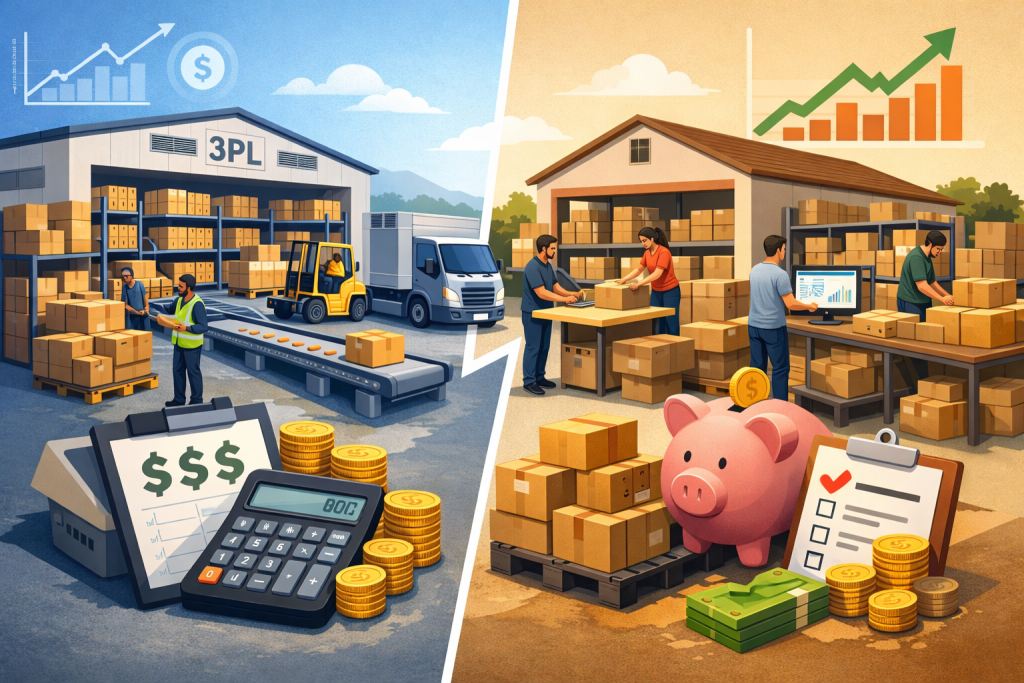
This creates bottlenecks during peak seasons and underutilization during slow periods.
3PL Scalability Advantage
3PL providers are designed for growth. They offer:
- Flexible storage space
- On-demand labor
- Multi-location distribution networks
Learn how flexible logistics models enable growth in this guide on on-demand warehousing.
Peak Season Performance
During high-demand periods like Black Friday:
- In-house operations often struggle with delays
- 3PL providers scale instantly using existing infrastructure
Scalability Verdict
3PL wins decisively due to:
- Elastic capacity
- Faster geographic expansion
- Reduced operational stress
Profit Impact: Which Model Drives Higher Margins?
In-House Profit Considerations
While in-house fulfillment can reduce per-order costs at very high volumes, it often:
- Increases overhead
- Reduces flexibility
- Limits growth potential
Profit margins shrink when operational inefficiencies arise.
3PL Profit Advantages
1. Reduced Shipping Costs
3PLs negotiate bulk rates with carriers, lowering shipping expenses.
2. Faster Delivery = Higher Conversion
Customers expect fast shipping. Businesses that deliver quickly:
- Reduce cart abandonment
- Increase repeat purchases
Explore this further in why fast shipping is crucial for e-commerce success.
3. Operational Efficiency
Outsourcing logistics allows businesses to focus on:
- Marketing
- Product development
- Customer acquisition
4. Reduced Inventory Waste
3PL providers use advanced systems to minimize overstock and stockouts.
Profit Verdict
For most growing businesses:
- 3PL delivers higher profit margins
- Faster growth leads to compounding revenue gains
Technology Comparison: 3PL vs In-House
In-House Technology Limitations
- High cost of warehouse management systems
- Manual processes in early stages
- Limited automation capabilities
3PL Technology Advantage
Modern 3PL providers offer:
- AI-driven inventory management
- Real-time tracking
- Data analytics dashboards
See how technology is shaping logistics in this article on AI in logistics.
Technology Verdict
3PL providers provide enterprise-level technology without upfront investment.
Control vs Efficiency: The Trade-Off
In-House Control Benefits
- Full oversight of operations
- Custom processes
- Direct inventory handling
3PL Efficiency Benefits
- Faster execution
- Reduced errors
- Professional logistics expertise
Balanced Insight
Control matters, but efficiency and scalability often outweigh it in competitive markets.
When In-House Fulfillment Makes Sense
In-house fulfillment may be ideal if:
- Order volume is low and stable
- Products require specialized handling
- Business prioritizes full control over operations
- Warehouse infrastructure already exists
When 3PL Fulfillment Is the Better Choice
3PL is the superior option when:
- Scaling rapidly
- Managing seasonal demand fluctuations
- Expanding geographically
- Seeking cost efficiency and speed
Hybrid Fulfillment: The Emerging Strategy
Many businesses in 2025 adopt a hybrid model:
- Core operations in-house
- Overflow and expansion handled by 3PL
This balances control with scalability.
Common Mistakes to Avoid
1. Underestimating Fulfillment Costs
Ignoring hidden costs leads to reduced profitability.
2. Delaying Outsourcing Too Long
Scaling internally beyond capacity creates operational chaos.
3. Choosing the Wrong 3PL Partner
Selecting the right partner is critical. See this guide on choosing the right fulfillment partner.
Future Trends in Fulfillment (2025 and Beyond)
Automation and Robotics
Warehouses are becoming fully automated, reducing labor costs.
Distributed Warehousing
Inventory is spread across multiple locations for faster delivery.
Sustainability
Eco-friendly logistics is becoming a competitive advantage.
Learn more in this forward-looking resource on warehouse automation trends.
Final Verdict: 3PL vs In-House Fulfillment
| Factor |
Winner |
| Cost Efficiency |
3PL |
| Scalability |
3PL |
| Profit Potential |
3PL |
| Control |
In-House |
| Technology |
3PL |
For most businesses in 2025, 3PL fulfillment is the smarter, more scalable, and more profitable choice.
Frequently Asked Questions (FAQs)
1. Is 3PL cheaper than in-house fulfillment?
Yes, for most businesses, 3PL is more cost-effective due to reduced overhead and access to bulk shipping rates.
2. Can small businesses use 3PL services?
Absolutely. Many 3PL providers offer flexible pricing for startups and growing brands.
3. Does outsourcing fulfillment reduce control?
Yes, but modern 3PL platforms provide transparency through real-time tracking and reporting.
4. What is the biggest advantage of 3PL?
Scalability. Businesses can grow without worrying about infrastructure or staffing limitations.
5. When should a business switch to 3PL?
When order volume increases, fulfillment becomes complex, or scaling internally becomes expensive.
Conclusion: Scale Smarter, Not Harder
The logistics landscape in 2025 demands speed, flexibility, and efficiency. Businesses that rely solely on in-house fulfillment often struggle to keep up with rising expectations and operational costs.
3PL solutions offer a clear path to:
- Lower costs
- Faster delivery
- Higher profitability
For companies aiming to grow aggressively and compete at scale, outsourcing fulfillment is no longer optional—it’s a strategic advantage.
Get Expert Fulfillment Support
If you’re ready to optimize your logistics and scale efficiently, explore professional solutions or contact a fulfillment expert to get started.