By Martin Vassilev / 15 Oct, 2025
In the rapidly evolving landscape of Canadian commerce, both B2B (Business-to-Business) and B2C (Business-to-Consumer) fulfillment services have become critical for growth, efficiency, and customer satisfaction. Ottawa and Toronto—two of Canada’s most strategically located cities—are at the center of this transformation. Whether you’re an e-commerce brand scaling across provinces or a wholesale distributor seeking faster delivery times, understanding the nuances of B2B and B2C fulfillment is essential to staying competitive.
This comprehensive guide covers everything from fulfillment strategies, warehousing trends, cost considerations, and logistics technologies to help businesses in Ottawa and Toronto make informed decisions.
B2B fulfillment focuses on large-volume shipments between businesses. These transactions often involve:
Palletized freight
Regular, scheduled deliveries
Custom billing and procurement systems
Advanced inventory control and documentation
For example, a Toronto-based electronics manufacturer shipping bulk orders to distributors in the U.S. would rely on structured B2B fulfillment services with precise logistics coordination.
B2C fulfillment, on the other hand, deals with direct-to-consumer orders, often through e-commerce platforms like Shopify or WooCommerce. Speed, accuracy, and branding are paramount. Consumers expect same-day or next-day delivery options, real-time tracking, and hassle-free returns.
For Ottawa-based e-commerce brands, leveraging modern fulfillment centers—like those discussed in Ottawa Fulfillment Services for Shopify & WooCommerce Stores—can significantly enhance customer experience while reducing shipping times.
Ottawa and Toronto sit at the heart of Canada’s distribution corridor, offering access to:
Major U.S. border crossings
Key highways and rail networks
Proximity to Montreal, Quebec City, and U.S. East Coast markets
Toronto’s dense infrastructure and Ottawa’s strategic location between major economic zones make them ideal for both B2B and B2C fulfillment.
Canada’s e-commerce sector has grown consistently, with Ontario leading in online retail activity. This trend drives demand for scalable, technology-driven fulfillment services.
For context, the Government of Canada reports a significant rise in online retail sales post-2020, with businesses increasingly outsourcing fulfillment to meet consumer expectations.
Leading 3PL providers in these regions integrate AI, robotics, and real-time tracking to streamline operations. Companies using platforms similar to those in The Future of Warehouse Automation gain visibility and cost control at scale.
Efficient warehousing is the backbone of fulfillment. Facilities in Ottawa and Toronto increasingly adopt on-demand warehousing to offer flexibility during peak seasons. Businesses can optimize space and costs with data-driven solutions—explored in How to Improve Warehouse Space Utilization.
For B2B, processing focuses on purchase orders, EDI integrations, and scheduled shipments. For B2C, it emphasizes real-time order intake, SKU-level accuracy, and automated pick-and-pack systems that accelerate delivery without compromising accuracy.
B2C fulfillment often involves branded packaging to enhance the unboxing experience, while B2B focuses on protective, bulk-oriented packaging optimized for transportation.
Fast and affordable shipping is essential for both models:
B2B: Freight and bulk cargo shipping with negotiated rates.
B2C: Carrier partnerships for same-day or next-day delivery, sometimes using distributed micro-warehousing.
Companies leveraging strategies like Real-Time Tracking in Delivery Services achieve higher transparency and customer trust.
| Feature | B2B Fulfillment | B2C Fulfillment |
|---|---|---|
| Order Size | Large, palletized | Single or few items |
| Shipping Frequency | Scheduled, regular | On-demand, variable |
| Packaging | Bulk, protective | Branded, consumer-friendly |
| Delivery Speed | Reliable timelines | Speed-sensitive |
| Technology | EDI, ERP systems | E-commerce integrations |
| Customer Relationship | Long-term contracts | Individual consumers |
Understanding these differences helps businesses choose the right fulfillment partner. For guidance, see Guide to Choosing the Right Fulfillment Partner.
Many businesses in Toronto and Ottawa debate whether to manage fulfillment in-house or outsource to a 3PL partner.
In-House: Provides control but requires significant investment in staff, technology, and infrastructure.
Outsourced: Reduces capital expenditure, offers scalability, and gives access to specialized expertise.
A detailed breakdown of this decision is available in Comparing In-House vs. Outsourced Fulfillment.
Tip: Hidden costs like warehouse leases, staffing fluctuations, and mismanaged inventory can erode margins quickly. Outsourcing helps avoid these pitfalls, as outlined in The Hidden Costs of Poor Warehousing Management.
Warehouses in Toronto and Ottawa increasingly deploy automated picking systems, conveyor belts, and robotics to increase throughput while reducing labor costs. These technologies align with trends covered in How Automation, AI, and Robotics Are Transforming Logistics.
Data-driven fulfillment enables businesses to:
Predict demand more accurately
Optimize storage layouts
Reduce shipping delays
This digital transformation mirrors broader trends in Canadian logistics and is supported by government initiatives such as Canada’s Supply Chain Task Force.
B2B operations benefit from AI-powered forecasting to plan bulk shipments, while B2C leverages AI to personalize consumer experiences and optimize inventory allocation across multiple warehouses.
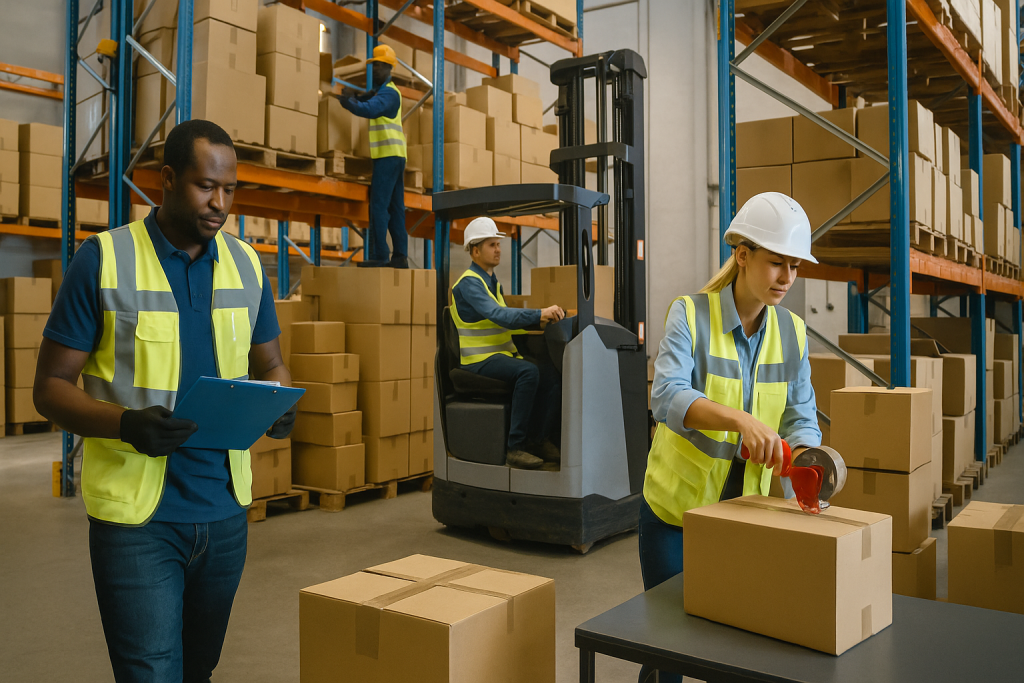
Using multiple warehouse locations reduces last-mile delivery costs and speeds up service. This model is increasingly popular among Toronto e-commerce brands targeting national markets.
Businesses moving high volumes benefit from cross-docking, which minimizes storage time and accelerates distribution. It’s particularly valuable in fast-moving B2B sectors like retail supply chains. Learn more in What Is Cross-Docking and Should You Use It?.
Efficient returns processing is a critical competitive factor in B2C fulfillment. Streamlining this process builds trust and reduces operational friction.
Sustainability is increasingly influencing fulfillment strategies. Ottawa and Toronto businesses adopting eco-friendly packaging, optimized routes, and energy-efficient facilities align with modern consumer expectations and regulatory trends.
Choosing the ideal fulfillment partner involves assessing:
Scalability: Can they support your business as it grows?
Technology: Do they offer modern integrations (Shopify, ERP, EDI)?
Coverage: Are their warehouses strategically located near key markets?
Reputation: Do they have a proven track record in B2B or B2C?
Cost transparency: Are pricing models clear and predictable?
ByExpress, a leading logistics provider, highlights these considerations in their Fulfillment Process Guide, helping businesses streamline operations in both Ottawa and Toronto.
For businesses operating in Ottawa and Toronto, fulfillment is no longer just a back-end operation—it’s a strategic driver of growth, profitability, and customer retention. B2B fulfillment focuses on efficiency, scale, and structured relationships, while B2C prioritizes speed, personalization, and consumer satisfaction. Leveraging advanced technologies, outsourcing to experienced 3PLs, and optimizing strategies for regional advantages can help businesses outperform competitors in 2025 and beyond.
For tailored fulfillment strategies, contact ByExpress to explore scalable B2B and B2C logistics solutions.


“Thanks to Byexpress all my shipping and fulfillment costs are in line now”

“All my issues were solved by Byexpress team that I had with pervious 3pl provider.”

“Thank you Byexpress team could not done it without you guys.”

“Their integration and customer service were the key for me”

“Outstanding delivery service! The package was well-packaged, and
the delivery team was professional and courteous”

“Great and knowledgeable team to work with.”

Thanks, guys, for reducing my shipping rates
Ottawa Office
2411 Holly Lane
Ottawa, ON, K1V 7P2
Toronto Office
13-280 West Beaver Creek Road Unit #136
Richmond Hill, ON, L4B 3Z1
Alexandria Office
173 Kenyon Street West
Alexandria, ON, K0C 1A0
Montreal Office
4388 Saint-Denis Street Unit #200
Montreal, QC, H2J 2L1
California Office
155 North Riverview Drive
Anaheim Hills, CA, 92808
Call Us
Toll-Free: 1-866-744-7122
Local : 613-739-3000
Email Us
Multilingual Services