By Martin Vassilev / 6 Nov, 2025
The e-commerce revolution has fundamentally changed customer expectations. Shoppers no longer accept vague shipping timelines — they want precise updates, minute-by-minute tracking, and instant visibility from checkout to delivery. Real-time order visibility has emerged as the defining feature of modern logistics. For growing e-commerce brands, it’s not a luxury — it’s the key to survival and competitive advantage.
Today, logistics providers like ByExpress are leading this transformation by offering real-time visibility systems that empower businesses to monitor every movement of their shipments. This transparency doesn’t just enhance customer satisfaction — it drives operational efficiency, builds trust, and fuels long-term growth.
Traditional logistics relied on milestone-based tracking — customers received occasional updates when a package departed or arrived at a facility. However, this method left long periods of uncertainty. Real-time visibility now fills this gap, offering live GPS tracking, automated notifications, and performance analytics that update continuously.
Modern fulfillment centers, powered by IoT sensors, AI analytics, and cloud-based dashboards, provide detailed views of order status and location. As covered in The Future of Warehouse Automation, these innovations are reshaping warehouse operations and logistics communication.
Real-time order visibility refers to the ability to track, analyze, and manage every stage of an order’s journey — from the warehouse shelf to the customer’s doorstep — in real-time. It integrates data from multiple sources including transport management systems (TMS), warehouse management systems (WMS), and carrier APIs.
This means retailers and logistics managers can see:
Exact order location
Estimated time of arrival (ETA)
Inventory availability
Carrier performance
Customer delivery feedback
It’s the foundation of what experts call “intelligent logistics.”
For example, companies using real-time visibility platforms can instantly reroute delayed shipments, update customers proactively, and optimize future delivery routes using predictive analytics — a concept explored in How AI Is Transforming the Logistics Industry in 2025.
In the era of Amazon Prime, speed and transparency define trust. Over 90% of online shoppers expect to track their orders in real time. When visibility is lacking, anxiety increases and customer satisfaction plummets.
Businesses that adopt advanced tracking systems report a 30% reduction in customer inquiries about order status. This allows customer service teams to focus on higher-value interactions, improving both efficiency and brand reputation.
Real-time insights eliminate bottlenecks. Logistics managers can identify idle shipments, reduce warehouse downtime, and improve delivery performance across regions. According to SupplyChain.gov, enhanced data visibility can cut logistics costs by up to 20%.
When paired with automated fulfillment strategies such as on-demand warehousing, companies can dynamically allocate inventory based on current demand — reducing waste and improving delivery speed.
Without visibility, logistics teams operate reactively. Real-time tracking flips this paradigm. If a shipment is delayed due to weather or customs, AI systems trigger alerts, suggest reroutes, and notify customers automatically.
This approach prevents missed deliveries, late penalties, and negative reviews — all while maintaining brand reliability.
Visibility systems collect granular data on delivery times, carrier performance, and regional demand. This data can be analyzed to forecast inventory needs and optimize supply chain planning. Integrating analytics tools (like those discussed in How to Leverage Data Analytics for Streamlined Inventory Management) enables e-commerce businesses to predict surges, manage returns, and plan for peak seasons effectively.
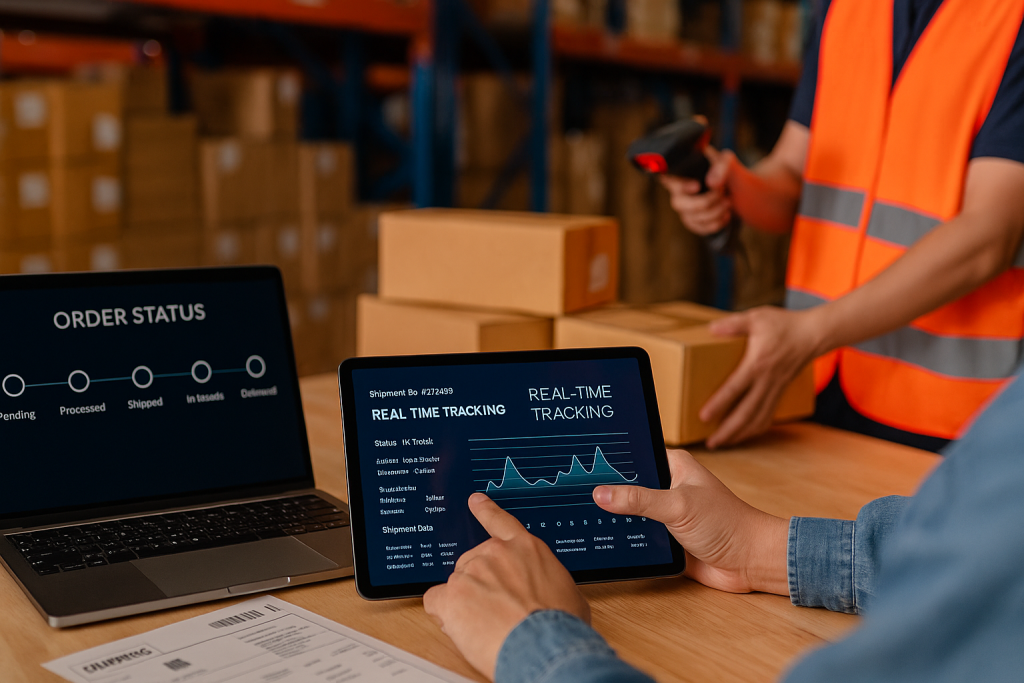
The visibility platform aggregates information from warehouses, carriers, and transportation systems. This includes barcode scans, GPS data, and RFID sensor readings.
All data is uploaded to a secure cloud environment accessible to both the business and the customer. The synchronization ensures consistency across all channels — web, mobile, and API integrations.
Artificial intelligence tools analyze trends to predict delivery delays, estimate times, and even suggest the best route or courier based on historical performance.
Customers receive automated notifications through SMS, email, or web dashboards — offering complete transparency throughout the delivery cycle.
This system design mirrors what ByExpress implements in its real-time tracking in delivery services — providing an integrated, scalable infrastructure for businesses of all sizes.
Transparency builds loyalty. A customer who can track their package live is 50% more likely to reorder. This strengthens retention and encourages word-of-mouth referrals.
Real-time data fosters collaboration between suppliers, couriers, and retailers. Everyone involved in the logistics process operates from a single source of truth, ensuring accuracy and accountability.
When customers know exactly when to expect deliveries, missed drop-offs decline. Likewise, automated verification processes reduce the risk of misplaced or duplicated shipments.
Brands offering live tracking and transparency gain credibility. In a competitive market, this can be the differentiator that converts a visitor into a loyal customer.
Real-time monitoring also helps ensure compliance with regulations such as customs documentation and product traceability — essential for industries like pharmaceuticals and food logistics. Government sources like Trade.gov highlight traceability as a top requirement for global shipping compliance.
IoT devices embedded in packages provide continuous data on location, temperature, and handling conditions. This ensures visibility even in cross-border logistics.
Machine learning models can forecast delivery delays, optimize routes, and minimize fuel costs — contributing to sustainability goals discussed in The Role of Green Logistics in Modern Warehousing.
Blockchain creates an immutable ledger of every shipment event. This enhances accountability, ensuring no data can be altered or falsified — a concept explored in The Impact of Blockchain Technology on Logistics and Supply Chain Transparency.
ByExpress integrates real-time tracking, predictive AI, and API connectivity into its fulfillment system. Whether managing inventory in Ottawa or coordinating cross-border freight, the platform allows clients to visualize every transaction and movement through a centralized dashboard.
This model is the blueprint for the next generation of e-commerce logistics — where customer satisfaction, cost control, and efficiency converge in one data-driven ecosystem.
Future warehouses will operate as digital twins of their physical environments — constantly mirroring real-world actions in real-time dashboards. As highlighted in Discover the Future of Warehousing, this transformation is already underway.
Chatbots and virtual assistants will provide customers with up-to-the-minute updates and even offer predictive delivery time adjustments.
Real-time systems will soon track carbon emissions per delivery, helping companies align with ESG standards and sustainability reporting frameworks.
Partnering with a fulfillment company like ByExpress that offers integrated tracking and data analytics ensures a seamless visibility rollout.
Ensure your e-commerce, ERP, and fulfillment systems are interconnected through APIs for synchronized updates.
Empower teams and clients to interpret visibility data effectively. Knowledge-sharing ensures maximum ROI from your system investment.
Continuously assess performance metrics and customer feedback to improve your real-time tracking experience.
E-commerce logistics is entering an age where visibility equals value. Real-time tracking is no longer just about knowing where an order is — it’s about knowing how your business performs, how customers feel, and how fast you can adapt.
Companies that embrace real-time order visibility will not only meet rising expectations but define the new standard for transparency, trust, and performance in logistics.
To elevate your e-commerce operations with full transparency and data-driven fulfillment, contact ByExpress today.
It’s the ability to track every stage of a shipment’s journey in real-time using live data from GPS, IoT, and carrier systems.
It provides accurate ETAs, reduces anxiety, and ensures customers always know the status of their order.
IoT sensors, GPS, AI algorithms, and cloud-based logistics platforms create continuous data streams across the supply chain.
Yes. Many 3PL providers like ByExpress offer scalable visibility systems designed for startups and SMEs.
Modern systems use encryption, blockchain, and secure cloud storage to ensure data integrity and protect customer information.


“Thanks to Byexpress all my shipping and fulfillment costs are in line now”

“All my issues were solved by Byexpress team that I had with pervious 3pl provider.”

“Thank you Byexpress team could not done it without you guys.”

“Their integration and customer service were the key for me”

“Outstanding delivery service! The package was well-packaged, and
the delivery team was professional and courteous”

“Great and knowledgeable team to work with.”

Thanks, guys, for reducing my shipping rates
Ottawa Office
2411 Holly Lane
Ottawa, ON, K1V 7P2
Toronto Office
13-280 West Beaver Creek Road Unit #136
Richmond Hill, ON, L4B 3Z1
Alexandria Office
173 Kenyon Street West
Alexandria, ON, K0C 1A0
Montreal Office
4388 Saint-Denis Street Unit #200
Montreal, QC, H2J 2L1
California Office
155 North Riverview Drive
Anaheim Hills, CA, 92808
Call Us
Toll-Free: 1-866-744-7122
Local : 613-739-3000
Email Us
Multilingual Services