By Martin Vassilev / 23 Dec, 2025
Global supply chains have become larger, faster, and more interconnected than ever before. At the same time, they have also become more fragile. A single data discrepancy, undocumented handoff, or lack of visibility can trigger costly delays, disputes, compliance failures, and reputational damage. In this environment, blockchain in supply chain management is no longer theoretical—it is a practical infrastructure upgrade.
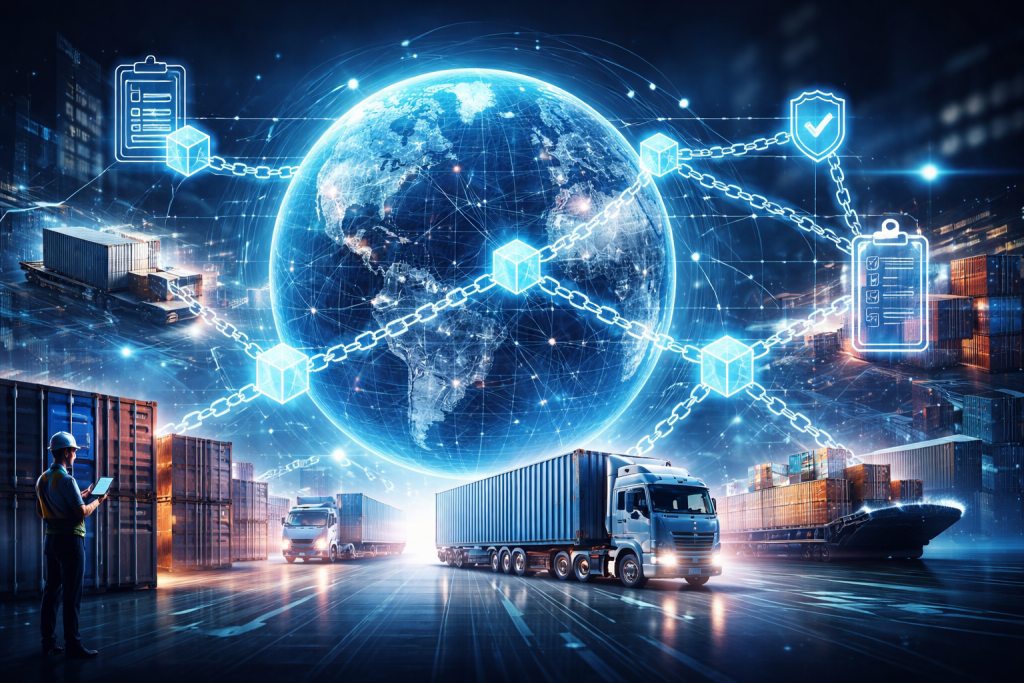
Blockchain introduces a shared, tamper-resistant ledger that records every transaction, movement, and status change across the supply chain. Unlike traditional databases controlled by a single party, blockchain creates distributed trust. Every stakeholder sees the same data, in real time, without relying on intermediaries or reconciliations.
This shift directly addresses the two biggest weaknesses in supply chains today: lack of transparency and erosion of trust.
At its core, blockchain is a decentralized ledger where records are immutable once verified. In supply chains, this means:
Every shipment event is permanently recorded
Every transaction is timestamped and traceable
Every participant works from a single source of truth
Unlike siloed ERP or WMS systems, blockchain enables cross-organizational data integrity without requiring companies to give up control of their internal systems.
This capability aligns naturally with modern logistics ecosystems that already rely on technology-driven coordination, such as real-time tracking, automated fulfillment, and distributed warehousing models. The same operational logic discussed in the role of logistics in the supply chain becomes exponentially stronger when supported by blockchain-backed data verification.
Traditional supply chains depend on fragmented reporting. Each carrier, warehouse, broker, and supplier maintains its own records, leading to discrepancies that must be reconciled manually.
Blockchain eliminates this by recording:
Shipment origin and destination
Custody transfers
Environmental conditions (temperature, humidity)
Customs and compliance documentation
Because all parties access the same ledger, disputes over delivery times, damage claims, or inventory counts are reduced dramatically. This complements real-time visibility strategies already transforming logistics, such as those explained in real-time tracking in delivery services.
Regulatory compliance increasingly requires proof—not promises. Blockchain provides immutable audit trails that regulators, auditors, and partners can trust.
Government bodies increasingly recognize the value of transparent digital records. For example, the U.S. National Institute of Standards and Technology (NIST) outlines blockchain’s role in secure data sharing and traceability across industries.
Trust has traditionally been enforced through contracts, intermediaries, and insurance. Blockchain shifts trust from relationships to mathematics.
Each participant validates transactions through consensus mechanisms. No single party can alter records retroactively. This is particularly valuable in:
Cross-border logistics
Multi-carrier freight movements
Third-party fulfillment partnerships
As outsourcing increases, especially through 3PL and distributed fulfillment models, blockchain reinforces confidence in external partners. This aligns directly with modern fulfillment strategies explored in what a 3PL company actually does.
Counterfeit goods and documentation fraud cost global supply chains billions annually. Blockchain creates verifiable product histories from raw materials to final delivery.
Each product’s digital identity can include:
Manufacturing origin
Batch numbers
Certifications
Chain-of-custody events
Major enterprises and public institutions continue to validate blockchain’s effectiveness. IBM’s blockchain research highlights its role in reducing fraud and improving traceability across global supply chains.
Smart contracts are self-executing rules stored on a blockchain. When predefined conditions are met, actions are triggered automatically.
In supply chains, smart contracts enable:
Automatic release of payments upon delivery confirmation
Real-time penalty enforcement for SLA breaches
Instant customs clearance validation
Automated inventory replenishment
This automation directly supports cost control and efficiency goals similar to those discussed in how to maximize warehouse efficiency and cut costs.
Manual invoicing, dispute resolution, and reconciliation processes slow down supply chains and drain resources. Smart contracts reduce reliance on back-office labor while improving accuracy and accountability.
Inventory inaccuracies lead to stockouts, overstocking, and lost sales. Blockchain synchronizes inventory data across suppliers, warehouses, and distribution nodes.
This creates alignment with advanced inventory strategies like those detailed in real-time inventory updates and why they matter.
By anchoring inventory events to blockchain records, businesses reduce human error and prevent unauthorized adjustments.
Cross-border logistics often fail due to paperwork delays and inconsistent documentation. Blockchain enables:
Digitized bills of lading
Verified certificates of origin
Automated compliance checks
This directly mitigates challenges outlined in the challenges and solutions of international shipping.
When customs authorities can verify shipment data instantly on a shared ledger, clearance times shrink, inspections become targeted, and delays drop.
As companies move toward regionalized, flexible fulfillment models, blockchain ensures consistency across multiple nodes. Whether inventory moves through urban micro-fulfillment centers or regional hubs, records remain synchronized.
This strengthens the operational foundation described in on-demand warehousing explained.
Blockchain does not operate in isolation. It integrates seamlessly with:
IoT sensors for condition monitoring
AI-driven demand forecasting
Automated warehouse management systems
These integrations enhance insights already explored in how AI is transforming the logistics industry in 2025.
Legacy systems require careful integration. Blockchain succeeds when it complements existing ERP, WMS, and TMS platforms rather than replacing them outright.
Industry-wide adoption depends on shared standards. Consortium-based blockchains are increasingly favored to balance openness with control.
Blockchain ensures data integrity after entry—but it does not correct bad inputs. This reinforces the importance of accurate scanning, automation, and sensor-driven data collection.
Blockchain adoption is accelerating from pilot projects to production-grade infrastructure. As regulatory scrutiny increases and customer expectations demand proof, transparency becomes a competitive advantage.
Forward-thinking logistics providers are embedding blockchain into broader technology stacks, creating resilient, data-driven supply chains built for scale.
Organizations exploring advanced supply chain optimization strategies gain a measurable edge when blockchain underpins visibility, accountability, and trust.
Customers increasingly expect ethical sourcing, accurate delivery timelines, and real-time updates. Blockchain allows businesses to prove claims rather than market them.
Transparent supply chains directly impact retention, satisfaction, and long-term brand equity—especially in e-commerce and high-value B2B logistics.
Successful implementation begins with:
Identifying high-friction processes
Selecting trusted logistics and technology partners
Integrating blockchain gradually into existing workflows
For businesses seeking expert guidance, logistics consulting and technology integration services play a critical role in turning blockchain from concept into ROI-driven execution.
To explore blockchain-enabled logistics, supply chain consulting, and advanced fulfillment solutions, connect with a technology-driven logistics partner through the official contact channels:
ByExpress
Blockchain is a distributed ledger technology that records supply chain transactions in a secure, immutable, and transparent manner across multiple stakeholders.
It provides real-time, shared visibility into shipments, inventory, and documentation without manual reconciliation or data silos.
Yes. Immutable records and verified identities significantly reduce document tampering, counterfeit goods, and unauthorized changes.
When implemented through logistics partners and consortium platforms, blockchain is accessible and scalable for businesses of all sizes.
Blockchain complements ERP, WMS, AI, and IoT systems by providing a trusted data layer without replacing core operational software.


“Thanks to Byexpress all my shipping and fulfillment costs are in line now”

“All my issues were solved by Byexpress team that I had with pervious 3pl provider.”

“Thank you Byexpress team could not done it without you guys.”

“Their integration and customer service were the key for me”

“Outstanding delivery service! The package was well-packaged, and
the delivery team was professional and courteous”

“Great and knowledgeable team to work with.”

Thanks, guys, for reducing my shipping rates
Ottawa Office
2411 Holly Lane
Ottawa, ON, K1V 7P2
Toronto Office
13-280 West Beaver Creek Road Unit #136
Richmond Hill, ON, L4B 3Z1
Alexandria Office
173 Kenyon Street West
Alexandria, ON, K0C 1A0
Montreal Office
4388 Saint-Denis Street Unit #200
Montreal, QC, H2J 2L1
California Office
155 North Riverview Drive
Anaheim Hills, CA, 92808
Call Us
Toll-Free: 1-866-744-7122
Local : 613-739-3000
Email Us
Multilingual Services