By Martin Vassilev / 23 Dec, 2025
In modern logistics, uncertainty is expensive. Delayed shipments, lost freight, damaged goods, and poor visibility erode margins and customer confidence faster than any pricing issue ever could. IoT tracking technology has emerged as the defining solution that eliminates blind spots across the supply chain, allowing businesses to know exactly where their shipments are, how they are moving, and what condition they are in—at all times.
Unlike traditional tracking methods that rely on manual scans or limited carrier updates, IoT-enabled shipment tracking delivers continuous, automated, real-time data from origin to destination. This technology is transforming logistics from a reactive operation into a predictive, intelligence-driven system that supports faster decisions, lower costs, and superior customer experiences.
IoT (Internet of Things) tracking technology refers to a network of connected sensors, devices, and communication systems embedded into shipments, pallets, containers, or vehicles. These devices continuously collect and transmit data such as location, temperature, humidity, shock, motion, and dwell time.
In logistics operations, IoT tracking integrates seamlessly with transportation management systems (TMS), warehouse management systems (WMS), and fulfillment platforms to provide a single source of truth across the entire shipping lifecycle.
Businesses using IoT tracking no longer ask “Where is my shipment?”—they already know.
IoT devices are attached directly to shipments or containers. These sensors monitor location via GPS and capture environmental data such as temperature or vibration, which is especially critical for pharmaceuticals, food, and high-value goods.
Unlike barcode scans that update only at checkpoints, IoT devices transmit data continuously using cellular, satellite, LPWAN, or hybrid networks. This ensures uninterrupted visibility even during cross-border or long-haul transit.
All tracking data flows into centralized dashboards, enabling logistics teams to monitor shipments in real time, set alerts, analyze trends, and proactively respond to disruptions before they escalate.
IoT tracking allows businesses to detect delays, route deviations, or environmental risks instantly. Instead of reacting after a failure, teams can intervene while shipments are still in motion.
This approach aligns directly with strategies outlined in real-time tracking in delivery services, where visibility is a cornerstone of modern logistics reliability.
With precise location data and tamper detection, IoT tracking drastically reduces cargo theft and unexplained losses. Insurance claims drop, investigations accelerate, and accountability improves across all partners.
Accurate delivery predictions powered by live data improve communication with customers and downstream partners. This transparency strengthens trust and reduces costly customer service escalations.
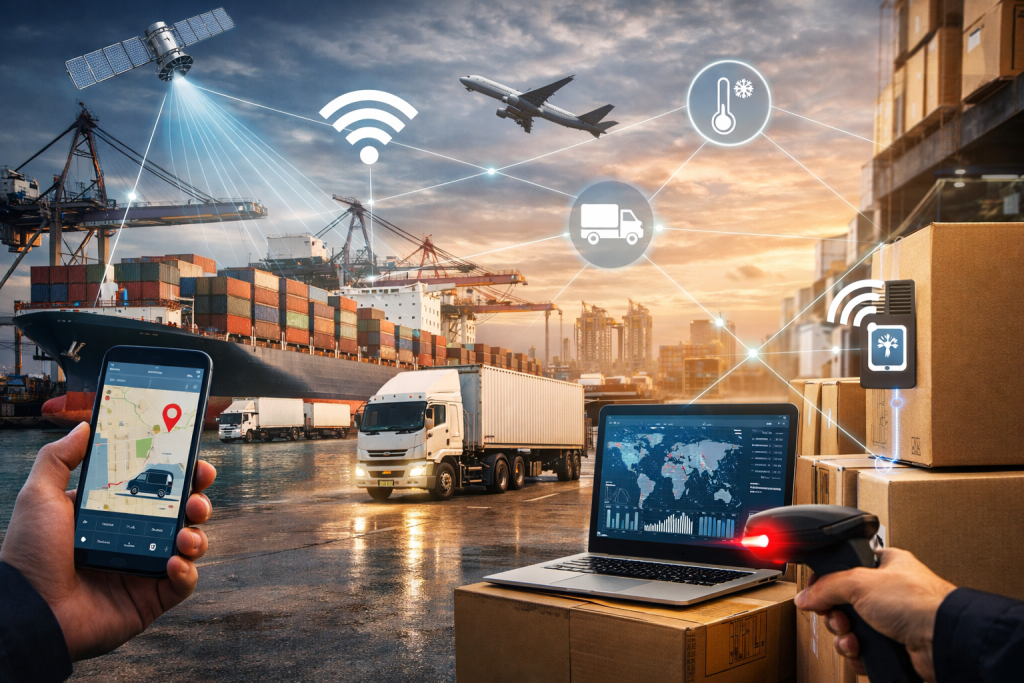
IoT tracking transforms fragmented logistics networks into connected ecosystems. From supplier pickup to final-mile delivery, every movement becomes visible and measurable.
This intelligence complements broader initiatives discussed in supply chain efficiency by enabling data-driven optimization at every stage.
When IoT tracking data feeds into analytics platforms, it enables predictive insights such as demand forecasting, route optimization, and capacity planning. Businesses gain foresight—not just hindsight.
The synergy between IoT and AI mirrors advancements highlighted in how AI is transforming the logistics industry in 2025.
Pharmaceuticals, food, and medical supplies depend on strict environmental controls. IoT sensors ensure compliance by monitoring conditions continuously and triggering alerts before spoilage occurs.
Electronics, luxury goods, and industrial equipment benefit from geofencing, shock detection, and theft alerts that protect assets throughout transit.
For international shipments, IoT tracking bridges gaps between carriers, customs checkpoints, and jurisdictions, delivering consistent visibility across borders.
Traditional tracking relies on manual scans and carrier updates that provide limited, delayed information. IoT tracking replaces uncertainty with certainty.
| Feature | Traditional Tracking | IoT Tracking |
|---|---|---|
| Update Frequency | Checkpoints only | Continuous |
| Data Type | Location only | Location + condition |
| Exception Detection | Reactive | Predictive |
| Customer Visibility | Limited | Real-time |
This shift supports faster fulfillment cycles similar to those described in the ultimate guide to fast fulfillment.
By identifying inefficiencies, reducing delays, and minimizing losses, IoT tracking directly improves profit margins.
When inbound shipments are tracked precisely, warehouses can plan labor, dock schedules, and inventory placement more efficiently—supporting strategies outlined in how to maximize warehouse efficiency and cut costs.
Real-time data removes ambiguity. Carriers, suppliers, and third-party partners operate with greater accountability when performance is measurable.
IoT tracking strengthens compliance with regulatory requirements by creating verifiable audit trails. This is particularly valuable in industries governed by strict transport regulations and customs requirements.
For broader compliance standards in transportation and logistics, official guidance from the U.S. Department of Transportation and Transport Canada provides regulatory frameworks that align closely with IoT-enabled monitoring.
IoT tracking technology scales effortlessly. Whether managing hundreds of shipments or tens of thousands, businesses gain visibility without increasing manual oversight.
This scalability supports growth strategies like distributed fulfillment and multi-node warehousing models increasingly adopted across North America.
Today’s customers expect transparency. IoT-powered tracking allows businesses to offer real-time delivery updates, accurate ETAs, and proactive communication during disruptions.
This level of visibility directly improves retention and loyalty, reinforcing insights shared in efficient fulfillment and customer satisfaction.
IoT tracking is evolving beyond visibility into predictive and autonomous logistics. Future advancements include self-optimizing routes, automated exception resolution, and deeper integration with robotics and warehouse automation.
As outlined by logistics innovation research from McKinsey & Company, companies that adopt connected, data-driven supply chains consistently outperform competitors in speed, resilience, and cost efficiency.
Technology alone is not enough. Businesses must partner with logistics providers that integrate IoT tracking into their operational DNA—connecting transportation, warehousing, fulfillment, and customer communication into one seamless experience.
This is where modern logistics platforms differentiate themselves by combining real-time tracking with operational expertise and scalable infrastructure.
To implement IoT tracking technology effectively and gain complete shipment visibility across your supply chain, connect with a logistics partner that prioritizes technology-driven transparency.
Explore intelligent logistics solutions and request a customized strategy through the official contact page:
👉 Request a Quote
IoT tracking provides continuous real-time data, including location and condition, instead of limited checkpoint updates.
Yes. IoT tracking scales easily and reduces costs by preventing losses, delays, and inefficiencies regardless of shipment volume.
Modern IoT platforms integrate seamlessly with WMS, TMS, ERP, and eCommerce fulfillment systems.
Yes. IoT devices use global communication networks to maintain visibility across international shipments.
Accurate delivery updates, proactive issue resolution, and transparency build trust and improve retention.


“Thanks to Byexpress all my shipping and fulfillment costs are in line now”

“All my issues were solved by Byexpress team that I had with pervious 3pl provider.”

“Thank you Byexpress team could not done it without you guys.”

“Their integration and customer service were the key for me”

“Outstanding delivery service! The package was well-packaged, and
the delivery team was professional and courteous”

“Great and knowledgeable team to work with.”

Thanks, guys, for reducing my shipping rates
Ottawa Office
2411 Holly Lane
Ottawa, ON, K1V 7P2
Toronto Office
13-280 West Beaver Creek Road Unit #136
Richmond Hill, ON, L4B 3Z1
Alexandria Office
173 Kenyon Street West
Alexandria, ON, K0C 1A0
Montreal Office
4388 Saint-Denis Street Unit #200
Montreal, QC, H2J 2L1
California Office
155 North Riverview Drive
Anaheim Hills, CA, 92808
Call Us
Toll-Free: 1-866-744-7122
Local : 613-739-3000
Email Us
Multilingual Services