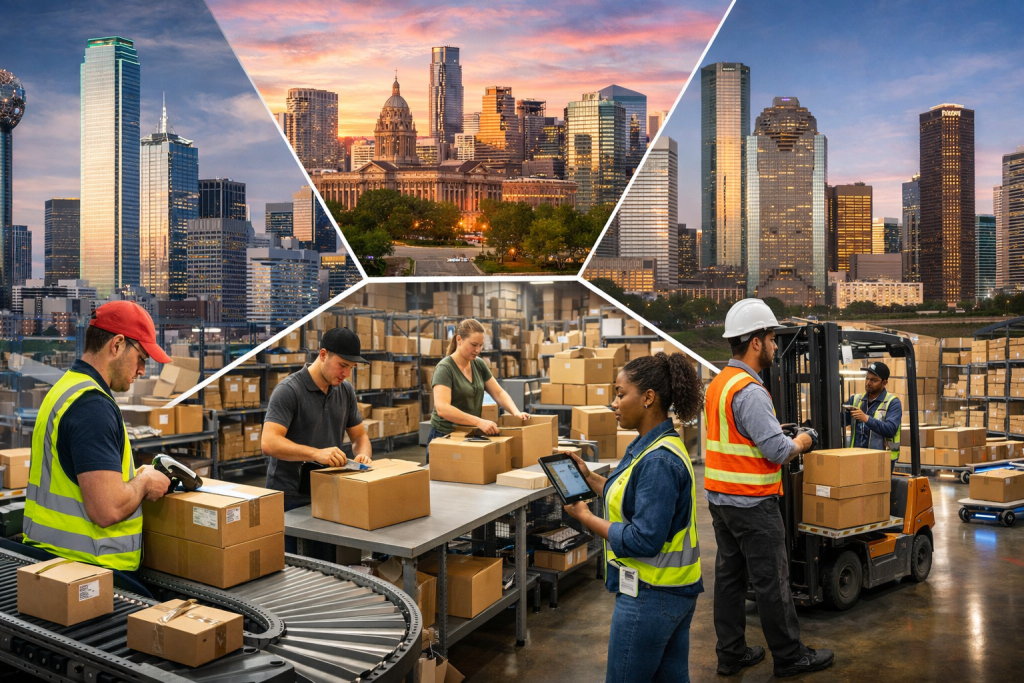
The Texas Triangle—formed by the powerful economic corridor linking Dallas, Houston, and Austin—has become one of the most influential logistics ecosystems in North America. Businesses seeking fast distribution across the United States increasingly rely on this region for fulfillment services, warehousing, transportation, and supply chain management.
Each city inside the Texas Triangle offers a unique logistics advantage. Dallas is a transportation powerhouse connecting east and west coast freight. Houston is a global shipping gateway tied to major ports and international trade. Austin, on the other hand, is rapidly becoming a high-tech fulfillment hub supporting e-commerce startups and innovative distribution networks.
Understanding how these three cities compare allows businesses to choose the most strategic location for order fulfillment, inventory storage, and fast shipping. Companies scaling their supply chain operations often combine multiple fulfillment hubs to optimize delivery speed, reduce shipping costs, and reach customers faster.
Understanding the Texas Triangle Logistics Network
The Texas Triangle refers to the economic megaregion connecting Dallas–Fort Worth, Houston, and Austin, where most of the state’s population, business activity, and freight movement occurs.
Major highways such as I-35, I-45, and I-10 link these cities together, creating an efficient distribution network capable of serving millions of consumers within a short delivery radius.
According to the U.S. Department of Transportation, freight volumes moving through Texas continue to rise due to growing e-commerce demand and cross-border trade.
For businesses shipping across North America, the Texas Triangle provides:
-
Access to major interstate highway corridors
-
Proximity to international shipping ports
-
Massive warehouse infrastructure
-
Access to growing consumer markets
-
Strategic central location within the United States
These advantages make Texas one of the most competitive regions for modern logistics operations.
Dallas Fulfillment Services: The Central Logistics Powerhouse
Dallas has long been recognized as one of the most strategic logistics cities in the United States. The Dallas–Fort Worth metroplex sits at the crossroads of national transportation routes, making it ideal for fulfillment operations that require rapid distribution.
Businesses often rely on Dallas because it enables two-day shipping coverage to most U.S. markets.
Companies exploring logistics infrastructure often review the insights shared in
Calgary Dallas Logistics Hubs to understand how Dallas connects continental supply chains.
Advantages of Dallas Fulfillment Centers
Dallas offers several major operational advantages:
Central Geographic Location
Dallas sits almost perfectly between the U.S. coasts, enabling efficient distribution nationwide. Many companies establish fulfillment warehouses here to shorten shipping times.
Massive Transportation Infrastructure
Dallas features:
-
Multiple interstate highways
-
Major rail hubs
-
One of the largest cargo airports in the country
-
Extensive trucking networks
Businesses using modern freight networks benefit from systems explained in
How Freight Tracking Works in Modern Logistics.
Large Warehouse Market
The Dallas region offers millions of square feet of warehouse space, making it ideal for high-volume fulfillment operations.
Industries Driving Dallas Fulfillment Demand
Dallas fulfillment services support industries such as:
-
Retail distribution
-
Consumer electronics
-
E-commerce brands
-
Automotive logistics
-
Wholesale distribution
The city’s infrastructure makes it one of the most efficient fulfillment locations for companies scaling nationwide shipping operations.
Houston Fulfillment Services: The Global Trade Gateway
Houston operates as one of the largest logistics gateways in North America due to its access to international maritime shipping routes.
The Port of Houston ranks among the busiest ports in the United States, handling massive cargo volumes each year.
External resource: https://www.porthouston.com
Because of its port infrastructure, Houston plays a critical role in global supply chains.
Strengths of Houston Fulfillment Operations
Houston fulfillment services provide several strategic benefits.
Port Access for International Shipping
Companies importing products from Asia, Europe, and Latin America often use Houston distribution centers to streamline customs clearance and inventory transfer.
Energy and Industrial Supply Chains
Houston supports major industries including:
-
Oil and energy
-
Manufacturing
-
Heavy equipment
-
International freight
Businesses shipping bulk cargo or oversized freight benefit from integrated transportation services.
Cross-Border Trade Advantages
Houston’s position near Mexico supports North American trade corridors, making it ideal for companies distributing goods across the United States and Mexico.
Companies optimizing cross-border logistics often study supply chain strategies outlined in
Optimizing Your Supply Chain for Global Challenges.
Austin Fulfillment Services: The Tech-Driven Logistics Hub
Austin has rapidly transformed into one of the most innovative logistics ecosystems in the country. The city’s booming technology sector has fueled the rise of modern fulfillment centers designed for e-commerce and startup brands.
Technology companies relocating to Austin have increased demand for smart warehousing systems and automated distribution.
Why Austin Is Emerging as a Fulfillment Leader
Austin fulfillment centers focus heavily on technology-driven logistics.
E-commerce Growth
Austin’s startup ecosystem drives demand for fulfillment services supporting:
-
Shopify stores
-
subscription box companies
-
direct-to-consumer brands
Companies looking to scale online operations often explore strategies discussed in
How E-commerce Brands Benefit From 3PL Warehousing.
Automation and Smart Warehousing
Austin warehouses frequently implement advanced technology such as:
-
automated picking systems
-
robotic packing lines
-
AI inventory management
Businesses exploring automation benefits often reference
The Future of Warehouse Automation.
Access to Skilled Tech Talent
Because Austin is home to many software and technology companies, logistics providers can integrate advanced systems into fulfillment operations faster.
Comparing Dallas vs Houston vs Austin Fulfillment Services
Each city in the Texas Triangle offers unique logistical strengths.
| City | Primary Advantage | Best For |
|---|---|---|
| Dallas | Central distribution hub | Nationwide shipping |
| Houston | International trade gateway | Imports and cross-border freight |
| Austin | Technology-driven logistics | E-commerce startups |
Businesses often use multi-node warehousing strategies that combine multiple fulfillment centers.
This approach reduces shipping times and helps companies reach customers faster.
Companies seeking modern fulfillment models often explore insights from
What Is a Fulfillment Center and How It Works.
The Rise of Distributed Fulfillment Networks
Modern logistics strategies rarely rely on a single warehouse. Instead, companies increasingly deploy distributed fulfillment networks.
This strategy spreads inventory across multiple fulfillment centers in different regions to improve delivery performance.
Benefits include:
-
Faster delivery speeds
-
Lower shipping costs
-
Reduced inventory risk
-
better geographic coverage
Businesses implementing these strategies often use data-driven inventory planning explained in
Real-Time Inventory Updates for Modern Supply Chains.
How Texas Fulfillment Centers Improve Delivery Speeds
Shipping speed has become one of the most important factors influencing customer satisfaction.
Consumers now expect fast delivery windows, often within two days or less.
The Texas Triangle enables this through:
-
highway transportation corridors
-
advanced warehousing systems
-
efficient last-mile delivery networks
Organizations studying logistics performance metrics often reference the Federal Highway Administration freight reports.
Strategically located fulfillment hubs inside Texas allow companies to dramatically improve shipping performance.
Choosing the Best Fulfillment Partner in Texas
Selecting a fulfillment provider requires evaluating several key factors.
Warehouse Location
Location determines how quickly inventory reaches customers.
Technology Integration
Modern fulfillment centers must integrate with:
-
Shopify
-
WooCommerce
-
Amazon
-
enterprise inventory systems
Scalability
Businesses must ensure their fulfillment provider can support seasonal demand spikes and rapid growth.
Companies seeking guidance often review the detailed strategies explained in
Guide to Choosing the Right Fulfillment Partner.
The Future of Fulfillment in the Texas Triangle
The Texas Triangle will continue expanding as a logistics powerhouse due to:
-
population growth
-
expanding infrastructure
-
rising e-commerce demand
-
increased automation
Emerging technologies such as AI forecasting, robotics, and predictive analytics are already transforming fulfillment operations.
Businesses studying next-generation logistics often explore the insights presented in
How AI Is Transforming the Logistics Industry.
These innovations will shape the next decade of distribution across North America.
Why Businesses Are Moving Their Fulfillment Operations to Texas
Companies relocating distribution centers to Texas gain multiple advantages:
-
lower operating costs
-
central location for national shipping
-
expanding infrastructure
-
strong workforce availability
Combined with rapid population growth, these factors position Texas as one of the most powerful logistics regions in the world.
Conclusion
The Texas Triangle—Dallas, Houston, and Austin—represents one of the most strategic fulfillment regions in North America.
Dallas excels at nationwide distribution, Houston connects global shipping networks, and Austin drives technology-powered fulfillment innovation.
Businesses seeking scalable supply chain solutions increasingly rely on the Texas Triangle to reduce delivery times, optimize shipping costs, and expand their distribution networks.
Companies looking to modernize their logistics strategy can explore customized solutions and infrastructure options through ByExpress logistics services or request tailored shipping and warehousing support through the contact page.
Frequently Asked Questions
1. What is the Texas Triangle in logistics?
The Texas Triangle refers to the economic corridor connecting Dallas, Houston, and Austin. This region forms one of the most powerful logistics networks in North America due to its transportation infrastructure and large population.
2. Which Texas city is best for fulfillment services?
Dallas is ideal for nationwide distribution, Houston excels in international shipping and port logistics, while Austin is best suited for technology-driven e-commerce fulfillment.
3. Why do companies choose Texas for distribution centers?
Texas offers a central U.S. location, lower operational costs, extensive transportation networks, and rapid population growth, making it ideal for logistics operations.
4. How fast can fulfillment centers in Texas ship orders?
Many fulfillment centers in Texas can deliver products across most of the United States within two days due to the state’s central geographic location.
5. What industries use Texas fulfillment services?
Industries using Texas fulfillment include e-commerce, retail distribution, manufacturing, automotive supply chains, and global import/export operations.