By Martin Vassilev / 22 Dec, 2025
Canada’s logistics ecosystem in 2025 is no longer driven by manual planning, static forecasts, or reactive decision-making. Artificial intelligence (AI) and machine learning (ML) have moved from experimental tools to core operational infrastructure across warehousing, transportation, fulfillment, and cross-border logistics. For Canadian businesses operating in a market defined by geographic scale, labor constraints, fluctuating demand, and rising customer expectations, AI-powered logistics has become a competitive necessity rather than a future ambition.
From predictive demand forecasting to real-time route optimization, machine learning systems now analyze millions of data points across supply chains—delivering speed, accuracy, and resilience that traditional systems simply cannot match. Canadian logistics leaders are using AI not just to reduce costs, but to unlock entirely new service models built around precision, transparency, and scalability.
Traditional demand forecasting relies on historical averages and manual adjustments. Machine learning models, by contrast, continuously ingest real-time data—sales velocity, seasonality, weather patterns, promotions, regional demand shifts, and even macroeconomic indicators.
In Canada’s multi-region market, this capability is transformative. ML-driven forecasting allows logistics providers to anticipate spikes in demand across provinces, adjust inventory positioning proactively, and avoid costly stockouts or overstocking scenarios.
AI-based demand forecasting is especially impactful for eCommerce and retail fulfillment operations that require rapid responsiveness across multiple fulfillment nodes. This directly supports more efficient inventory management strategies that reduce waste while maintaining high service levels.
Warehouses across Canada are rapidly evolving into intelligent environments. AI-powered computer vision systems now monitor picking accuracy, identify damaged goods, optimize slotting layouts, and improve safety compliance in real time.
Machine learning algorithms analyze warehouse workflows continuously, identifying inefficiencies that human supervisors often miss. These systems dynamically adjust pick paths, labor allocation, and storage configurations based on order patterns and inventory velocity.
The shift toward intelligent facilities aligns closely with the rise of automation and AI-driven warehouse design explored in The Future of Warehouse Automation: What Businesses Need to Know, where operational intelligence replaces static layouts.
In Canadian logistics, downtime is expensive—especially during peak seasons or in remote regions. Machine learning models now monitor forklifts, conveyor systems, robotics, and fleet vehicles to predict failures before they occur.
By analyzing sensor data such as vibration, temperature, and usage cycles, AI systems trigger maintenance interventions proactively. This predictive maintenance approach reduces unplanned outages, extends equipment lifespan, and improves operational continuity across warehouses and transportation networks.
Canada’s geography presents unique challenges—long distances, weather variability, and cross-border complexity. AI-powered transportation management systems (TMS) now dynamically optimize routes using live traffic data, weather forecasts, fuel costs, and delivery windows.
Machine learning algorithms continuously learn from past deliveries, improving accuracy with every completed route. This results in faster delivery times, lower fuel consumption, and improved carrier utilization.
AI-driven transportation optimization also supports complex freight strategies across regional hubs, such as those outlined in Calgary–Dallas Logistics Hubs, where cross-border efficiency depends on precision planning.
Visibility has become a defining expectation in modern logistics. AI-powered tracking systems consolidate data from IoT devices, GPS, warehouse systems, and carrier APIs into a single real-time dashboard.
Machine learning enhances this visibility by identifying anomalies—delays, route deviations, or fulfillment risks—before they escalate into service failures. This level of insight allows Canadian logistics providers to communicate proactively with customers and partners, improving trust and reliability.
Inventory optimization is no longer about holding more stock “just in case.” Machine learning models calculate optimal inventory levels at each node of the supply chain, balancing carrying costs with service requirements.
By analyzing SKU-level performance, regional demand patterns, and lead-time variability, AI ensures inventory is positioned exactly where it is needed. This strategy directly supports higher warehouse efficiency and lower operating costs, reinforcing principles discussed in How to Maximize Warehouse Efficiency and Cut Costs.
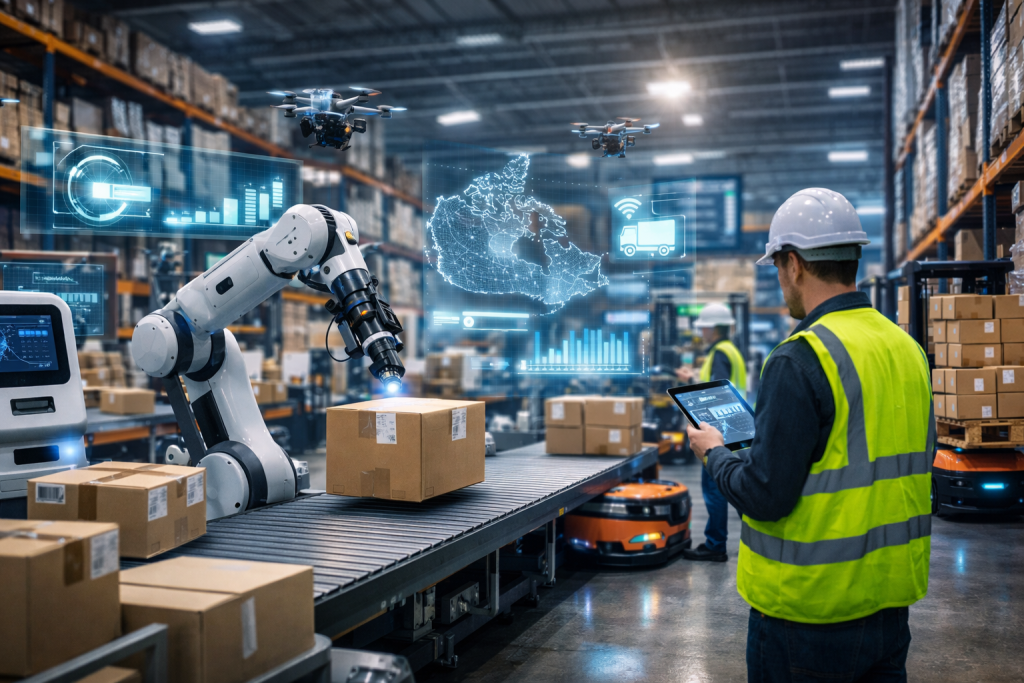
Order fulfillment in 2025 is defined by speed and precision. AI-powered fulfillment engines prioritize orders based on delivery deadlines, customer value, carrier availability, and inventory location.
Machine learning systems automatically select the most efficient fulfillment path—whether same-day, next-day, or consolidated shipping—without manual intervention. This adaptability is essential for businesses scaling rapidly or managing seasonal surges.
AI-enhanced fulfillment directly supports smarter distribution strategies aligned with Top 10 Warehousing Strategies to Optimize Your Supply Chain in 2025.
Cross-border shipping between Canada and the U.S. introduces regulatory complexity and compliance risks. AI systems now assist with customs documentation, tariff classification, and compliance checks by learning from historical clearance data.
Machine learning models flag high-risk shipments, reduce documentation errors, and streamline customs workflows—significantly reducing delays and penalties for Canadian exporters and importers.
These innovations align with federal trade modernization initiatives supported by Government of Canada Trade and Export Resources.
Sustainability is no longer optional. AI-powered logistics platforms reduce carbon emissions by optimizing routes, consolidating shipments, and minimizing empty miles.
Machine learning also supports energy-efficient warehouse operations by dynamically adjusting lighting, heating, and cooling based on activity levels. These practices complement national sustainability objectives promoted by Natural Resources Canada.
From labor shortages to geopolitical disruptions, AI strengthens supply chain resilience by simulating risk scenarios and recommending contingency strategies. Machine learning models continuously evaluate supplier reliability, transportation capacity, and inventory exposure.
This predictive resilience enables Canadian businesses to adapt quickly—rerouting shipments, reallocating inventory, or adjusting sourcing strategies before disruptions escalate.
Third-party logistics providers leveraging AI deliver measurable advantages—faster onboarding, data-driven decision-making, and scalable infrastructure. AI-powered 3PLs offer integrated visibility, advanced analytics, and automation capabilities that in-house operations struggle to replicate.
These capabilities are central to modern fulfillment partnerships and are increasingly critical for businesses evaluating outsourcing options through guides like Guide to Choosing the Right Fulfillment Partner for Your Business.
AI does not replace logistics professionals—it elevates them. Machine learning systems handle repetitive analysis and optimization tasks, allowing teams to focus on strategy, exception management, and customer relationships.
In Canada’s tight labor market, AI-driven productivity gains are essential for sustaining growth without proportional increases in headcount.
AI and machine learning will continue to deepen their influence across Canadian logistics. Expect broader adoption of autonomous vehicles, AI-negotiated carrier pricing, and hyper-local micro-fulfillment models driven by predictive analytics.
As logistics networks become increasingly intelligent, businesses that embrace AI-driven transformation will outperform competitors on cost, speed, and customer experience—while those that delay risk falling behind permanently.
Technology alone does not deliver results. Execution matters. Logistics providers with integrated AI platforms, data expertise, and scalable infrastructure are best positioned to turn machine intelligence into real operational advantage.
To explore how advanced logistics technology can support smarter warehousing, transportation, and fulfillment across Canada, connect with a provider built for intelligent supply chains via Contact ByExpress.
AI is used for demand forecasting, route optimization, warehouse automation, inventory management, predictive maintenance, and real-time visibility across supply chains.
No. Scalable AI platforms are increasingly accessible to mid-sized and growing businesses through modern 3PL partnerships.
Yes. AI reduces costs by minimizing waste, improving efficiency, optimizing transportation, and preventing downtime.
Machine learning optimizes fulfillment paths, carrier selection, and routing in real time—resulting in faster, more reliable deliveries.
Modern AI systems are designed to support compliance, documentation accuracy, and transparency aligned with Canadian trade and data regulations.


“Thanks to Byexpress all my shipping and fulfillment costs are in line now”

“All my issues were solved by Byexpress team that I had with pervious 3pl provider.”

“Thank you Byexpress team could not done it without you guys.”

“Their integration and customer service were the key for me”

“Outstanding delivery service! The package was well-packaged, and
the delivery team was professional and courteous”

“Great and knowledgeable team to work with.”

Thanks, guys, for reducing my shipping rates
Ottawa Office
2411 Holly Lane
Ottawa, ON, K1V 7P2
Toronto Office
13-280 West Beaver Creek Road Unit #136
Richmond Hill, ON, L4B 3Z1
Alexandria Office
173 Kenyon Street West
Alexandria, ON, K0C 1A0
Montreal Office
4388 Saint-Denis Street Unit #200
Montreal, QC, H2J 2L1
California Office
155 North Riverview Drive
Anaheim Hills, CA, 92808
Call Us
Toll-Free: 1-866-744-7122
Local : 613-739-3000
Email Us
Multilingual Services