By Martin Vassilev / 22 Dec, 2025
Modern fulfillment centers are no longer passive storage environments. They are high-velocity operational hubs engineered to process thousands of orders daily with minimal error, compressed timelines, and full visibility. Automation is the core system that enables this transformation, allowing fulfillment operations to scale, adapt, and remain resilient under volatile demand conditions.
As fulfillment expectations shift toward same-day delivery, real-time tracking, and flawless execution, manual workflows become structural liabilities. Automation replaces inconsistency with precision and transforms fulfillment from a cost center into a competitive advantage—particularly when aligned with intelligent logistics strategies outlined in The Ultimate Guide to Fast Fulfillment.
Automation in fulfillment encompasses interconnected technologies that coordinate inventory, labor, and transportation in real time. These systems execute tasks traditionally handled by human labor while continuously optimizing throughput and accuracy.
In advanced operations, automation is deeply integrated into the fulfillment process itself, orchestrating receiving, put-away, picking, packing, shipping, and returns with minimal friction.
Customer expectations are shaped by platforms offering next-day and same-day delivery. Automation allows fulfillment centers to meet these expectations consistently, especially when paired with same-day fulfillment strategies.
Rising labor costs and workforce shortages have exposed the fragility of manual fulfillment models. Automated workflows reduce dependency on labor while improving productivity per square foot, aligning with cost-reduction principles outlined in How to Lower Fulfillment Costs Without Sacrificing Quality.
Automation eliminates manual error through barcode scanning, RFID, and machine vision—critical for avoiding losses tied to the true cost of poor inventory management.
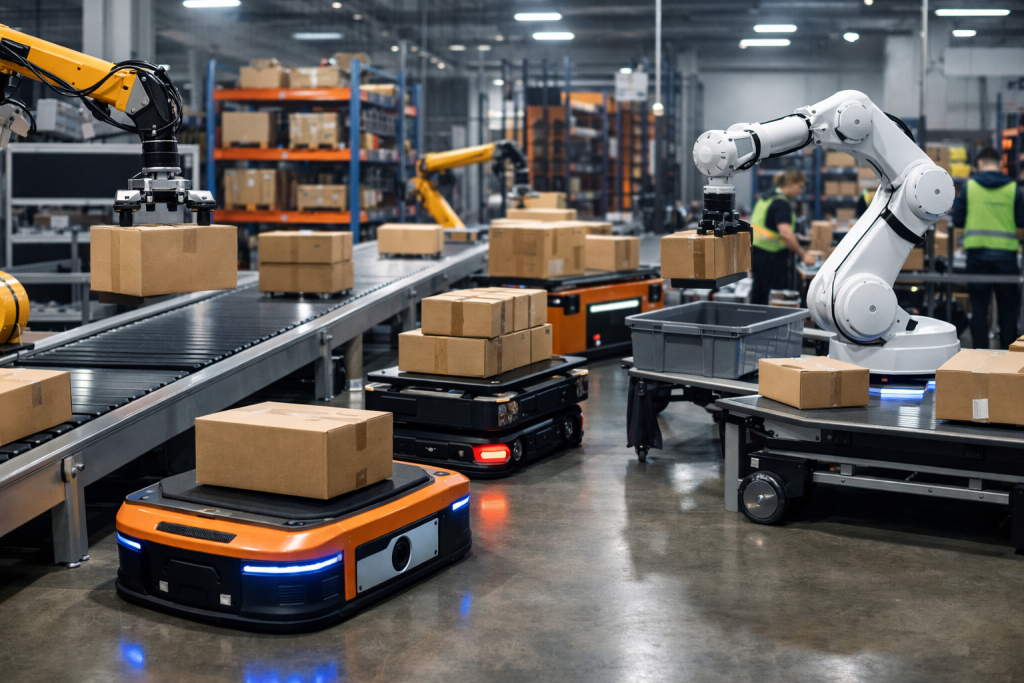
Robotic arms equipped with AI vision systems now perform high-volume picking with consistent accuracy. These systems are particularly effective in ecommerce environments, where SKU variability and order complexity are high—key challenges discussed in 10 Common Fulfillment Mistakes and How to Avoid Them.
AMRs transport goods across fulfillment centers without fixed infrastructure, adapting dynamically to layout changes and order surges. This flexibility supports distributed fulfillment models highlighted in Why Businesses Are Switching to Distributed Warehousing.
AS/RS solutions maximize vertical space and dramatically reduce retrieval time. These systems directly support warehouse density strategies discussed in How to Improve Warehouse Space Utilization for Maximum Efficiency.
A modern WMS acts as the command center of automated fulfillment. AI-enabled systems forecast demand, optimize pick paths, and balance workloads in real time—capabilities central to Integrating AI in Warehouse Management and How AI Is Transforming the Logistics Industry in 2025.
Automated inventory tracking ensures real-time visibility across all channels, preventing overselling and stockouts. This capability is essential for brands scaling ecommerce operations, as outlined in Real-Time Inventory Updates: Why They Matter.
Automation also enables predictive inventory planning using analytics frameworks detailed in How to Leverage Data Analytics for Streamlined Inventory Management.
Automation compresses fulfillment timelines by removing bottlenecks. Orders are batch-processed, routed intelligently, and dispatched faster—key to improving conversion rates and customer loyalty as explored in Why Fast Shipping Is Crucial for E-Commerce Success.
Automated fulfillment also supports high-velocity retail and B2B environments discussed in B2B Fulfillment vs B2C Fulfillment in Canada.
Automation directly reduces:
Labor overhead
Picking errors
Returns processing costs
Space inefficiencies
These benefits align with cost-reduction strategies outlined in 5 Key Ways Warehousing Optimization Can Boost Your Bottom Line and How to Reduce Warehousing Costs Without Sacrificing Quality.
Modern fulfillment increasingly relies on strategically located hubs connected through standardized automated systems. Cross-regional fulfillment strategies—such as those linking Calgary and Dallas logistics hubs—benefit from consistent automation frameworks that enable seamless scaling.
Automation ensures operational consistency across regions like Ottawa logistics networks and national distribution infrastructures described in The Importance of Warehousing for Business Efficiency and Growth.
Automation contributes to sustainability by reducing energy waste, minimizing excess inventory, and optimizing transportation routes—principles aligned with The Role of Green Logistics in Modern Warehousing.
Canadian regulatory frameworks from https://tc.canada.ca and https://natural-resources.canada.ca emphasize efficiency, traceability, and reduced environmental impact—standards automation helps fulfillment centers meet consistently.
Automation is not a standalone investment. Its true value emerges when aligned with broader supply chain strategies, including outsourcing decisions covered in Why Outsourcing Warehousing Is More Cost-Effective Than In-House Management and fulfillment partner selection frameworks in Guide to Choosing the Right Fulfillment Partner.
The next generation of fulfillment centers will be predictive, autonomous, and self-optimizing. AI-driven forecasting, robotics, and real-time analytics will define fulfillment leaders, as explored in What Makes a Warehouse Truly Smart in 2026.
Businesses that delay automation risk falling behind competitors already adopting automation, AI, and robotics in logistics.
Implementing automation requires strategic planning, not guesswork. To explore scalable, automated fulfillment solutions tailored to your business, connect with specialists through the ByExpress Contact Page or request pricing directly via Request a Quote.
It is the use of robotics, AI, and intelligent software to automate inventory handling, order processing, and shipping operations.
Yes. Automation lowers labor dependency, minimizes errors, and improves space efficiency.
Automation is essential for ecommerce scalability, especially during peak seasons and rapid growth phases.
Timelines vary by complexity, but modular automation allows phased implementation with early ROI.
Modern automation platforms integrate seamlessly with ERP, WMS, and ecommerce platforms.


“Thanks to Byexpress all my shipping and fulfillment costs are in line now”

“All my issues were solved by Byexpress team that I had with pervious 3pl provider.”

“Thank you Byexpress team could not done it without you guys.”

“Their integration and customer service were the key for me”

“Outstanding delivery service! The package was well-packaged, and
the delivery team was professional and courteous”

“Great and knowledgeable team to work with.”

Thanks, guys, for reducing my shipping rates
Ottawa Office
2411 Holly Lane
Ottawa, ON, K1V 7P2
Toronto Office
13-280 West Beaver Creek Road Unit #136
Richmond Hill, ON, L4B 3Z1
Alexandria Office
173 Kenyon Street West
Alexandria, ON, K0C 1A0
Montreal Office
4388 Saint-Denis Street Unit #200
Montreal, QC, H2J 2L1
California Office
155 North Riverview Drive
Anaheim Hills, CA, 92808
Call Us
Toll-Free: 1-866-744-7122
Local : 613-739-3000
Email Us
Multilingual Services