By Martin Vassilev / 21 Nov, 2025
Warehousing operations face increasing pressure to deliver accurate, fast, and cost-efficient fulfillment. Even one mislabeled pallet or mis-scanned order can cost thousands, especially in high-volume environments such as e-commerce, B2B distribution, and 3PL logistics. Barcode and RFID technologies have become the backbone of modern accuracy systems—enabling real-time visibility, automated tracking, and error-free workflows.
As companies shift toward smarter warehousing models like automation, robotics, and predictive inventory control, both barcode and RFID systems stand as foundational technologies driving accuracy, speed, and transparency across operations.
This article explains how each technology works, how they reduce errors, and how businesses can strategically deploy them to improve performance—while integrating logistics-ready approaches from industry leaders such as ByExpress.
Warehouse errors affect far more than internal costs—they damage customer trust, increase return rates, delay shipments, and reduce long-term profitability. Studies show that even a 1% error rate in picking accuracy can lead to millions in losses for high-volume distribution centers.
Common warehouse errors include:
Mis-picks and mis-ships
Wrong quantities
Lost items
Inventory discrepancies
Incorrect labeling
Put-away mistakes
Poor location accuracy
Many of these issues occur because of manual processes, outdated documentation, and lack of real-time visibility.
Businesses optimizing for accuracy often adopt end-to-end improvements, such as those found in lean warehousing frameworks (see: Lean Warehousing) and AI-driven inventory analytics (see: How to Leverage Data Analytics).
Barcode and RFID systems directly target the root causes of these errors.
Barcode systems use machine-readable labels scanned through handheld or fixed readers. Despite being one of the oldest warehouse technologies, barcodes remain the standard for accuracy, affordability, and universal compatibility.
Barcodes eliminate manual writing or visual identification errors. Modern scanners achieve up to 99.9% read accuracy, significantly reducing mis-picks, mismatched SKUs, and labeling errors.
Barcode scanning reduces processing time for:
Receiving
Put-away
Cycle counts
Replenishment
Picking
Packing
Shipping
Each scan instantly updates your warehouse management system (WMS), ensuring all data remains accurate across departments.
Barcodes are inexpensive to print and easy to deploy. Even small warehouses can adopt them with minimal investment—making barcode systems ideal for companies focused on cost-efficiency (see: How to Reduce Warehousing Costs).
Because barcodes integrate universally, they work across industries such as e-commerce, manufacturing, healthcare, retail, and logistics.
RFID (Radio Frequency Identification) uses radio waves to identify items without needing line-of-sight scanning. This breakthrough removes friction from traditional scanning processes.
RFID tags can be read hundreds at a time, enabling precise location tracking during:
Receiving
Cross-docking
Movement within the warehouse
Staging and shipping
RFID helps logistics providers like ByExpress ensure high-speed throughput in large-volume operations (see: The Future of Warehouse Automation).
RFID achieves near-perfect accuracy levels, often reaching 99%+ inventory precision. This eliminates:
Phantom inventory
Shrinkage
Overstocking
Cycle counting errors
This is especially valuable for temperature-sensitive storage, high-value goods, and high-velocity SKUs.
RFID gates and portals automatically:
Record goods entering or leaving zones
Validate pallet contents
Trigger alerts for unauthorized movements
These automated checkpoints significantly reduce human error.
RFID makes it easier to integrate with advanced logistics systems in multi-region networks such as those connecting Calgary–Dallas logistics corridors (see: Calgary–Dallas Logistics Hubs).
| Feature | Barcode | RFID |
|---|---|---|
| Cost | Low | Higher |
| Accuracy | High | Very High |
| Scan Method | Line-of-sight | Automatic, bulk reading |
| Implementation | Easy | Moderate |
| Best For | General warehouses | High-volume, automation-driven facilities |
| Durability | Vulnerable to damage | More durable (metal, liquid options available) |
Most companies adopt hybrid systems, using barcodes for low-cost applications and RFID for high-value, high-velocity, or automation-heavy workflows.
Manual typing errors, handwriting issues, and transcription mistakes disappear when using automated scanning or RFID reading.
Pickers receive precise instructions, and scanning ensures the right item is picked—critical for e-commerce accuracy (see: Efficient Fulfillment & Customer Satisfaction).
Both systems enable double verification:
Scan items when picked
Scan again during packing and shipping
This two-step validation minimizes return rates and customer complaints.
RFID and barcode systems guide workers to correct locations and update inventory instantly, preventing bin-level inaccuracies.
Real-time data ensures accurate forecasting, replenishment, and space utilization—key strategies highlighted in Warehouse Space Utilization.
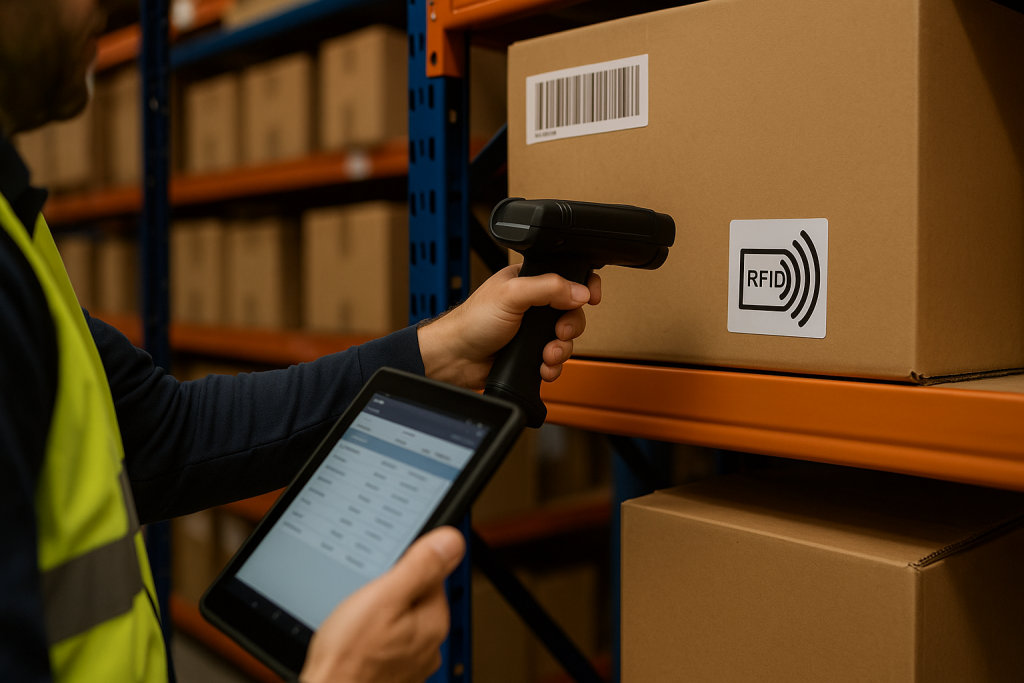
Shelves detect movement and automatically update stock levels.
RFID allows cycle counts in minutes instead of hours or days.
Robots equipped with barcode/RFID scanners validate goods as they transport them across the warehouse (see: Automation & AI in Warehousing).
RFID portals instantly verify inbound and outbound goods, improving speed in cross-docking operations (see: What is Cross-Docking?).
Both provide compliance standards, technical specifications, and best practices for global supply chain operations.
Assess existing workflows and identify where errors occur most frequently.
An optimized layout ensures scanning paths and RFID read zones work flawlessly.
Low-quality barcodes or tags increase read errors and slow workflow.
A well-integrated WMS ensures scanning data flows into:
Inventory control
Replenishment
Order management
Customer notifications
Even the most advanced technology fails without proper adoption.
AI analyzes RFID data to predict stockouts, damage, and demand trends.
RFID data stored on blockchain ensures tamper-proof supply chain records (see: Blockchain in Logistics).
Integrated with robots, drones, IoT sensors, and predictive analytics to build fully automated, self-correcting warehouses.
Barcode and RFID technologies form the foundation of modern warehouse accuracy. By eliminating human error, improving real-time visibility, and enabling automation, these tools help businesses reduce operational costs, strengthen customer trust, and achieve scalable fulfillment excellence.
Companies focused on efficiency and reliability, such as ByExpress, use these technologies to deliver faster, more accurate logistics services across Canada and the U.S. For tailored solutions, businesses can explore ByExpress’ expertise in inventory management, fulfillment, and supply chain optimization.
For next steps or consultation, visit the ByExpress Contact Page.
RFID is more advanced and provides automated tracking, but barcodes remain cheaper and highly reliable, making them ideal for many warehouses.
Barcode systems can reduce picking and shipping errors by up to 90% when fully integrated into warehouse workflows.
Yes. Although more expensive, RFID is excellent for high-value goods, fast-moving inventory, and automated facilities.
Yes. Hybrid systems are the most common setup and allow businesses to assign the right technology to the right task.
E-commerce, retail, pharmaceutical, electronics, automotive, and cold-storage logistics gain significant advantages from RFID.


“Thanks to Byexpress all my shipping and fulfillment costs are in line now”

“All my issues were solved by Byexpress team that I had with pervious 3pl provider.”

“Thank you Byexpress team could not done it without you guys.”

“Their integration and customer service were the key for me”

“Outstanding delivery service! The package was well-packaged, and
the delivery team was professional and courteous”

“Great and knowledgeable team to work with.”

Thanks, guys, for reducing my shipping rates
Ottawa Office
2411 Holly Lane
Ottawa, ON, K1V 7P2
Toronto Office
13-280 West Beaver Creek Road Unit #136
Richmond Hill, ON, L4B 3Z1
Alexandria Office
173 Kenyon Street West
Alexandria, ON, K0C 1A0
Montreal Office
4388 Saint-Denis Street Unit #200
Montreal, QC, H2J 2L1
California Office
155 North Riverview Drive
Anaheim Hills, CA, 92808
Call Us
Toll-Free: 1-866-744-7122
Local : 613-739-3000
Email Us
Multilingual Services