By Martin Vassilev / 31 Dec, 2025
Cross-border shipping between Canada and the United States is one of the most active trade corridors in the world. Yet despite geographic proximity and strong trade agreements, international shipping across this border can quickly become complex, expensive, and error-prone without the right strategy. Businesses that master Canada–U.S. shipping gain a powerful competitive advantage: faster delivery times, lower landed costs, fewer customs delays, and higher customer satisfaction.
This guide delivers a clear, business-focused framework for shipping from Canada to the U.S. efficiently, compliantly, and profitably. Every section is written to outperform competing resources by providing depth, clarity, and real operational value.
Shipping internationally from Canada to the United States is not simply “domestic shipping with a border.” It is governed by customs regulations, security requirements, trade agreements, carrier rules, and documentation standards that must align perfectly.
The United States–Mexico–Canada Agreement (USMCA) removed many tariffs, but it did not remove compliance obligations. Customs authorities on both sides expect accurate classification, transparent valuation, and consistent documentation. Any discrepancy can result in delays, inspections, fines, or returned shipments.
Businesses that treat cross-border shipping as a strategic function—rather than a transactional task—consistently outperform competitors in speed, reliability, and cost control.
The first strategic decision is determining whether shipments should move as parcels or freight.
Parcel shipping works best for:
Small, lightweight packages
Direct-to-consumer (DTC) eCommerce orders
High shipment frequency with low per-order value
Freight shipping is more suitable for:
Palletized or oversized goods
B2B shipments
Bulk inventory replenishment
Cost optimization at scale
For businesses moving consistent volumes, combining freight for inventory positioning with parcel shipping for last-mile delivery creates a highly efficient hybrid model.
Carrier selection impacts transit times, customs clearance speed, damage rates, and total landed cost. Businesses should prioritize carriers with:
Proven Canada–U.S. customs expertise
Integrated tracking across borders
Established U.S. distribution networks
Working with a logistics provider that offers integrated cross-border freight and fulfillment solutions reduces handoffs, miscommunication, and delays. A strong example of strategic cross-border infrastructure is outlined in Calgary–Dallas logistics hub operations, where optimized routing dramatically improves delivery reliability.
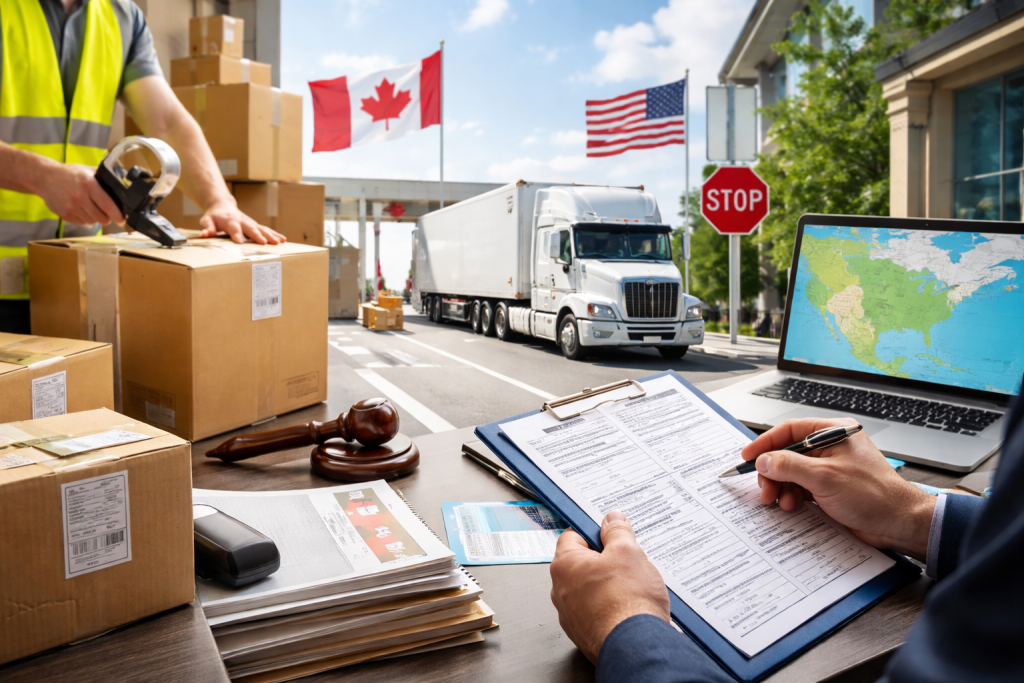
Every shipment entering the United States must include:
Commercial invoice
Packing list
Bill of lading or waybill
Harmonized System (HS) codes
Country of origin declaration
Errors in documentation are the leading cause of border delays. Even small mismatches between invoice values and declared shipment contents can trigger inspections.
To avoid this, businesses should standardize documentation workflows and automate wherever possible using modern logistics technology. Advanced fulfillment systems discussed in what a 3PL company actually does show how automation reduces human error at scale.
HS codes determine:
Duty rates
Eligibility under USMCA
Regulatory requirements
Inspection risk level
Misclassification exposes businesses to retroactive penalties and shipment seizures. Assigning correct HS codes should be treated as a compliance function, not an afterthought.
The United States allows duty-free entry for shipments valued under USD $800. Structuring shipments to take advantage of this threshold—where appropriate—can significantly reduce costs for eCommerce sellers.
However, artificially splitting shipments to avoid duties can trigger compliance issues. Strategic shipment planning must balance savings with regulatory integrity.
Choosing the right Incoterm impacts customer experience and cost predictability.
DDP (Delivered Duty Paid): Seller covers all duties and taxes; best for premium customer experience.
DAP (Delivered At Place): Buyer pays duties on arrival; reduces seller risk but may increase delivery friction.
Businesses focused on long-term U.S. growth typically adopt DDP to eliminate surprises at checkout and reduce abandoned deliveries.
One of the most effective ways to improve delivery speed and reduce shipping costs is U.S.-based warehousing. By moving inventory in bulk across the border and fulfilling domestically, businesses eliminate per-order customs clearance.
This strategy aligns closely with modern fulfillment models explained in on-demand warehousing explained and why businesses are switching to distributed warehousing.
Cross-docking minimizes storage time by transferring goods directly from inbound to outbound transport. For Canada–U.S. shipping, this reduces handling costs and accelerates delivery.
The operational benefits of this approach are detailed in what is cross-docking, especially for time-sensitive or seasonal inventory.
Customers expect real-time visibility regardless of borders. Advanced tracking systems provide:
Live shipment status
Customs clearance updates
Exception alerts
This level of transparency reduces customer service inquiries and builds trust. The impact of real-time logistics visibility is explored in how freight tracking works in modern logistics.
Artificial intelligence is transforming cross-border logistics through:
Predictive demand forecasting
Carrier performance optimization
Route optimization
The future-forward advantages of AI-driven logistics are clearly outlined in how AI is transforming the logistics industry in 2025.
Returns between Canada and the U.S. are expensive if unmanaged. A clear reverse logistics strategy reduces costs and preserves customer satisfaction.
Best practices include:
U.S.-based return centers
Consolidated return shipments
Automated return authorization workflows
Efficient reverse logistics directly impact profitability, as discussed in how reverse logistics can save your bottom line.
U.S. Customs and Border Protection (CBP) and the Canada Border Services Agency (CBSA) enforce strict security protocols. Programs such as C-TPAT can reduce inspection frequency for trusted shippers.
Official regulatory guidance should always be referenced directly from authoritative sources such as:
These agencies define compliance expectations that businesses cannot afford to ignore.
As shipping volume grows, manual processes become bottlenecks. Scaling safely requires:
Centralized inventory management
Standardized customs workflows
Strategic fulfillment partnerships
Businesses that attempt to scale without professional logistics support often encounter hidden costs, delays, and customer dissatisfaction—issues thoroughly analyzed in the hidden costs of poor warehousing management.
A specialized logistics partner should provide:
End-to-end cross-border expertise
Integrated warehousing and fulfillment
Customs clearance support
Transparent pricing models
The selection process is critical and explored in depth in guide to choosing the right fulfillment partner.
For businesses ready to optimize their shipping strategy, a direct consultation can accelerate results. The next step is connecting through the official contact page to assess requirements and design a scalable solution.
The fastest method combines bulk freight cross-border shipping with U.S.-based fulfillment for last-mile delivery.
While not legally required, a customs broker significantly reduces the risk of delays, fines, and rejected shipments.
Ensure accurate HS codes, consistent documentation, and compliance with CBP and CBSA regulations.
USMCA eliminates many tariffs but does not remove documentation or compliance requirements.
Yes, for high-volume sellers, U.S.-based warehousing reduces shipping costs and improves delivery speed.


“Thanks to Byexpress all my shipping and fulfillment costs are in line now”

“All my issues were solved by Byexpress team that I had with pervious 3pl provider.”

“Thank you Byexpress team could not done it without you guys.”

“Their integration and customer service were the key for me”

“Outstanding delivery service! The package was well-packaged, and
the delivery team was professional and courteous”

“Great and knowledgeable team to work with.”

Thanks, guys, for reducing my shipping rates
Ottawa Office
2411 Holly Lane
Ottawa, ON, K1V 7P2
Toronto Office
13-280 West Beaver Creek Road Unit #136
Richmond Hill, ON, L4B 3Z1
Alexandria Office
173 Kenyon Street West
Alexandria, ON, K0C 1A0
Montreal Office
4388 Saint-Denis Street Unit #200
Montreal, QC, H2J 2L1
California Office
155 North Riverview Drive
Anaheim Hills, CA, 92808
Call Us
Toll-Free: 1-866-744-7122
Local : 613-739-3000
Email Us
Multilingual Services