By Martin Vassilev / 23 Jan, 2026
California is more than a massive consumer market—it’s a logistics advantage. For eCommerce brands, retailers, and B2B shippers, California fulfillment services can reduce shipping zones, speed up delivery promises, protect margins, and create a smoother customer experience from checkout to doorstep. The best West Coast fulfillment operations combine strategic warehouse locations, tight inventory control, and technology-driven execution so businesses can scale without drowning in operational complexity.
The most effective California 3PL partners don’t just store and ship cartons. They provide end-to-end fulfillment processes, order visibility, returns workflows, and data insights that help brands ship faster, ship accurately, and ship profitably. If your goal is West Coast logistics excellence, California is the place to build a distribution strategy that performs under real-world conditions—seasonality, promotions, carrier disruptions, and cross-border growth.
California’s geography and infrastructure make it a natural hub for high-velocity fulfillment. With major ports, air cargo gateways, intermodal rail, and dense metro populations, the state supports quick replenishment cycles and rapid last-mile delivery across the West Coast.
A California fulfillment center can shorten transit times to major markets like Los Angeles, San Diego, the Bay Area, Sacramento, and beyond. That speed translates into measurable outcomes:
Higher conversion rates (fewer shoppers abandon carts when delivery is fast and predictable).
Lower customer service friction (fewer “Where is my order?” tickets).
Stronger retention (reliable delivery builds brand trust).
For brands seeking broader network flexibility, distribution strategies that combine nodes across North America can reduce costs and increase resilience—especially when paired with optimized shipping routes and technology-enabled planning. A useful perspective on multi-hub strategies can be found in this resource on logistics hubs and regional coverage: Calgary–Dallas logistics hubs.
Carrier pricing is heavily influenced by distance. When inventory is positioned closer to customers, more orders ship in lower zones, which can materially reduce per-order cost. California placement often helps brands cut cross-country shipping expenses—especially if you’re currently fulfilling from a single East Coast warehouse.
Scaling fulfillment internally often breaks in predictable ways: space constraints, staffing challenges, pick/pack inefficiencies, and inventory accuracy issues. Outsourcing to a capable 3PL allows scaling through:
Flexible labor and throughput during peak seasons
Better warehouse layouts and standardized workflows
Established carrier relationships and rate shopping capabilities
A practical starting point for evaluating partners is this selection framework: Guide to choosing the right fulfillment partner.
The right fulfillment partner will offer a complete operating system, not a single service. California 3PL capabilities commonly include the following.
Inbound shipments are checked, counted, and stored based on a defined slotting strategy. Strong receiving processes prevent downstream errors like phantom inventory and mislabeled SKUs.
Inventory accuracy is the foundation of great fulfillment. Leading providers offer robust inventory management processes that support:
Cycle counts and audits
SKU-level traceability
Lot/batch handling when needed
Reorder triggers and safety stock planning
Better visibility also helps you make smarter decisions about purchasing, promotions, and multi-channel allocation.
Pick/pack is where margins are protected or destroyed. High-performance California fulfillment operations optimize:
Pick paths (zone picking, batch picking, wave picking)
Packaging selection (right-sizing to reduce DIM weight)
Inserts, kitting, bundling, and subscription assembly
If you want a clearer picture of what best-in-class order processing looks like, this breakdown is helpful: Pick and pack.
The best warehouses don’t “print a label and hope.” They actively compare carriers and service levels to hit delivery targets at the lowest possible cost. Explore how shipping cost reductions can be achieved without sacrificing customer experience: How to reduce shipping costs without cutting corners.
Returns are not a nuisance—they’re a profit lever. A strong returns operation reduces losses through fast inspection, restocking, refurbishment workflows, and disposition rules. If returns are a meaningful part of your business, consider building a clear process using a provider that supports returns management.
California isn’t one fulfillment market—it’s multiple sub-markets with different advantages. The “best” location depends on your customer distribution, product profile, and delivery promises.
Strong for import-heavy supply chains
Dense population for same-day/next-day coverage
Established warehousing ecosystem and carrier networks
Great for tech-forward brands and regional distribution
Proximity to Northern CA consumers and faster access to Pacific Northwest lanes
Many brands run a single California warehouse plus one additional node (Central/East) to reach national targets. If you’re designing a broader network, you may also want to review how distributed warehousing improves delivery times and service consistency.
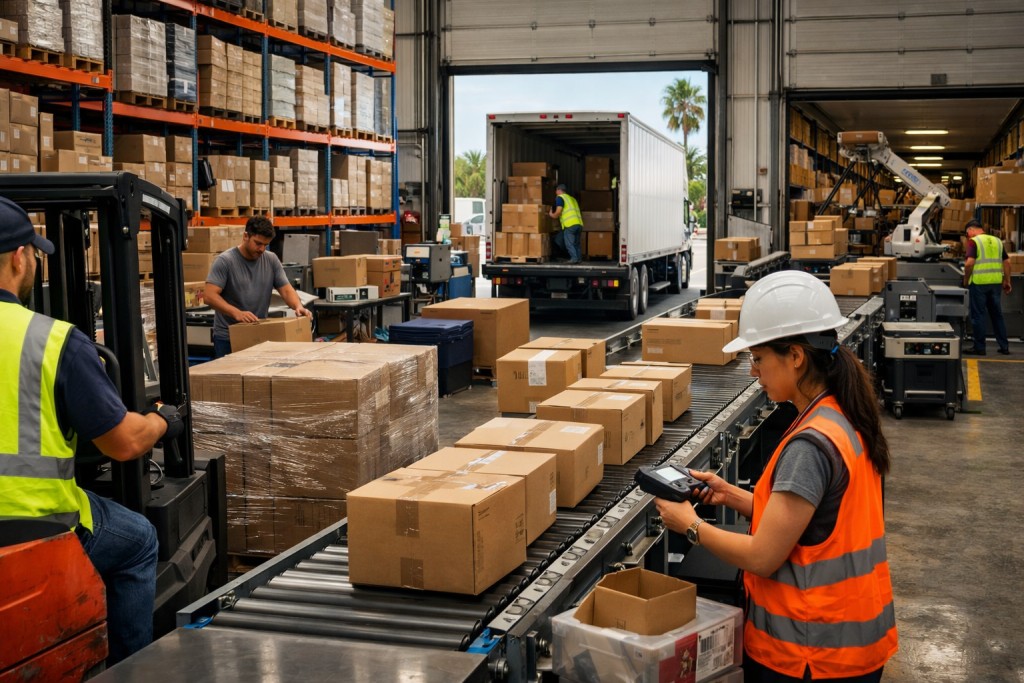
eCommerce fulfillment is not just shipping boxes—it’s executing customer expectations at scale. California 3PL services are particularly valuable when you need speed, flexibility, and accuracy across multiple sales channels.
Your fulfillment partner should support clean integrations and order routing rules. For brands selling on multiple channels, operational consistency matters: the same SLA, the same packaging standard, the same tracking visibility—no matter where the order originated.
Black Friday, product launches, influencer spikes—these moments expose operational weaknesses. Strong partners plan capacity, labor, and packaging supplies in advance and use forecasting to prevent bottlenecks.
If you want a modern perspective on speed-focused fulfillment strategies, this guide is relevant: The ultimate guide to fast fulfillment.
Speed and accuracy aren’t achieved by effort alone—they’re enabled by systems.
Automation doesn’t have to mean expensive robots. It can include barcode standards, optimized slotting, scanning compliance, and software-driven pick paths. If you’re evaluating modern warehouse capabilities, this trend-focused resource provides useful direction: The future of warehouse automation.
AI is increasingly used to forecast demand, detect inventory anomalies, and optimize carrier selection. For a forward-looking view of how AI is shaping logistics operations, reference: How AI is transforming the logistics industry in 2025.
Customer expectations have shifted: shoppers want visibility and accuracy, not vague delivery windows. Real-time tracking supports fewer support tickets, fewer disputes, and higher trust.
A serious fulfillment operation is built on compliance and risk control—not just speed.
Warehouse safety practices reduce downtime, protect workers, and prevent costly delays. A strong 3PL will have documented standards, training, and incident prevention workflows.
If you ship across borders, make sure your partner understands documentation and customs workflows. For U.S.-based cross-border considerations and compliance resources, it’s worth reviewing official guidance from U.S. Customs and Border Protection and shipping export resources from export.gov (U.S. government resources).
These types of external references matter when you’re building processes that must stand up to audits, carrier claims, and international shipping complexity.
Pricing varies, but the drivers are consistent. California fulfillment costs typically depend on:
Pallet vs. bin vs. shelf storage
Seasonal fluctuations and space allocation
Product dimensions and turnover rate
Single-SKU orders vs. multi-line orders
Kitting, inserts, special packaging
Handling requirements (fragile, oversized, hazmat where applicable)
Zone distribution and average parcel weight
DIM weight exposure (packaging efficiency matters)
Carrier mix and negotiated rates
Inspection time and restocking rules
Refurbishment or repackaging needs
Disposal and liquidation workflows
If you suspect warehousing costs are creeping up without clear explanation, it’s useful to understand the operational causes and hidden drains on margin: The hidden costs of poor warehousing management.
Selecting a 3PL is a strategic move. A strong decision framework should evaluate operations, tech, and partnership fit.
Ask how they prevent mis-picks, mislabels, and inventory discrepancies. Look for scanning compliance at receiving, picking, packing, and shipping.
Define:
Same-day shipping cutoff times
Peak season performance expectations
Damage/claim processes
Inventory reconciliation timelines
A modern partner should offer clean integrations, dashboards, and reporting that helps you run the business—not just ship orders.
Ask how they handle growth spikes, new SKUs, product launches, and channel expansion.
Avoid surprise fees through clarity on:
Minimums
Account management costs
Packaging charges
Storage overages
Onboarding and implementation timelines
A helpful operational overview of how fulfillment should run end-to-end can be reviewed here: Fulfillment process.
California fulfillment performs best when it’s part of a deliberate network strategy.
Most customers are in the West
Product catalog is stable
Delivery promises are 2–4 days nationwide (not 1–2)
National delivery expectations (2-day shipping across the U.S.)
High order volume with tight SLAs
Seasonal demand requiring distributed inventory
Cross-border growth (Canada–U.S. flows)
If you’re designing for resilience and performance, a modern 3PL should help you think beyond square footage and into supply chain strategy—planning routes, inventory placement, and service levels as one system.
California fulfillment is especially valuable for:
Fast shipping, branded packaging, and flexible promotions demand a warehouse that can execute cleanly every day.
Kitting, inserts, custom packaging, and batch cycles require disciplined pick/pack workflows and inventory controls.
Retail routing guides, pallet builds, labeling compliance, and appointment deliveries require mature warehouse operations.
More SKUs means more opportunities for errors. Strong slotting, scanning, and cycle counts become non-negotiable.
California fulfillment services include warehousing, inventory management, picking and packing, shipping coordination, and returns processing from a California-based facility—designed to speed up West Coast delivery and reduce shipping zones.
Yes, especially if you have meaningful order volume in the West. Many brands combine a California node with a central/eastern node to achieve fast nationwide coverage while controlling shipping costs.
They reduce distance-based shipping zones, optimize packaging to minimize DIM weight, and use rate shopping across carriers and service levels to hit delivery promises more efficiently.
A strong provider should support your storefront and order channels (e.g., Shopify/WooCommerce), provide real-time inventory visibility, and enable automated tracking updates and reporting.
Key items include SLAs, fee schedules, storage rules, onboarding timelines, accuracy metrics, claims processes, and clear definitions for peak season operations and surcharges.
If you’re ready to improve delivery times, tighten inventory accuracy, and scale without adding warehouse overhead, a proven 3PL partner can help build a California fulfillment strategy that performs under pressure. Start by requesting pricing and a fulfillment plan tailored to your order volume, SKUs, and delivery expectations: Request a Quote.


“Thanks to Byexpress all my shipping and fulfillment costs are in line now”

“All my issues were solved by Byexpress team that I had with pervious 3pl provider.”

“Thank you Byexpress team could not done it without you guys.”

“Their integration and customer service were the key for me”

“Outstanding delivery service! The package was well-packaged, and
the delivery team was professional and courteous”

“Great and knowledgeable team to work with.”

Thanks, guys, for reducing my shipping rates
Ottawa Office
2411 Holly Lane
Ottawa, ON, K1V 7P2
Toronto Office
13-280 West Beaver Creek Road Unit #136
Richmond Hill, ON, L4B 3Z1
Alexandria Office
173 Kenyon Street West
Alexandria, ON, K0C 1A0
Montreal Office
4388 Saint-Denis Street Unit #200
Montreal, QC, H2J 2L1
California Office
155 North Riverview Drive
Anaheim Hills, CA, 92808
Call Us
Toll-Free: 1-866-744-7122
Local : 613-739-3000
Email Us
Multilingual Services