Canada’s logistics and fulfillment landscape is evolving rapidly, driven by eCommerce expansion, cross-border trade, and consumer demand for faster delivery. Choosing the right fulfillment hub—whether Toronto, Vancouver, or Montreal—can significantly impact your shipping speed, operational costs, and overall scalability.
This guide provides a deep, strategic comparison of these three major fulfillment markets to help businesses identify the optimal location for growth, efficiency, and customer satisfaction.
Understanding Fulfillment Services in Canada
Fulfillment services encompass storage, inventory management, order processing, pick-and-pack, shipping, and returns. Businesses increasingly rely on third-party logistics (3PL) providers to streamline operations and reduce overhead.
For a deeper understanding of fulfillment fundamentals, explore this resource on
👉 what a fulfillment center is and how it works
Modern fulfillment centers integrate automation, AI, and real-time tracking to optimize performance. These innovations are reshaping the logistics industry, as detailed in
👉 how AI is transforming logistics
Toronto Fulfillment Services: Canada’s Logistics Powerhouse
Strategic Location and Market Access
Toronto is the largest logistics hub in Canada, offering unmatched access to:
-
Over 6 million residents in the Greater Toronto Area (GTA)
-
Proximity to major U.S. markets like New York, Chicago, and Detroit
-
Canada’s busiest transportation corridors
Businesses leveraging
👉 Toronto warehousing and distribution solutions
benefit from rapid last-mile delivery and cross-border efficiency.
Advantages of Toronto Fulfillment
1. Centralized Distribution
Toronto enables efficient nationwide shipping, especially to Eastern Canada and the U.S.
2. High Volume Infrastructure
-
Advanced warehouse automation
-
Extensive carrier networks
-
Strong freight and courier ecosystem
3. eCommerce Dominance
Toronto leads Canada in online retail activity, making it ideal for high-volume fulfillment.
For businesses focused on scaling, combining fulfillment with
👉 top fulfillment strategies to reduce costs
can significantly improve margins.
Challenges of Toronto Fulfillment
-
Higher warehouse rental costs
-
Increased competition for space
-
Traffic congestion affecting last-mile delivery
Despite these challenges, Toronto remains the most powerful fulfillment hub for businesses prioritizing scale and market reach.
Vancouver Fulfillment Services: Gateway to the Pacific
Strategic Coastal Advantage
Vancouver serves as Canada’s primary gateway to Asia-Pacific trade. Its port is one of the busiest in North America, making it ideal for import-heavy businesses.
Companies utilizing
👉 Vancouver logistics and fulfillment solutions
benefit from reduced international shipping times and lower import costs.
Advantages of Vancouver Fulfillment
1. Faster Imports from Asia
Shorter transit times for goods coming from China, Japan, and Southeast Asia.
2. Strong Tech Ecosystem
Vancouver’s tech-driven logistics sector supports automation, AI, and real-time inventory systems.
3. Ideal for West Coast Distribution
Efficient delivery across British Columbia and the U.S. West Coast.
Businesses can enhance efficiency further by implementing
👉 smart warehousing solutions
to improve delivery speed.
Challenges of Vancouver Fulfillment
-
High real estate costs
-
Limited warehouse availability
-
Geographic distance from Eastern Canada
Vancouver is best suited for businesses focused on international imports and West Coast markets.
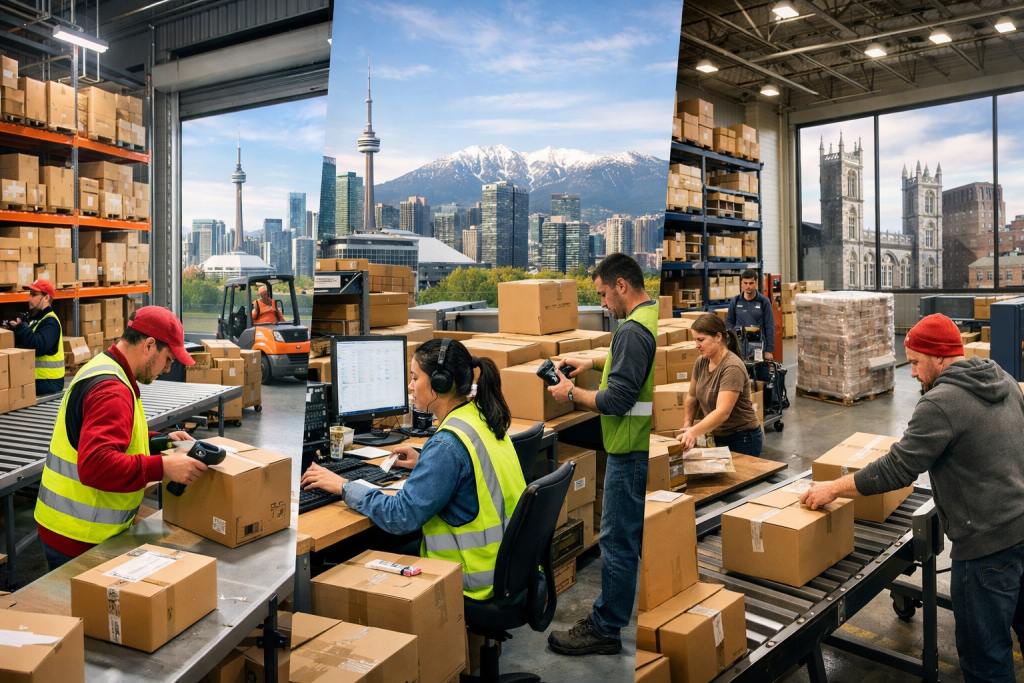
Montreal Fulfillment Services: Cost-Effective Eastern Hub
Strategic Bilingual Market Access
Montreal offers a unique advantage with access to both English and French-speaking markets, making it ideal for businesses targeting Quebec and Eastern Canada.
Businesses can explore
👉 Montreal logistics and fulfillment services
for cost-effective operations.
Advantages of Montreal Fulfillment
1. Lower Operating Costs
Warehouse space and labor costs are significantly lower than Toronto and Vancouver.
2. Strong Transportation Network
-
Major rail connections
-
Efficient port access
-
Growing air cargo capacity
3. Government Support
Businesses can benefit from economic incentives and tax advantages. Learn more at canada.ca.
Challenges of Montreal Fulfillment
-
Slightly slower delivery to Western Canada
-
Smaller eCommerce market compared to Toronto
-
Language considerations for operations
Montreal is ideal for businesses seeking cost efficiency without sacrificing service quality.
Toronto vs Vancouver vs Montreal: Direct Comparison
1. Shipping Speed
-
Toronto: Fastest nationwide delivery
-
Vancouver: Best for international imports
-
Montreal: Efficient for Eastern Canada
2. Cost Efficiency
-
Toronto: Highest costs
-
Vancouver: High costs with import savings
-
Montreal: Most affordable option
3. Market Reach
-
Toronto: Best overall coverage
-
Vancouver: West Coast + Asia
-
Montreal: Eastern Canada + Quebec
4. Infrastructure
-
Toronto: Most advanced
-
Vancouver: Tech-driven
-
Montreal: Balanced and growing
Key Factors to Consider When Choosing a Fulfillment Location
1. Customer Location
Understanding your customer base is critical. Businesses shipping primarily to Ontario and the U.S. should prioritize Toronto, while those targeting Western Canada or Asia should consider Vancouver.
2. Cost Structure
Outsourcing fulfillment can reduce overhead significantly. Learn more about
👉 why outsourcing warehousing is cost-effective
3. Scalability
Choose a fulfillment partner that can grow with your business. Insights from
👉 how to choose the right fulfillment partner
highlight the importance of scalability and flexibility.
4. Technology Integration
Modern fulfillment relies on:
-
Real-time tracking
-
AI-driven forecasting
-
Inventory automation
Explore how the role of technology in modern supply chains.
The Rise of Multi-Node Fulfillment in Canada
Leading businesses are no longer relying on a single warehouse. Instead, they are adopting multi-node fulfillment strategies:
-
Toronto for central distribution
-
Vancouver for imports
-
Montreal for cost efficiency
This hybrid model reduces shipping times and costs while improving customer satisfaction.
Future Trends in Canadian Fulfillment
1. Automation and Robotics
Warehouses are becoming smarter with robotics and AI.
2. Same-Day Delivery Expansion
Demand for faster shipping is driving investments in urban fulfillment centers.
3. Sustainable Logistics
Green logistics practices are becoming a competitive advantage.
4. Data-Driven Decision Making
Analytics are optimizing inventory, routing, and demand forecasting.
Which City is Best for Your Business?
Choose Toronto if:
-
You need nationwide coverage
-
Your business is scaling rapidly
-
You prioritize speed and infrastructure
Choose Vancouver if:
-
You import goods from Asia
-
You focus on West Coast markets
-
You want faster international shipping
Choose Montreal if:
-
You want lower costs
-
You target Eastern Canada
-
You need bilingual logistics support
Why a Strategic Fulfillment Partner Matters
Selecting the right fulfillment provider can transform your operations. From reducing shipping costs to improving delivery times, a strong logistics partner enables long-term growth.
To see how fulfillment impacts business performance, review
👉 how efficient fulfillment improves customer satisfaction
Get Started with the Right Fulfillment Strategy
Businesses that optimize their fulfillment strategy outperform competitors in speed, cost, and customer experience.
To take the next step, request a tailored logistics solution here:
👉 Get a fulfillment quote
FAQs
1. Which city is cheapest for fulfillment in Canada?
Montreal is generally the most cost-effective due to lower warehouse and labor costs.
2. Is Toronto the best city for eCommerce fulfillment?
Yes, Toronto offers the best infrastructure, market access, and delivery speed.
3. Why choose Vancouver for fulfillment?
Vancouver is ideal for businesses importing goods from Asia due to faster shipping times.
4. Can I use multiple fulfillment centers in Canada?
Yes, multi-node fulfillment is becoming the standard for improving delivery speed and reducing costs.
5. What is a 3PL provider?
A 3PL (third-party logistics provider) handles warehousing, inventory, and shipping for businesses.
6. How do I choose the right fulfillment partner?
Focus on scalability, technology, location, and pricing to ensure long-term success.