By Martin Vassilev / 18 Dec, 2025
Cold chain logistics has become one of the most decisive competitive advantages in Canada’s food and beverage e-commerce landscape. As consumer expectations shift toward faster delivery, fresher products, and full transparency, brands selling perishable goods can no longer rely on traditional fulfillment models. Temperature-sensitive logistics is now a foundational requirement—not a premium add-on.
Canada’s geography, climate variability, and strict food safety regulations make cold chain execution uniquely complex. From frozen meal kits shipped across provinces to fresh beverages delivered same-day in urban centers, every step of the supply chain must preserve product integrity while maintaining speed and cost efficiency. Businesses that master cold chain logistics not only reduce spoilage and compliance risk—they build trust, loyalty, and long-term brand equity.
This guide explores how cold chain logistics supports food and beverage e-commerce in Canada, the operational challenges involved, the regulatory framework, and how modern fulfillment partners are redefining temperature-controlled delivery at scale.
Cold chain logistics refers to the end-to-end management of temperature-controlled environments across storage, handling, transportation, and last-mile delivery. In food and beverage e-commerce, this includes frozen, chilled, and controlled ambient products that must remain within strict temperature ranges from fulfillment center to consumer doorstep.
For Canadian online brands, cold chain logistics typically covers:
Frozen foods (-18°C and below)
Refrigerated goods (0°C to 4°C)
Temperature-sensitive beverages
Dairy, meat, seafood, and ready-to-eat meals
Functional foods and nutraceutical beverages
Any break in this chain—whether during warehousing, cross-docking, or final delivery—can compromise safety, quality, and regulatory compliance.
Canada presents one of the most demanding cold chain environments in the world. Long distances between major population centers, extreme seasonal temperature swings, and cross-border shipping requirements add layers of complexity.
Sub-zero winters and heatwaves in summer mean temperature control must be actively managed year-round. Passive insulation alone is not enough for national distribution.
Shipping from Ontario to Western Canada or Atlantic provinces requires multi-day transit planning with refrigerated trucking and strategically located fulfillment nodes.
Same-day or next-day cold delivery is feasible in cities like Toronto, Vancouver, Calgary, and Ottawa, while rural regions require optimized routing and hybrid cold solutions.
Strategic logistics planning—supported by technology and regional warehousing—becomes essential for scalability.
Food and beverage e-commerce brands must comply with strict national standards governing food safety, handling, and transportation.
Key regulatory considerations include:
Safe Food for Canadians Regulations (SFCR) enforced by the Canadian Food Inspection Agency (CFIA)
Hazard Analysis Critical Control Point (HACCP) protocols
Temperature monitoring and record retention
Traceability across the supply chain
Guidelines from the Canadian Food Inspection Agency (CFIA) and Health Canada define acceptable temperature ranges, sanitation practices, and recall procedures. Non-compliance can result in fines, product seizures, or permanent brand damage.
Cold chain logistics providers must therefore integrate compliance into daily operations—not treat it as an afterthought.
Cold chain success starts inside the warehouse. Temperature-controlled warehousing enables e-commerce brands to store perishable inventory safely while supporting fast order fulfillment.
Modern cold warehouses offer:
Multi-zone temperature environments
Real-time temperature monitoring
Automated inventory rotation (FIFO/FEFO)
Integrated quality control checkpoints
Businesses exploring scalable solutions often pair cold storage with advanced inventory systems. This aligns closely with the principles outlined in temperature-controlled warehousing for modern businesses, where automation and data visibility reduce waste and increase accuracy.
Transportation is the most fragile link in the cold chain. Even brief exposure outside approved temperature ranges during transit can result in product loss.
Reefer trucks, insulated vans, and temperature-controlled containers maintain product integrity across long-haul and last-mile routes.
IoT-enabled sensors and GPS tracking provide continuous temperature visibility, enabling rapid intervention if deviations occur. This mirrors broader trends in smart logistics technology, where transparency improves customer trust and operational control.
Cold cross-docking minimizes dwell time by transferring goods directly from inbound to outbound transport—reducing storage costs and exposure risks.
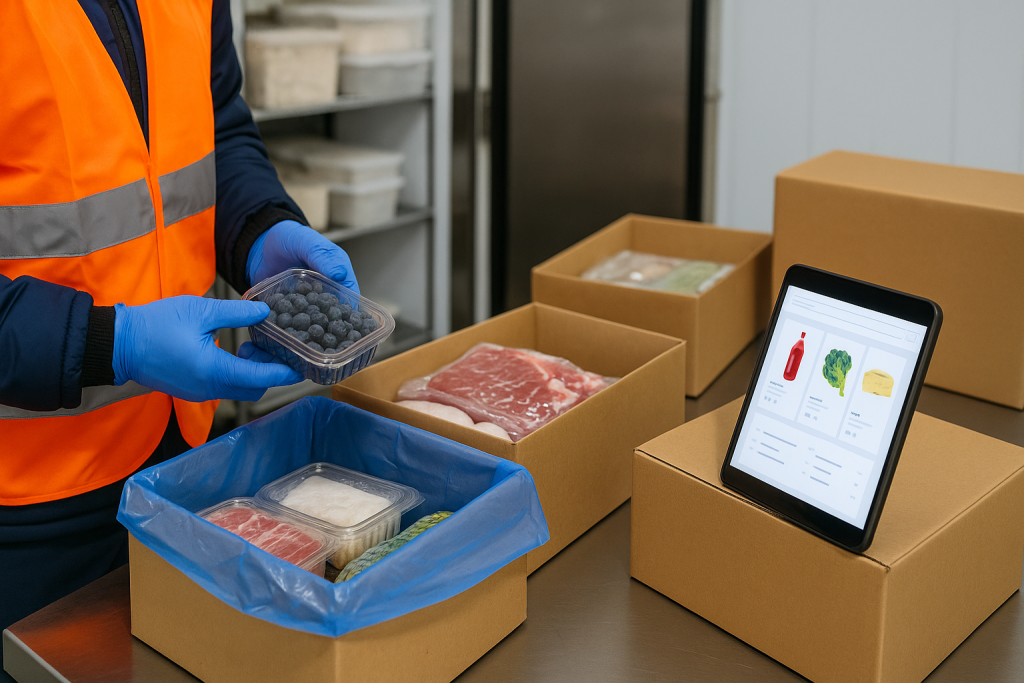
The last mile is where customer experience is won or lost. Cold chain e-commerce requires delivery models that balance speed, accuracy, and temperature control.
Successful last-mile cold strategies include:
Same-day and next-day refrigerated delivery in metro areas
Time-slot delivery to reduce door-step exposure
Insulated packaging with gel packs or dry ice
Carrier training for food safety handling
Optimized delivery networks—like those used in logistics operations across Ottawa—demonstrate how regional expertise improves speed and reliability for temperature-sensitive shipments.
Packaging plays a critical role in cold chain resilience. The right materials can absorb delays, weather exposure, and transit variability.
Effective cold packaging solutions include:
Insulated liners and phase-change materials
Tamper-evident seals
Eco-friendly thermal packaging
Custom configurations based on transit duration
Sustainable packaging is increasingly important as consumers demand environmentally responsible fulfillment without sacrificing food safety.
Advanced technology has transformed cold chain logistics from a reactive process into a predictive, data-driven system.
AI-powered forecasting improves demand planning, reduces overstocking, and aligns cold storage capacity with sales velocity. This evolution parallels insights from how AI is transforming the logistics industry.
Automated picking and temperature-zoned robotics reduce human error and speed up cold fulfillment, aligning with innovations discussed in the future of warehouse automation.
Centralized dashboards connect inventory, orders, temperature data, and delivery status—enabling real-time decision-making.
Building an in-house cold chain is capital-intensive and operationally complex. Many Canadian e-commerce brands partner with specialized 3PL providers to gain scalability and compliance without heavy infrastructure investment.
Outsourcing benefits include:
Access to certified cold facilities
Nationwide refrigerated transport networks
Regulatory expertise
Elastic capacity during seasonal demand spikes
This approach aligns with best practices outlined in choosing the right fulfillment partner for growing e-commerce brands.
As food and beverage brands grow nationally, distributed warehousing becomes essential. Strategic fulfillment hubs reduce transit time, shipping costs, and temperature exposure.
A multi-node strategy allows brands to:
Position inventory closer to customers
Support same-day or next-day delivery
Reduce long-haul refrigerated transport
Maintain consistent quality across regions
Data-driven network optimization ensures scalability without sacrificing freshness.
Cold chain disruptions—equipment failure, weather delays, carrier shortages—can quickly escalate into costly losses.
Risk mitigation strategies include:
Redundant cold storage locations
Backup power and refrigeration systems
Carrier diversification
Proactive exception management through real-time alerts
Resilient cold chains protect revenue and brand reputation in unpredictable conditions.
Cold logistics is energy-intensive, but sustainability innovations are reshaping the sector.
Eco-conscious practices include:
Energy-efficient refrigeration systems
Route optimization to reduce fuel usage
Recyclable thermal packaging
Carbon offset programs
Green cold chain strategies increasingly influence purchasing decisions and regulatory incentives.
For Canadian food and beverage e-commerce brands, cold chain logistics is not just about compliance—it’s about differentiation. Reliable temperature control enables broader product assortments, faster delivery promises, and stronger customer trust.
Brands that invest in modern cold chain infrastructure consistently outperform competitors struggling with spoilage, delays, and inconsistent quality.
Frozen foods, refrigerated meals, dairy, meat, seafood, beverages, and any temperature-sensitive consumables require cold chain management.
Continuous temperature control and real-time monitoring prevent spoilage caused by exposure or delays, significantly reducing shrinkage.
Outsourcing to specialized providers allows small and mid-sized brands to access cold infrastructure without large upfront costs.
Through sensor-based monitoring, digital logs, and automated alerts that document temperature conditions throughout transit.
Yes, with strategically located warehouses and refrigerated last-mile networks, same-day cold delivery is achievable in major Canadian cities.
Cold chain logistics is the foundation of successful food and beverage e-commerce in Canada. It protects product quality, ensures regulatory compliance, and delivers the customer experience modern consumers expect.
Brands that partner with experienced, technology-driven logistics providers gain the ability to scale nationally while maintaining freshness, safety, and speed. In a competitive digital marketplace, cold chain excellence is not optional—it is the standard.
For businesses seeking reliable, scalable temperature-controlled fulfillment solutions, explore tailored logistics strategies or request a quote to design a cold chain that supports growth without compromise.


“Thanks to Byexpress all my shipping and fulfillment costs are in line now”

“All my issues were solved by Byexpress team that I had with pervious 3pl provider.”

“Thank you Byexpress team could not done it without you guys.”

“Their integration and customer service were the key for me”

“Outstanding delivery service! The package was well-packaged, and
the delivery team was professional and courteous”

“Great and knowledgeable team to work with.”

Thanks, guys, for reducing my shipping rates
Ottawa Office
2411 Holly Lane
Ottawa, ON, K1V 7P2
Toronto Office
13-280 West Beaver Creek Road Unit #136
Richmond Hill, ON, L4B 3Z1
Alexandria Office
173 Kenyon Street West
Alexandria, ON, K0C 1A0
Montreal Office
4388 Saint-Denis Street Unit #200
Montreal, QC, H2J 2L1
California Office
155 North Riverview Drive
Anaheim Hills, CA, 92808
Call Us
Toll-Free: 1-866-744-7122
Local : 613-739-3000
Email Us
Multilingual Services