By Martin Vassilev / 27 Jan, 2026
Illinois is where American logistics becomes efficient, scalable, and fast. From Chicago’s intermodal dominance to the state’s highway and air cargo connectivity, Illinois fulfillment services power two-day reach to most U.S. customers and create a true Midwest distribution hub advantage for eCommerce, retail, and B2B brands. When inventory sits in the middle of the country, shipping zones shrink, delivery promises become easier to keep, and operations become simpler to manage—even as order volume grows.
Illinois is also one of the most practical places to build a multi-node strategy: a central distribution point that complements coastal warehouses while keeping nationwide delivery times competitive. The result is a fulfillment footprint that is cost-conscious, customer-friendly, and built to scale.
Illinois is positioned to serve the entire continental U.S. quickly. With inventory located centrally, brands reduce the distance to customers in multiple regions, which lowers shipping zones and helps stabilize last-mile costs. That translates into more orders delivered on time, fewer expensive upgrades to air shipping, and less pressure on customer support teams during peak demand.
For businesses comparing hub-and-spoke distribution and multi-node warehousing, Illinois often becomes the operational “anchor” that balances speed and cost.
Illinois has a rare combination of transportation options, and that flexibility is critical when carriers tighten capacity or weather disrupts certain lanes. A fulfillment operation that can pivot from one transport mode to another can protect service-level targets and avoid costly delays.
If you’re building a logistics network that relies on resilient routing and hub redundancy, studying how multi-hub logistics strategies work is essential. A useful reference point is this overview of hub-to-hub logistics strategy: Calgary–Dallas Logistics Hubs.
At the heart of fulfillment is the pick-and-pack operation: receiving orders, picking SKUs efficiently, verifying accuracy, and packing for carrier handoff. A strong Illinois fulfillment provider designs pick paths, bin locations, and packing workflows to minimize touches and maximize throughput during both normal and peak volumes.
For a deeper look at how modern pick-and-pack programs support speed without sacrificing accuracy, see Pick and Pack.
Inventory accuracy is not a “nice to have.” It’s the mechanism that protects margins, prevents oversells, and supports the customer experience. Illinois fulfillment centers that operate at a high level typically provide real-time inventory updates, cycle counting, SKU-level reporting, and structured receiving processes to ensure inbound inventory becomes sellable quickly.
Inventory strategy is also tied to warehouse layout and slotting decisions. When space is used poorly, travel time rises, labor costs climb, and fulfillment speed drops. Practical guidance on improving utilization is covered in How to Improve Warehouse Space Utilization for Maximum Efficiency.
Returns are part of modern commerce. The best Illinois fulfillment programs build returns workflows that include fast receiving, condition-based sorting, restocking rules, and clear customer updates. This reduces the time inventory stays “stuck” in reverse logistics and helps brands recover value from resellable goods.
A dedicated returns workflow is typically handled through a structured service like Returns Management.
Illinois warehouses can’t operate like legacy storage facilities. High-performing fulfillment centers integrate directly with eCommerce platforms and order management systems so that orders flow automatically, tracking updates are immediate, and inventory counts sync reliably. This cuts manual work, reduces mistakes, and gives operators visibility into order health.
To understand how eCommerce fulfillment systems support scalable growth, explore eCommerce Fulfillment.
Customers expect transparency. Tracking is no longer a “bonus”; it’s the default experience. Illinois fulfillment providers that support real-time tracking reduce “where is my order?” tickets and increase buyer confidence during peak season.
For a practical breakdown of why tracking changes customer behavior and retention, see Real-Time Tracking in Delivery Services.
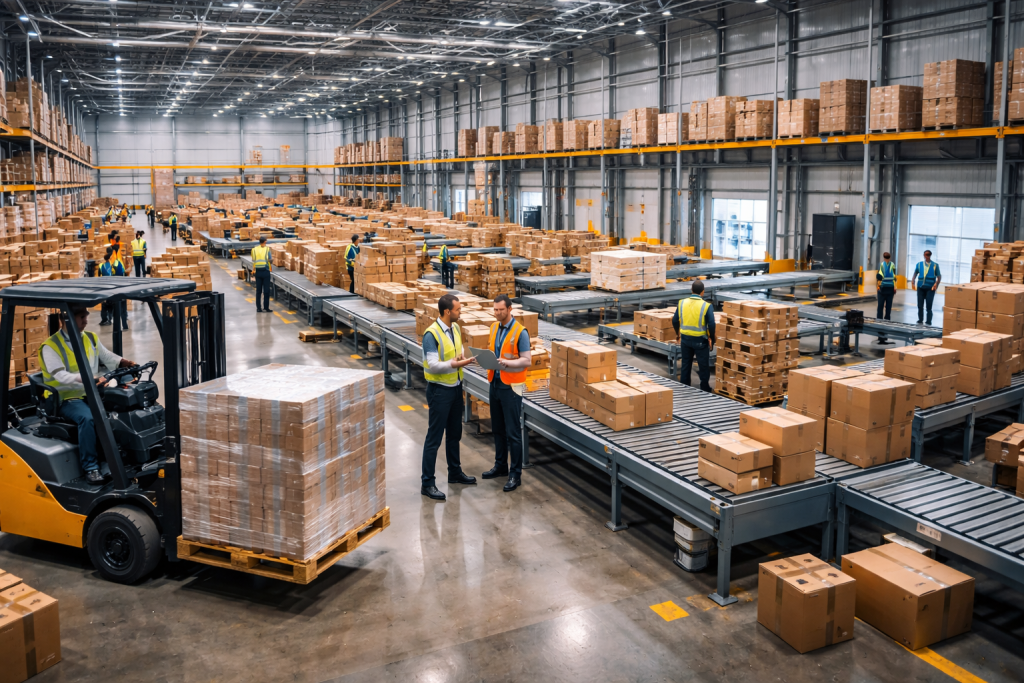
Modern fulfillment is increasingly driven by intelligent decision-making. AI tools can support better demand forecasting, smarter replenishment, optimized slotting, and improved labor planning during promotions or seasonal spikes. Illinois fulfillment centers that invest in technology reduce operational variance and protect SLA performance.
A useful overview of this transformation is How AI Is Transforming the Logistics Industry in 2025.
Automation can mean many things—from scanning workflows and smart conveyors to robotics and automated sortation. The key is implementing automation that matches your SKU profile, order mix, and throughput requirements.
For a grounded look at what warehouse automation really changes operationally, review The Future of Warehouse Automation: What Businesses Need to Know.
Illinois’ central location makes it practical for brands shipping domestically and supporting cross-border distribution. While Illinois itself is not a border state, it acts as a consolidation and distribution engine for freight moving toward major crossings, allowing for planned linehauls, reliable transit times, and simplified inventory placement.
For official guidance on cross-border shipping requirements and customs processes, consult U.S. Customs and Border Protection (CBP).
Fulfillment operations that handle regulated goods, high-value inventory, or sensitive SKUs need security standards and documented procedures. Many Illinois warehouses support secure access controls, audit trails, and standardized receiving/shipping documentation that helps reduce claims and improve accountability.
For broader data on U.S. business activity patterns (including warehousing and distribution trends), the U.S. Census Bureau provides authoritative resources useful for market context.
Warehouse efficiency is not vague—it’s measurable. When space is poorly used, travel time increases. When slotting is wrong, pickers backtrack. When packing stations are under-designed, labor gets wasted. Illinois fulfillment centers that optimize processes can cut pick labor cost per order and stabilize performance as volume grows.
For practical cost-reduction strategies that do not compromise speed or service, see How to Maximize Warehouse Efficiency and Cut Costs.
A Midwest distribution hub should reduce shipping zones, but carrier strategy still matters. Rate shopping, service mapping, and carrier diversification can improve delivery speed and reduce spend. Fulfillment providers with built-in rate tools help brands stay competitive without constantly renegotiating from scratch.
If you’re evaluating how carrier strategy impacts total fulfillment cost, a helpful operational angle is 5 Ways to Lower Shipping Costs Without Compromising Speed.
The right provider should align with your:
SKU complexity (size range, kitting, bundles)
Order volume patterns (steady vs. seasonal spikes)
Channel requirements (DTC + wholesale + retail replenishment)
Packaging needs (branded unboxing, inserts, sustainability)
If you want a structured framework for evaluating providers, this selection guide is built for decision-making: Guide to Choosing the Right Fulfillment Partner for Your Business.
Many fulfillment relationships fail during onboarding: inventory receiving issues, inaccurate SKU mapping, slow integrations, and unclear SLAs. A strong provider has a documented implementation process with milestones, test orders, and accountability.
When assessing operational maturity, it’s worth reviewing what a professional onboarding workflow looks like: Implementation Process.
Illinois fulfillment should not only ship orders—it should improve distribution outcomes. That includes inventory placement strategies, replenishment planning, and multi-channel coordination.
For businesses seeking broader distribution optimization, explore Distribution Management.
Retail requires strict compliance: labeling, carton requirements, delivery windows, and routing compliance. Illinois-based warehouses often support retail-ready fulfillment, ensuring shipments meet requirements and reduce chargebacks.
A reference point for retail-ready services is Retail Fulfillment.
B2B distribution often involves scheduled shipments, pallet builds, case picking, and freight coordination. A Midwest hub supports predictable replenishment cycles and efficient linehaul planning.
For businesses expanding into end-to-end logistics services beyond pure fulfillment, explore Transportation Services.
Illinois is a strategic distribution advantage because it improves the fundamentals that matter most:
Faster delivery times across multiple regions
Lower shipping cost through reduced zones
Scalable warehousing for growth and peak season
Better inventory visibility and order accuracy
Stronger customer experience through reliable tracking and service
A Midwest distribution hub is only as good as the operations behind it. The best Illinois fulfillment programs combine process discipline, technology integration, inventory control, and transportation strategy to produce predictable outcomes—day after day.
When you’re ready to build a Midwest fulfillment footprint that supports faster delivery, smarter inventory placement, and scalable cost control, start with a direct operations conversation and a quote request.
Illinois fulfillment services are ideal for eCommerce brands, retailers, and B2B distributors that need fast nationwide shipping, lower zones, and scalable warehouse capacity from a central location.
A Midwest distribution hub reduces average shipping distance, which often lowers zone-based carrier costs and decreases the need for expedited shipping upgrades.
Yes. Many Illinois fulfillment providers integrate directly with Shopify and WooCommerce, enabling automated order flow, real-time inventory syncing, and instant tracking updates. See eCommerce Fulfillment.
Yes. Illinois warehouses often offer scalable labor, flexible storage, and process designs that support high-volume fulfillment during Q4, promotions, and seasonal spikes.
Confirm integration capability, onboarding process, inventory accuracy controls, SLA commitments, returns workflows, and carrier strategy. A structured evaluation approach is in Guide to Choosing the Right Fulfillment Partner for Your Business.


“Thanks to Byexpress all my shipping and fulfillment costs are in line now”

“All my issues were solved by Byexpress team that I had with pervious 3pl provider.”

“Thank you Byexpress team could not done it without you guys.”

“Their integration and customer service were the key for me”

“Outstanding delivery service! The package was well-packaged, and
the delivery team was professional and courteous”

“Great and knowledgeable team to work with.”

Thanks, guys, for reducing my shipping rates
Ottawa Office
2411 Holly Lane
Ottawa, ON, K1V 7P2
Toronto Office
13-280 West Beaver Creek Road Unit #136
Richmond Hill, ON, L4B 3Z1
Alexandria Office
173 Kenyon Street West
Alexandria, ON, K0C 1A0
Montreal Office
4388 Saint-Denis Street Unit #200
Montreal, QC, H2J 2L1
California Office
155 North Riverview Drive
Anaheim Hills, CA, 92808
Call Us
Toll-Free: 1-866-744-7122
Local : 613-739-3000
Email Us
Multilingual Services