By Martin Vassilev / 25 Dec, 2025
E-commerce growth today is no longer limited by marketing or product demand—it is constrained by fulfillment performance. Customers expect fast shipping, real-time order updates, flawless accuracy, and easy returns. Meeting these expectations consistently is impossible without tightly integrating your e-commerce platform with advanced fulfillment software.
Modern fulfillment systems connect storefronts, inventory, warehouses, carriers, and customer service into a single automated workflow. Instead of relying on manual processes, spreadsheets, or disconnected tools, businesses gain real-time visibility and control over every order from checkout to delivery. This integration is no longer a competitive advantage—it is the foundation of scalable e-commerce operations.
Advanced fulfillment software goes far beyond basic order processing. It combines warehouse management systems (WMS), order management systems (OMS), transportation management systems (TMS), and real-time analytics into one unified platform.
When integrated with an e-commerce platform, fulfillment software automatically:
Syncs inventory across multiple sales channels
Routes orders to the optimal warehouse location
Generates pick, pack, and ship workflows
Selects the best carrier and shipping method
Updates customers with real-time tracking
Manages returns and reverse logistics
This level of automation eliminates friction, reduces errors, and allows businesses to scale without increasing operational complexity.
Most modern e-commerce platforms use APIs to connect with fulfillment software. These APIs allow data to move instantly between systems without manual intervention. Orders placed on your storefront are automatically transmitted to the fulfillment system, while inventory updates and tracking details flow back in real time.
Advanced providers also offer custom integrations for complex workflows, allowing brands to connect proprietary systems or third-party tools through solutions such as custom API integrations.
Integration is not a one-way process. True fulfillment integration ensures that:
Inventory levels update instantly after every sale
Stock adjustments reflect returns and restocks
Shipping status updates are pushed to customers
Order exceptions trigger alerts automatically
This real-time synchronization eliminates overselling, delays, and customer frustration.
Integrated systems remove manual handoffs between departments. Orders flow directly from checkout to the warehouse floor, enabling same-day or next-day fulfillment. This is especially powerful when combined with strategies outlined in The Ultimate Guide to Fast Fulfillment, where automation directly correlates with reduced delivery times.
Manual picking and data entry are the leading causes of fulfillment errors. Advanced fulfillment software uses barcode scanning, automated workflows, and system validations to ensure the right product reaches the right customer every time. Accuracy rates above 99.9% become achievable at scale.
Automation reduces labor requirements, minimizes re-shipping expenses, and optimizes warehouse space usage. Businesses that integrate fulfillment software consistently outperform those relying on fragmented systems, as highlighted in How to Maximize Warehouse Efficiency and Cut Costs.
Integrated fulfillment software provides a single source of truth for inventory across all channels. Whether selling through Shopify, WooCommerce, marketplaces, or wholesale portals, stock levels remain accurate and synchronized.
This real-time control is essential for preventing stockouts and excess inventory, a challenge explored in How to Leverage Data Analytics for Streamlined Inventory Management.
Advanced systems use historical data and predictive analytics to forecast demand. This allows businesses to replenish inventory proactively, optimize reorder points, and align warehousing strategies with seasonal demand fluctuations.
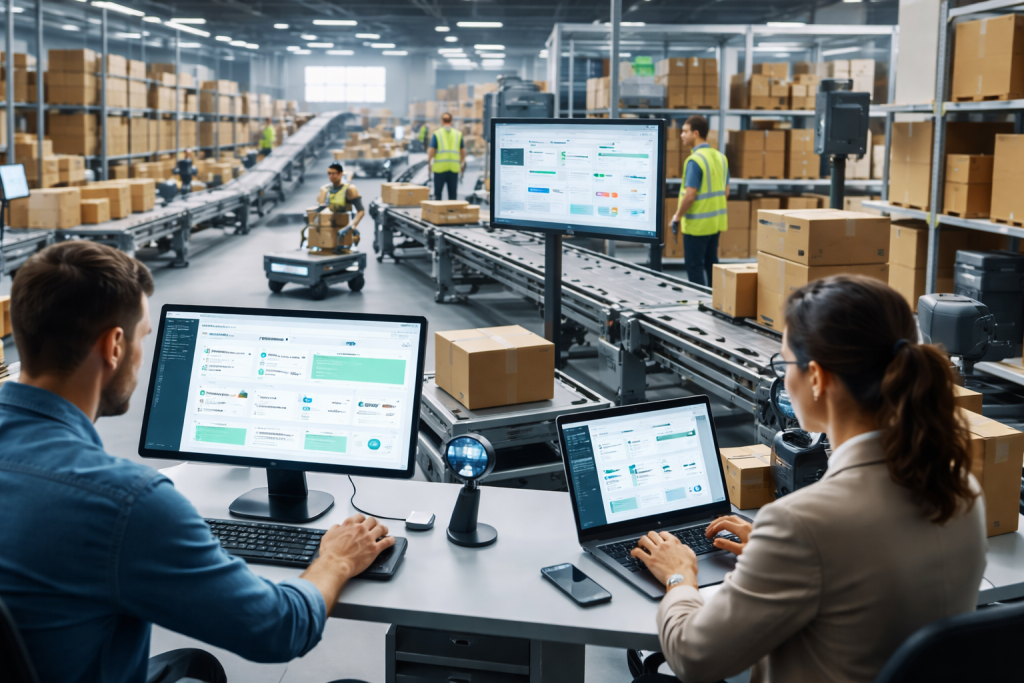
Once integrated, fulfillment software generates optimized picking routes, assigns tasks to warehouse staff, and validates each step through scanning technology. Packing rules ensure correct packaging and branding, while shipping labels are generated automatically.
This operational efficiency aligns directly with principles outlined in The Future of Warehouse Automation: What Businesses Need to Know.
For businesses operating across regions, integrated fulfillment software intelligently routes orders to the closest warehouse, reducing shipping costs and delivery times. This is especially effective when leveraging distributed logistics hubs such as those discussed in Calgary–Dallas Logistics Hubs.
Advanced fulfillment platforms integrate directly with multiple carriers, automatically comparing rates, transit times, and service levels. This ensures each order ships using the most cost-effective option without compromising delivery speed.
Once shipped, tracking information is instantly pushed back to the e-commerce platform, providing customers with live updates. Transparency builds trust and reduces customer service inquiries, a major factor in retention-focused fulfillment strategies.
Returns are a critical but often overlooked part of fulfillment. Integrated software streamlines returns by:
Generating return labels automatically
Tracking returned inventory in real time
Triggering refunds or exchanges instantly
Reintegrating sellable items into inventory
This closed-loop process protects margins while improving customer satisfaction.
Integrated fulfillment systems are designed with enterprise-grade security. Role-based access controls, encrypted data transfers, and compliance with international shipping regulations ensure sensitive customer and order data remains protected.
For cross-border operations, alignment with regulatory frameworks from authoritative bodies such as Government of Canada Trade Controls ensures smooth customs processing and reduced delays.
Black Friday, holiday seasons, and flash sales create massive order spikes. Integrated fulfillment software scales automatically, allowing warehouses to process increased volumes without performance degradation.
This scalability is a core reason brands adopt third-party fulfillment solutions, as detailed in The Benefits of Outsourcing Warehousing for E-Commerce Brands.
As brands expand into new marketplaces, regions, or sales models, integrated fulfillment systems adapt instantly. New channels can be added without rebuilding infrastructure, preserving operational consistency across the business.
Not all fulfillment providers offer the same integration capabilities. The right partner provides:
Native integrations with major e-commerce platforms
Custom API support for complex workflows
Real-time inventory and order visibility
Scalable infrastructure across regions
Dedicated onboarding and implementation support
A structured selection process, such as the one outlined in Guide to Choosing the Right Fulfillment Partner for Your Business, ensures long-term success.
Before integration, document every step of your current order lifecycle. This ensures the new system enhances existing processes rather than introducing friction.
Sandbox testing allows businesses to validate data synchronization, order routing, and exception handling without disrupting live operations.
Even the most advanced software requires human alignment. Training ensures teams understand dashboards, alerts, and escalation procedures.
Fulfillment integration is not a one-time upgrade—it is an evolving capability. As technologies such as AI-driven forecasting, robotics, and real-time analytics mature, integrated platforms adapt seamlessly.
Trends shaping the next phase of fulfillment are explored in How AI Is Transforming the Logistics Industry in 2025, where intelligent automation becomes a strategic differentiator rather than a cost center.
Integrating your e-commerce platform with advanced fulfillment software transforms operations from reactive to predictive, from manual to automated, and from constrained to scalable. It reduces costs, improves accuracy, accelerates delivery, and enhances customer satisfaction across every touchpoint.
For brands serious about growth, this integration is not a technical upgrade—it is a strategic investment in operational excellence.
To implement a fully integrated, scalable fulfillment solution tailored to your e-commerce business, connect with a logistics partner that specializes in advanced technology-driven fulfillment.
👉 Contact BYExpress for a Custom Fulfillment Integration
Most modern platforms such as Shopify, WooCommerce, and custom storefronts support API-based integration with advanced fulfillment systems.
Depending on complexity, integrations typically range from a few days for standard setups to several weeks for custom workflows.
Yes. Automated rate shopping, optimized routing, and reduced errors significantly lower total fulfillment and shipping expenses.
Integrated systems manage customs documentation, carrier selection, and compliance for cross-border shipping efficiently.
Absolutely. Scalable fulfillment software allows small brands to operate with enterprise-level efficiency from day one.


“Thanks to Byexpress all my shipping and fulfillment costs are in line now”

“All my issues were solved by Byexpress team that I had with pervious 3pl provider.”

“Thank you Byexpress team could not done it without you guys.”

“Their integration and customer service were the key for me”

“Outstanding delivery service! The package was well-packaged, and
the delivery team was professional and courteous”

“Great and knowledgeable team to work with.”

Thanks, guys, for reducing my shipping rates
Ottawa Office
2411 Holly Lane
Ottawa, ON, K1V 7P2
Toronto Office
13-280 West Beaver Creek Road Unit #136
Richmond Hill, ON, L4B 3Z1
Alexandria Office
173 Kenyon Street West
Alexandria, ON, K0C 1A0
Montreal Office
4388 Saint-Denis Street Unit #200
Montreal, QC, H2J 2L1
California Office
155 North Riverview Drive
Anaheim Hills, CA, 92808
Call Us
Toll-Free: 1-866-744-7122
Local : 613-739-3000
Email Us
Multilingual Services