By Martin Vassilev / 5 Jan, 2026
New York City is one of the most complex and opportunity-rich fulfillment markets in North America. Brands operating in NYC face a unique mix of challenges: limited warehouse space, premium real estate costs, dense last-mile delivery routes, and customers who expect fast, accurate, and transparent order fulfillment. In this environment, fulfillment is no longer a background operation—it is a core business strategy.
This guide delivers a comprehensive, operationally focused overview of fulfillment services in New York City, covering how modern fulfillment works, which services matter most, how costs are structured, and how businesses can scale efficiently without sacrificing speed or customer experience.
Fulfillment services in New York City include inventory storage, order processing, picking and packing, shipping, delivery coordination, returns management, and real-time inventory visibility. These services are typically handled by third-party logistics (3PL) providers that specialize in urban logistics environments.
To understand the fundamentals behind fulfillment operations, businesses often begin with
What Is a Fulfillment Center and How Does It Work? – Complete 2025 Guide.
Unlike suburban fulfillment models, NYC fulfillment must operate within tight delivery windows, traffic restrictions, and limited physical space. This requires advanced warehouse design, technology-driven workflows, and optimized carrier networks.
New York City provides direct access to one of the largest consumer markets in the world. Placing inventory close to customers dramatically reduces last-mile delivery costs and shortens delivery times, which directly impacts conversion rates and repeat purchases.
Many businesses evaluate NYC alongside other major logistics hubs, as explored in
Vancouver vs Toronto vs New York: Fulfillment & Warehousing Comparison.
Strategic NYC fulfillment enables:
Same-day and next-day delivery
Faster inventory turnover
Lower shipping costs per order
Improved customer satisfaction and retention
Warehouse space in NYC is expensive and limited, making efficient space utilization essential. Modern fulfillment centers rely on vertical storage, optimized layouts, and real-time inventory tracking to maximize every square foot.
Best practices for warehouse layout and storage efficiency are detailed in
How to Improve Warehouse Space Utilization for Maximum Efficiency.
Inventory accuracy is equally critical. Businesses that rely on data-driven inventory systems reduce stockouts, overstocks, and operational waste, as explained in
How to Leverage Data Analytics for Streamlined Inventory Management.
Pick-and-pack services are the operational core of fulfillment. Orders are automatically received from eCommerce platforms or ERPs, items are picked from inventory, packed according to carrier and brand standards, and prepared for dispatch.
Lean workflows reduce errors, labor costs, and delays. Businesses focused on operational discipline often adopt the principles outlined in
Lean Warehousing: What It Is and How It Benefits Your Business.
Last-mile delivery is the most expensive component of NYC fulfillment. Traffic congestion, parking limitations, and delivery restrictions require sophisticated route planning and carrier management.
Technology-enabled delivery systems are transforming how shipments move through cities, as explored in
How Technology Is Revolutionizing the Delivery Industry.
Delivery speed is a major competitive advantage, especially in eCommerce, which is why many brands prioritize insights from
Why Fast Shipping Is Crucial for E-Commerce Success.
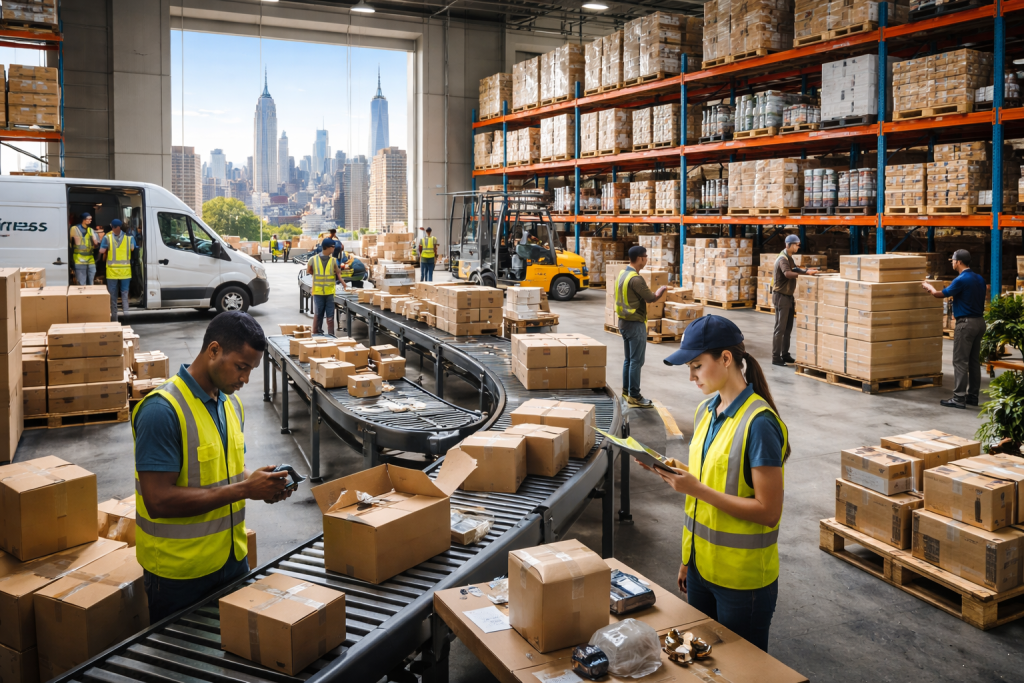
Ecommerce fulfillment in NYC supports direct-to-consumer brands, subscription businesses, and omnichannel retailers. These operations require seamless integration with platforms such as Shopify and WooCommerce, real-time inventory synchronization, and scalable workflows.
Brands selling online often benefit from outsourcing fulfillment rather than managing in-house operations, as detailed in
The Benefits of Outsourcing Warehousing for E-Commerce Brands.
Fast fulfillment directly impacts customer loyalty, a relationship explained further in
Efficient Fulfillment: Customer Satisfaction & Retention.
Beyond eCommerce, NYC fulfillment centers support B2B distribution, wholesale shipping, and retail replenishment. These services include pallet handling, scheduled deliveries, cross-docking, and compliance with retailer routing guides.
Cross-docking is particularly effective in urban environments because it reduces storage time and accelerates distribution. Businesses exploring this model can reference
What Is Cross Docking: Understanding Its Benefits and Best Practices.
Modern fulfillment centers rely on warehouse management systems (WMS), automation, and AI-powered forecasting to maintain speed and accuracy at scale.
Automation reduces dependency on manual labor while improving consistency, a trend explored in
How Automation, AI & Robotics Are Transforming Logistics.
Businesses seeking long-term efficiency gains often review
The Future of Warehouse Automation: What Businesses Need to Know.
Fulfillment pricing in NYC typically includes:
Receiving and inbound processing
Storage fees (per pallet or cubic foot)
Pick and pack fees
Packaging materials
Shipping and delivery costs
Returns processing
Hidden inefficiencies can quietly erode margins, which is why businesses analyze
The Hidden Costs of Poor Warehousing Management and How to Avoid Them.
For businesses weighing internal operations versus outsourcing,
Comparing In-House vs Outsourced Fulfillment provides valuable clarity.
NYC fulfillment operations must comply with transportation, labor, and safety regulations. Inventory security, controlled access, and shipment traceability are essential.
For regulatory guidance, authoritative external sources include:
U.S. Department of Transportation for logistics and carrier compliance
U.S. Customs and Border Protection for cross-border and import/export fulfillment requirements
Selecting the right fulfillment partner is a strategic decision. Businesses should prioritize providers with urban logistics expertise, scalable infrastructure, transparent pricing, and advanced technology.
A structured evaluation framework is outlined in
Guide to Choosing the Right Fulfillment Partner for Your Business.
Fulfillment performance directly influences customer experience, brand reputation, and revenue growth. Fast, accurate, and reliable fulfillment increases repeat purchases and reduces churn.
Businesses that optimize fulfillment operations consistently outperform competitors, as shown in
Why Smart Distribution Management Is Key to Meeting Today’s Delivery Demands.
New York City rewards businesses that execute fulfillment with precision. From inventory management to last-mile delivery, the right fulfillment strategy enables growth without operational chaos.
To explore customized fulfillment solutions, connect directly through the
BYExpress Contact Page.
Ecommerce brands, subscription companies, retailers, and B2B distributors with high order volumes or time-sensitive deliveries benefit most.
Yes. Strategically located warehouses and optimized carrier networks make same-day fulfillment achievable.
Proximity to customers lowers last-mile distance, improves delivery density, and reduces per-order shipping costs.
Advanced fulfillment centers are designed to handle volume spikes through automation and flexible labor models.
Yes. Most providers integrate with Shopify, WooCommerce, ERPs, and marketplaces for real-time order synchronization.


“Thanks to Byexpress all my shipping and fulfillment costs are in line now”

“All my issues were solved by Byexpress team that I had with pervious 3pl provider.”

“Thank you Byexpress team could not done it without you guys.”

“Their integration and customer service were the key for me”

“Outstanding delivery service! The package was well-packaged, and
the delivery team was professional and courteous”

“Great and knowledgeable team to work with.”

Thanks, guys, for reducing my shipping rates
Ottawa Office
2411 Holly Lane
Ottawa, ON, K1V 7P2
Toronto Office
13-280 West Beaver Creek Road Unit #136
Richmond Hill, ON, L4B 3Z1
Alexandria Office
173 Kenyon Street West
Alexandria, ON, K0C 1A0
Montreal Office
4388 Saint-Denis Street Unit #200
Montreal, QC, H2J 2L1
California Office
155 North Riverview Drive
Anaheim Hills, CA, 92808
Call Us
Toll-Free: 1-866-744-7122
Local : 613-739-3000
Email Us
Multilingual Services