By Martin Vassilev / 29 Dec, 2025
Last-mile delivery is the most expensive, complex, and customer-visible stage of the logistics process. It is also the stage where margins are won or lost. Rising fuel prices, urban congestion, failed delivery attempts, labor shortages, and increasing consumer expectations for same-day or next-day shipping have turned last-mile delivery into a strategic battlefield for modern businesses.
Reducing last-mile delivery costs without sacrificing speed is not about cutting corners. It is about structural optimization, intelligent routing, smarter fulfillment models, and leveraging data-driven logistics strategies that align cost efficiency with customer satisfaction. Companies that master this balance gain a durable competitive advantage—lower operating costs, faster delivery promises, and stronger brand loyalty.
This guide breaks down proven, scalable strategies to reduce last-mile delivery costs while maintaining or even improving delivery speed.
Last-mile delivery can account for 40–55% of total shipping costs, even though it represents the shortest physical distance in the supply chain. The cost drivers are structural, not accidental.
High labor costs for drivers and couriers
Inefficient routing and low drop density
Urban congestion and parking restrictions
Failed or repeated delivery attempts
Fragmented fulfillment networks
Lack of real-time visibility and coordination
Without addressing these root causes, businesses often fall into the trap of paying more for speed rather than designing systems that deliver speed efficiently.
Distance is the enemy of affordable speed. The farther your inventory is from the end customer, the more expensive fast delivery becomes.
Distributed fulfillment places inventory closer to demand centers, reducing delivery distances, transit time, and fuel consumption. Shorter routes mean:
Lower per-order delivery costs
Higher same-day and next-day success rates
Fewer delivery exceptions
Businesses using strategically located fulfillment hubs can dramatically cut last-mile expenses while improving delivery promises. This is especially effective in high-density metro areas and cross-border corridors.
A strong example of strategic regional positioning is highlighted in Calgary–Dallas logistics hubs, where proximity to key trade routes reduces transit friction and last-mile inefficiencies.
Static routing is one of the most expensive mistakes in last-mile delivery. Traffic patterns, weather, delivery windows, and real-time constraints change constantly.
Advanced route optimization software uses real-time data to:
Minimize total miles driven
Increase drop density per route
Avoid congestion and delivery delays
Reduce fuel and overtime costs
Modern logistics platforms now integrate AI to continuously re-optimize routes throughout the day. The result is faster deliveries with fewer vehicles and lower labor costs.
Businesses leveraging AI-driven logistics systems gain a measurable edge, as outlined in How AI is transforming the logistics industry in 2025.
Large centralized warehouses are efficient for storage but inefficient for last-mile delivery in urban markets. Micro-fulfillment centers solve this gap.
Inventory placed inside or near city cores
Faster order picking and dispatch
Reduced reliance on long courier routes
Improved same-day delivery feasibility
Micro-fulfillment centers enable businesses to serve dense customer populations quickly without premium courier pricing. When paired with local courier networks, they significantly reduce per-order last-mile costs.
Urban logistics strategies like those discussed in Logistics in Ottawa show how proximity-based fulfillment improves speed while controlling expenses.
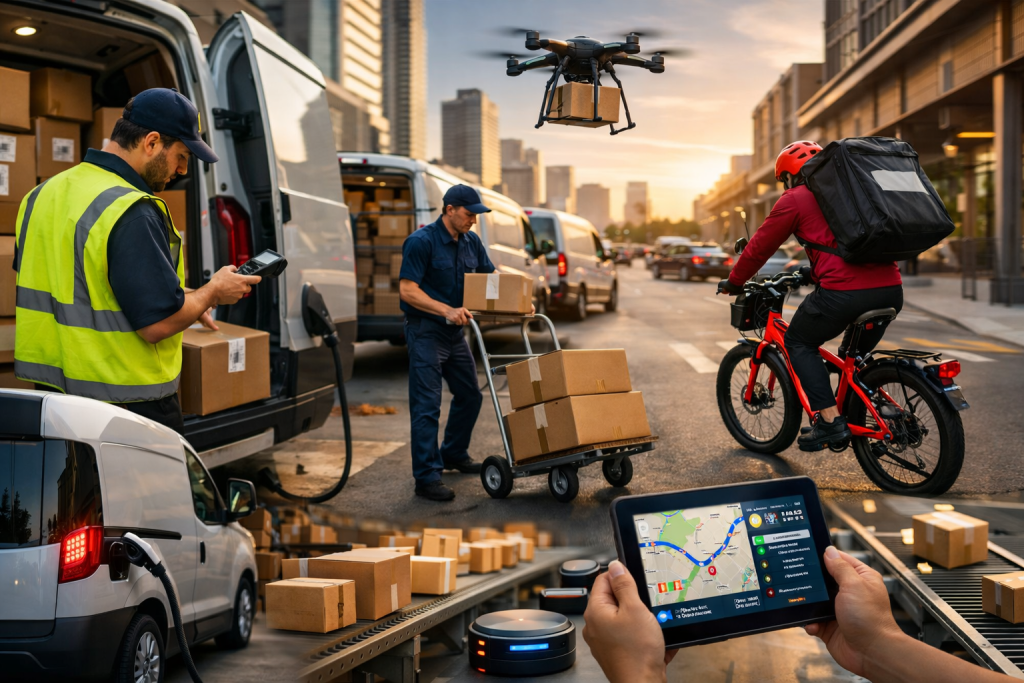
Every failed delivery attempt multiplies costs—driver time, fuel, re-routing, customer service handling, and delayed revenue recognition.
Accurate address validation at checkout
Real-time delivery notifications and tracking
Narrow delivery windows customers can commit to
Alternative pickup points or lockers
Improving first-attempt success is one of the highest-ROI ways to reduce last-mile costs without slowing delivery. Each avoided reattempt directly lowers operational spend.
According to the U.S. Department of Transportation, urban delivery inefficiencies and failed stops are major contributors to rising logistics costs, reinforcing the importance of delivery precision and planning.
National carriers are optimized for scale, not always for local efficiency. In many metro areas, regional and local courier partners outperform large carriers on both speed and cost.
Faster response times
Better knowledge of local routes
Flexible delivery windows
Lower per-mile costs
Blending national carriers for long-haul transport with local couriers for last-mile delivery creates a hybrid model that maximizes speed while minimizing costs.
This approach aligns with modern courier evolution trends outlined in The evolution of courier services from traditional mail to modern delivery solutions.
Speed does not always require immediate dispatch. Intelligent order consolidation can reduce costs without impacting delivery expectations.
Combine nearby deliveries into optimized routes
Hold orders briefly to increase drop density
Dispatch once efficiency thresholds are met
The key is micro-consolidation, not bulk delays. Holding orders for minutes or hours—rather than days—can dramatically improve route efficiency while maintaining promised delivery times.
Visibility reduces cost leakage across the last mile. When customers can track deliveries in real time, failed attempts decrease and support inquiries drop.
Fewer “Where is my order?” tickets
Reduced failed delivery attempts
Improved driver accountability
Faster exception resolution
Transparency also improves customer trust and satisfaction, reducing refund requests and chargebacks.
The impact of tracking technology is explored further in Real-time tracking in delivery services.
Oversized or inefficient packaging increases last-mile costs by limiting vehicle capacity and increasing handling time.
Right-size packaging to reduce cubic volume
Use standardized box dimensions
Reduce fragile packaging that slows handling
Smarter packaging increases drop density per vehicle and lowers per-order delivery costs without affecting speed.
Last-mile inefficiencies often hide in plain sight. Data analytics reveals where money is being lost.
Cost per delivery
Cost per mile
First-attempt delivery rate
Average delivery time by zone
Failed delivery percentage
Data-driven logistics teams continuously refine delivery strategies instead of relying on static assumptions. Advanced analytics are a cornerstone of efficient fulfillment models discussed in How to leverage data analytics for streamlined inventory management.
McKinsey & Company highlights that companies using advanced analytics in logistics can reduce delivery costs by up to 15% while improving service levels.
Building and managing last-mile delivery infrastructure in-house is expensive, complex, and difficult to scale. Specialized third-party logistics providers spread infrastructure costs across multiple clients, delivering economies of scale.
Pre-existing courier networks
Optimized routing systems
Flexible capacity during peak periods
Integrated fulfillment and delivery operations
Businesses that outsource strategically gain faster delivery speeds without capital investment or fixed overhead.
A deeper look into this advantage is outlined in Why outsourcing warehousing is more cost-effective than in-house management.
Reducing last-mile delivery costs without sacrificing speed is not a single tactic—it is a system. The most successful businesses align fulfillment location, routing intelligence, courier selection, data visibility, and customer communication into one cohesive logistics strategy.
Speed becomes affordable when:
Inventory is closer to demand
Routes are optimized in real time
Delivery success rates are high
Technology replaces manual inefficiencies
Businesses looking to implement cost-efficient, high-speed last-mile delivery strategies can explore tailored solutions through BYExpress or request a customized logistics assessment via Request a Quote to identify immediate savings opportunities without compromising delivery performance.
Moving inventory closer to customers and optimizing routing with real-time data delivers the fastest cost reductions without impacting delivery speed.
No. Structural optimization, distributed fulfillment, and smart routing allow businesses to deliver faster at lower cost.
Last-mile delivery can represent up to 55% of total shipping costs, depending on geography and delivery model.
Local couriers often outperform national carriers for last-mile delivery in dense urban areas due to route familiarity and flexibility.
Yes. Outsourcing to a specialized 3PL provides access to optimized networks and technology without high upfront investment.


“Thanks to Byexpress all my shipping and fulfillment costs are in line now”

“All my issues were solved by Byexpress team that I had with pervious 3pl provider.”

“Thank you Byexpress team could not done it without you guys.”

“Their integration and customer service were the key for me”

“Outstanding delivery service! The package was well-packaged, and
the delivery team was professional and courteous”

“Great and knowledgeable team to work with.”

Thanks, guys, for reducing my shipping rates
Ottawa Office
2411 Holly Lane
Ottawa, ON, K1V 7P2
Toronto Office
13-280 West Beaver Creek Road Unit #136
Richmond Hill, ON, L4B 3Z1
Alexandria Office
173 Kenyon Street West
Alexandria, ON, K0C 1A0
Montreal Office
4388 Saint-Denis Street Unit #200
Montreal, QC, H2J 2L1
California Office
155 North Riverview Drive
Anaheim Hills, CA, 92808
Call Us
Toll-Free: 1-866-744-7122
Local : 613-739-3000
Email Us
Multilingual Services