By Martin Vassilev / 21 Oct, 2025
In today’s competitive logistics environment, businesses face constant pressure to reduce storage and operational costs while maintaining — or even improving — service speed and quality. Whether you’re managing a single fulfillment center or a network of regional warehouses, efficiency is the key to staying profitable and agile. This comprehensive guide reveals how leading companies achieve cost efficiency without compromising delivery speed or customer satisfaction.
Before exploring strategies, it’s vital to understand where storage costs come from. Expenses go beyond rent or square footage; they include labor, utilities, handling, insurance, inventory loss, and technology. As operations scale, inefficiencies compound. That’s why companies now turn to data-driven optimization and smart warehousing models to uncover hidden savings.
For a deeper look into these inefficiencies, see The Hidden Costs of Poor Warehousing Management, which explains how operational blind spots can erode margins over time.
Lean warehousing is built around minimizing waste and maximizing efficiency in every process — from inbound logistics to order dispatch. Techniques such as cross-docking, slotting optimization, and inventory turnover analysis ensure faster movement and lower storage overhead.
Reduces idle inventory and frees up valuable floor space.
Improves picking accuracy and speed.
Enhances warehouse labor utilization and safety.
You can learn more about implementing lean principles from Lean Warehousing: What It Is and How It Benefits Your Business, which showcases how small process improvements lead to significant financial savings.
Efficient use of available space is one of the most cost-effective ways to reduce storage expenses. Vertical storage systems, narrow aisle racking, and modular shelving can increase storage density without expanding footprint.
For actionable insights on warehouse layout and optimization, read How to Improve Warehouse Space Utilization for Maximum Efficiency.
Implement ABC analysis to store high-velocity items closer to dispatch zones.
Introduce mezzanine levels for seasonal or low-rotation stock.
Use dynamic slotting algorithms to rearrange inventory based on demand.
External resource: The U.S. Department of Energy provides guidelines on warehouse efficiency that also reduce energy consumption during storage and handling.
Data analytics helps logistics managers identify slow-moving inventory, forecast demand fluctuations, and allocate storage more effectively. With integrated Warehouse Management Systems (WMS), it becomes easier to track SKU velocity, storage duration, and turnover ratios.
ByExpress offers guidance on Leveraging Data Analytics for Streamlined Inventory Management, detailing how predictive analytics can reduce waste and improve profitability.
Carrying Cost per SKU: Reveals inefficiencies in stockholding.
Inventory Turnover Ratio: Indicates how quickly products move through storage.
Fulfillment Cycle Time: Shows how fast customer orders are processed.
Instead of bearing the full cost of private warehousing, many companies now outsource storage and fulfillment to third-party logistics (3PL) providers. Shared facilities lower capital expenditure and offer scalable solutions for seasonal demand.
ByExpress explains why Outsourcing Warehousing Is More Cost-Effective Than In-House Management. Outsourcing reduces infrastructure, labor, and utility costs while giving access to advanced automation and tracking systems.
Rapid business growth or seasonal volume fluctuations.
Expensive or limited local real estate markets.
Need for faster last-mile delivery across multiple regions.
Automation doesn’t just reduce labor costs—it accelerates order fulfillment while improving accuracy. Technologies like Automated Guided Vehicles (AGVs), AI-powered picking systems, and robotic sorters enable warehouses to handle high volumes efficiently.
Learn about the transformation in The Future of Warehouse Automation: What Businesses Need to Know. Companies using automation often report 30–50% cost reductions alongside improved service speed.
Predictive maintenance to minimize downtime.
Smart routing for faster fulfillment.
Inventory optimization using real-time data analytics.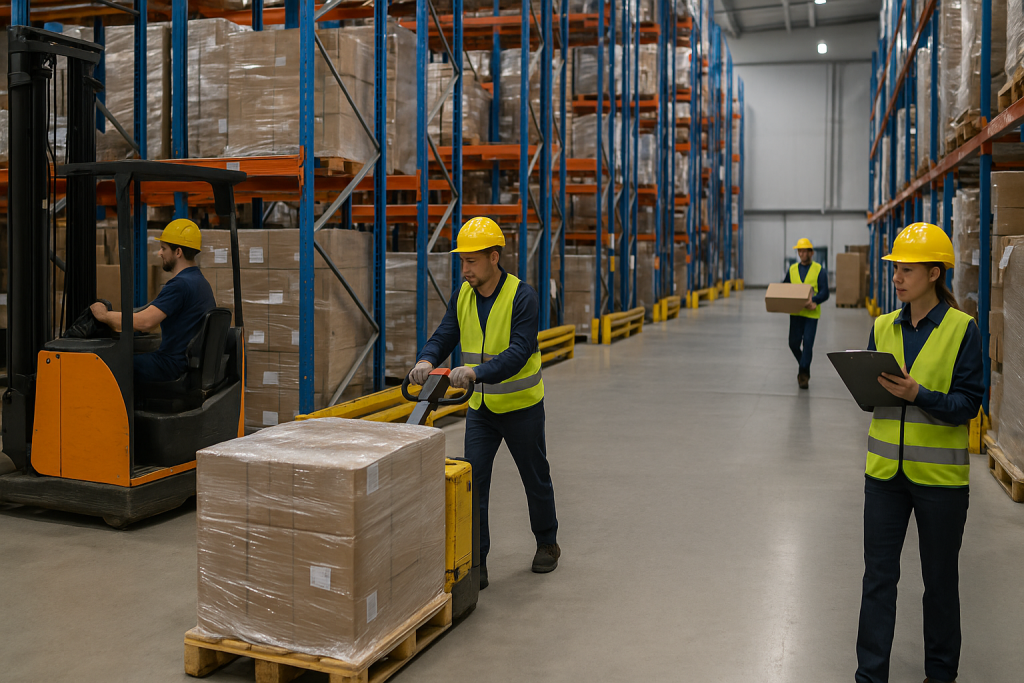
Modern logistics networks are moving toward on-demand warehousing—temporary or shared storage that scales with your needs. This model minimizes long-term leases and capital commitments.
Discover how On-Demand Warehousing allows businesses to adapt to fluctuating sales cycles while maintaining consistent customer service.
Pay only for the space and time you use.
Access nationwide networks without owning facilities.
Expand quickly into new markets without heavy investment.
Energy consumption in cold storage is a major cost driver. Instead of keeping entire facilities temperature-controlled, use zoned cooling systems to maintain specific temperatures only where necessary. For more, see Temperature-Controlled Warehousing: Why Your Business Needs It in 2025.
The Environmental Protection Agency (EPA) also offers resources on energy-efficient refrigeration systems to help businesses lower operational costs sustainably.
A well-planned inventory system reduces both overstocking and understocking. Use real-time tracking and reorder point automation to ensure items move efficiently through the supply chain.
Check out The Role of Inventory Control in Reducing Operational Costs and Improving Order Accuracy to understand how data-driven inventory strategies improve ROI.
Use demand forecasting tools integrated with sales analytics.
Conduct regular cycle counts instead of full inventory shutdowns.
Centralize purchasing for bulk pricing benefits.
Optimizing shipments is another critical way to reduce overall storage time and costs. By consolidating freight and improving scheduling, companies minimize idle stock in warehouses.
Refer to How to Reduce Shipping Costs Without Cutting Corners for strategies on load optimization and route efficiency.
Suppliers are key to cost reduction. Through vendor-managed inventory (VMI) and shared data access, suppliers can align production schedules with real-time warehouse needs, reducing holding costs.
A strong partnership network also enables faster restocking cycles, ensuring consistent product availability while freeing up space for high-demand goods.
Sustainability and cost savings now go hand in hand. Implementing green logistics not only reduces your carbon footprint but also lowers fuel, lighting, and packaging costs. Explore The Role of Green Logistics in Modern Warehousing to learn how eco-efficient systems improve long-term profitability.
To ensure lasting savings, perform quarterly audits of space usage, labor efficiency, and utility costs. Implement feedback loops and key performance indicators (KPIs) to measure ongoing improvement.
For a full process overview, see How to Maximize Warehouse Efficiency and Cut Costs, which outlines operational benchmarks for both small and large warehouses.
Reducing storage costs no longer means slowing down operations or lowering service quality. By combining lean practices, automation, data insights, and flexible warehousing, businesses can achieve scalable efficiency. The most successful logistics operations treat cost reduction as a continuous strategy — not a one-time fix.
To explore how your company can implement these proven strategies with professional support, visit ByExpress Logistics and connect with an expert for a tailored consultation.
1. How can automation reduce storage costs?
Automation reduces human error, speeds up handling, and increases throughput—allowing warehouses to do more with less space and fewer resources.
2. What’s the difference between lean and flexible warehousing?
Lean warehousing focuses on minimizing waste, while flexible warehousing emphasizes scalability and adaptability for fluctuating demand.
3. Are 3PL services suitable for small businesses?
Yes, 3PL partnerships are ideal for small and medium enterprises seeking cost-effective fulfillment without capital investment in facilities.
4. How often should warehouse audits be performed?
At least quarterly, to assess inventory accuracy, energy efficiency, and process optimization.
5. Does green logistics actually save money?
Yes, sustainable initiatives often lead to lower fuel, energy, and material costs while improving brand image and compliance.


“Thanks to Byexpress all my shipping and fulfillment costs are in line now”

“All my issues were solved by Byexpress team that I had with pervious 3pl provider.”

“Thank you Byexpress team could not done it without you guys.”

“Their integration and customer service were the key for me”

“Outstanding delivery service! The package was well-packaged, and
the delivery team was professional and courteous”

“Great and knowledgeable team to work with.”

Thanks, guys, for reducing my shipping rates
Ottawa Office
2411 Holly Lane
Ottawa, ON, K1V 7P2
Toronto Office
13-280 West Beaver Creek Road Unit #136
Richmond Hill, ON, L4B 3Z1
Alexandria Office
173 Kenyon Street West
Alexandria, ON, K0C 1A0
Montreal Office
4388 Saint-Denis Street Unit #200
Montreal, QC, H2J 2L1
California Office
155 North Riverview Drive
Anaheim Hills, CA, 92808
Call Us
Toll-Free: 1-866-744-7122
Local : 613-739-3000
Email Us
Multilingual Services