By Martin Vassilev / 25 Dec, 2025
Canadian warehousing is entering a decisive era where robotic picking and packing are no longer experimental technologies—they are rapidly becoming operational necessities. Rising labour costs, chronic workforce shortages, same-day delivery expectations, and the explosive growth of eCommerce are forcing warehouses across Canada to rethink how orders are fulfilled. At the center of this transformation sits robotic picking and packing: intelligent systems capable of identifying, selecting, sorting, and packaging products with precision, speed, and consistency that manual processes cannot match at scale.
From Toronto and Vancouver distribution hubs to fast-growing logistics corridors in Calgary, Montreal, and Ottawa, robotics-driven fulfillment is reshaping how goods move through the supply chain. These systems are not replacing warehouses—they are redefining them. Robotic picking arms, autonomous mobile robots (AMRs), AI-powered vision systems, and smart packing stations are converging into fully orchestrated fulfillment ecosystems.
Canadian warehouses that adopt these technologies early gain measurable advantages: lower per-order costs, higher accuracy rates, improved throughput during peak seasons, and the operational flexibility required to scale nationally and cross-border. Those that delay risk falling behind competitors who can ship faster, cheaper, and more reliably.
Robotic picking and packing refers to automated systems that physically handle products inside a warehouse—from storage locations to final shipment packaging—using robotics, artificial intelligence, and advanced sensing technologies.
Robotic Picking Arms equipped with grippers, suction tools, and force sensors
Computer Vision Systems that identify SKUs regardless of shape or packaging
Autonomous Mobile Robots (AMRs) that transport items between zones
Automated Packing Stations that right-size boxes and reduce void fill
Warehouse Management System (WMS) Integration for real-time orchestration
These systems operate continuously, learn from historical data, and improve accuracy over time. When combined with AI-driven warehouse optimization strategies, robotic picking becomes a strategic asset rather than a tactical upgrade.
Warehouses implementing robotics often pair them with broader automation initiatives such as smart inventory tracking, dynamic slotting, and data-driven demand forecasting—topics explored in detail within The Future of Warehouse Automation: What Businesses Need to Know.
Canada’s logistics sector continues to face skilled labour shortages, particularly in urban fulfillment hubs. Recruiting, training, and retaining warehouse staff is increasingly difficult, especially for repetitive picking tasks with high turnover rates. Robotics reduces dependency on manual labour while allowing human teams to focus on exception handling, quality control, and strategic oversight.
Consumers now expect faster fulfillment across Canada, including same-day or next-day delivery even outside major metros. Robotic picking dramatically shortens order cycle times, making aggressive delivery promises achievable without sacrificing accuracy.
Black Friday, Cyber Monday, and seasonal retail spikes strain traditional warehouses. Robots scale instantly—no onboarding, no overtime, no fatigue. This scalability is especially critical for businesses using on-demand or distributed warehousing models.
Robotic systems consistently achieve picking accuracy rates above 99.9%, reducing costly returns and reverse logistics operations. This precision aligns closely with strategies outlined in How to Maximize Warehouse Efficiency and Cut Costs.
At the heart of robotic picking lies computer vision and machine learning. These technologies allow robots to “see,” interpret, and act within complex warehouse environments.
Modern vision systems can:
Identify products regardless of orientation or packaging changes
Distinguish between similar SKUs in dense storage locations
Adapt to new products without manual reprogramming
Learn optimal gripping techniques over time
This intelligence enables robots to operate effectively in mixed-SKU environments, making them ideal for eCommerce fulfillment, retail distribution, and B2B logistics.
A deeper exploration of AI’s role in logistics can be found in How AI Is Transforming the Logistics Industry in 2025, which outlines how predictive analytics and machine learning are redefining operational decision-making.
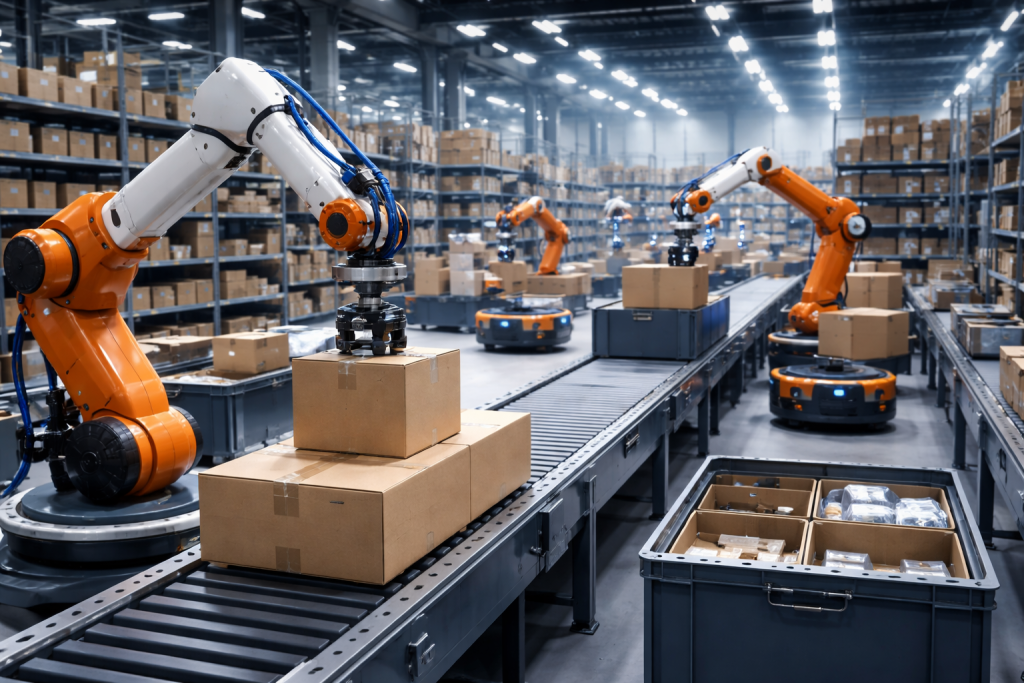
While robotic picking gets much of the attention, robotic packing delivers equally powerful benefits.
Right-sized packaging reduces shipping dimensional weight costs
Lower material waste supports sustainability goals
Consistent package integrity minimizes damage during transit
Faster order throughput during peak demand
Automated packing directly impacts profitability, especially for Canadian businesses shipping nationally or cross-border where dimensional pricing significantly affects freight costs.
These efficiencies align with warehouse space optimization strategies discussed in How to Improve Warehouse Space Utilization for Maximum Efficiency.
High-SKU, high-order-volume environments benefit the most. Robotics enables rapid picking across thousands of SKUs while maintaining near-perfect accuracy.
Robotic systems excel at store replenishment, kitting, and batch picking for omnichannel operations.
Third-party logistics providers gain competitive advantage by offering faster, more reliable fulfillment without increasing overhead—particularly important in multi-tenant warehouses.
Robotics reduces human exposure in temperature-controlled environments while maintaining consistency and safety.
Robotic picking and packing systems do not operate in isolation. Their true power is unlocked when tightly integrated with modern WMS platforms.
Real-time inventory visibility
Dynamic order prioritization
Automated exception handling
Predictive maintenance scheduling
This integration supports data-driven decision-making across the supply chain, reinforcing strategies covered in Integrating AI in Warehouse Management: Future Trends and Current Applications.
Robotic warehouses are inherently more sustainable. They reduce energy waste through optimized travel paths, minimize packaging materials, and enable more compact warehouse layouts.
Sustainability-conscious Canadian businesses increasingly view robotics as a pathway to meeting ESG commitments while improving margins—principles aligned with The Role of Green Logistics in Modern Warehousing.
Robotic systems must comply with Canadian workplace safety regulations and standards. Organizations such as Employment and Social Development Canada and Transport Canada provide frameworks that guide automation safety, training, and compliance.
Robotic systems often improve safety outcomes by reducing repetitive strain injuries and minimizing human exposure to hazardous environments.
Robotic picking achieves maximum ROI when deployed in strategically located facilities that support fast national distribution. Canadian logistics corridors—such as Ontario-Quebec routes and Western Canada hubs—are increasingly optimized for automation-driven throughput.
Insights into location-driven logistics strategy are explored in Logistics in Ottawa, highlighting how regional infrastructure supports modern fulfillment models.
While robotics requires capital investment, ROI is typically achieved through labour savings, accuracy improvements, and higher order capacity.
Leading warehouses mitigate complexity through phased deployments and modular automation strategies.
Successful implementations prioritize workforce training and human-robot collaboration rather than replacement.
Case-based insights into overcoming these challenges are illustrated in Case Studies: Successful Warehousing Strategies from Industry Leaders.
Robotic picking and packing will evolve toward:
Fully autonomous fulfillment zones
AI-driven self-optimizing workflows
Predictive inventory positioning
Increased use of micro-fulfillment centers
Warehouses that adopt these systems now position themselves to scale effortlessly as demand accelerates across Canada and the U.S.
Robotic picking and packing is not a futuristic concept—it is a present-day competitive advantage for Canadian warehouses. Businesses that embrace robotics achieve faster fulfillment, lower costs, higher accuracy, and greater resilience in an increasingly complex supply chain landscape.
For organizations seeking to modernize operations, integrate automation, and future-proof fulfillment strategies, partnering with a technology-driven logistics provider is a decisive step forward.
👉 Contact and next steps:
Explore automation-ready fulfillment solutions and speak with specialists through ByExpress or request a customized assessment via Request a Quote.
Yes. Modular and scalable robotic systems allow small and mid-sized warehouses to automate specific workflows without full facility overhauls.
Modern systems consistently achieve accuracy rates above 99.9%, significantly reducing returns and order errors.
Robotics shifts human roles toward supervision, exception handling, and process optimization rather than elimination.
Implementation timelines range from a few months to a year depending on facility size, system complexity, and integration requirements.
Absolutely. Robotics improves consistency, compliance, and speed—critical factors for Canada–U.S. fulfillment operations.


“Thanks to Byexpress all my shipping and fulfillment costs are in line now”

“All my issues were solved by Byexpress team that I had with pervious 3pl provider.”

“Thank you Byexpress team could not done it without you guys.”

“Their integration and customer service were the key for me”

“Outstanding delivery service! The package was well-packaged, and
the delivery team was professional and courteous”

“Great and knowledgeable team to work with.”

Thanks, guys, for reducing my shipping rates
Ottawa Office
2411 Holly Lane
Ottawa, ON, K1V 7P2
Toronto Office
13-280 West Beaver Creek Road Unit #136
Richmond Hill, ON, L4B 3Z1
Alexandria Office
173 Kenyon Street West
Alexandria, ON, K0C 1A0
Montreal Office
4388 Saint-Denis Street Unit #200
Montreal, QC, H2J 2L1
California Office
155 North Riverview Drive
Anaheim Hills, CA, 92808
Call Us
Toll-Free: 1-866-744-7122
Local : 613-739-3000
Email Us
Multilingual Services