By Martin Vassilev / 11 Nov, 2025
The logistics and warehousing industry is experiencing a major digital transformation — one powered by smart sensors and the Internet of Things (IoT). As global supply chains demand greater speed, accuracy, and transparency, IoT-enabled warehouses have emerged as the next frontier of efficiency. From real-time tracking of assets to predictive maintenance and data-driven decision-making, IoT technologies are revolutionizing warehouse visibility like never before.
According to a Government of Canada report, industrial automation and IoT integration are among the fastest-growing technology trends in logistics. The shift is not just about adopting new tools — it’s about creating smarter ecosystems that connect machines, inventory, and people into one intelligent network.
Traditional warehouses relied heavily on manual entries, barcode scanning, and routine checks to monitor inventory. However, these methods lacked real-time accuracy and often led to delays, misplaced goods, and inefficient operations. The introduction of smart sensors and IoT networks has redefined this process by connecting every element of warehouse operations — from forklifts and pallets to HVAC systems — to a central digital platform.
Today’s IoT-driven warehouses provide complete visibility into every aspect of the supply chain. This transformation supports a more agile approach to logistics management, as seen in ByExpress’s insights on how AI is transforming logistics in 2025.
Smart sensors continuously monitor the location and status of inventory. When integrated with RFID and GPS technologies, warehouse operators can instantly locate any product, detect anomalies, and automate restocking alerts. By connecting this system with digital inventory dashboards, warehouses eliminate human error and boost fulfillment accuracy by over 90%.
Learn how companies are leveraging data visibility to enhance performance in real-time inventory management.
Sensors attached to critical warehouse machinery — conveyors, cranes, forklifts — detect vibrations, temperature changes, or voltage fluctuations. When anomalies occur, the system sends alerts to prevent downtime before failures happen. This predictive maintenance capability ensures continuous operations and reduces costly repair delays.
According to Forbes Technology Council, predictive analytics in warehouse equipment can lower maintenance costs by up to 30%, saving time and enhancing productivity.
In sectors such as pharmaceuticals, electronics, or food logistics, maintaining the correct temperature and humidity is crucial. IoT-enabled temperature sensors track environmental conditions in real-time, ensuring compliance with safety regulations and maintaining product integrity. Warehouses specializing in temperature-controlled logistics now depend on IoT for consistent, automated reporting.
To explore more about controlled environments, see Temperature-Controlled Warehousing: Why Your Business Needs It.
IoT devices also monitor energy consumption patterns — from lighting to HVAC systems — identifying wasteful practices and optimizing efficiency. Smart lighting systems use motion sensors to activate only in active zones, while temperature sensors adjust heating and cooling dynamically. This approach contributes to green logistics initiatives, aligning with the principles discussed in The Role of Green Logistics in Modern Warehousing.
IoT is not only about data collection — it’s about transforming raw data into actionable insights. By combining IoT sensors with AI analytics and cloud computing, warehouses can predict trends, streamline resource allocation, and plan for disruptions before they occur.
For example, a smart warehouse can anticipate an upcoming surge in e-commerce orders and adjust staffing levels and delivery routes accordingly. This predictive intelligence makes logistics networks proactive instead of reactive, reducing delays and improving customer satisfaction.
See how advanced analytics support this transformation in How to Leverage Data Analytics for Streamlined Inventory Management.
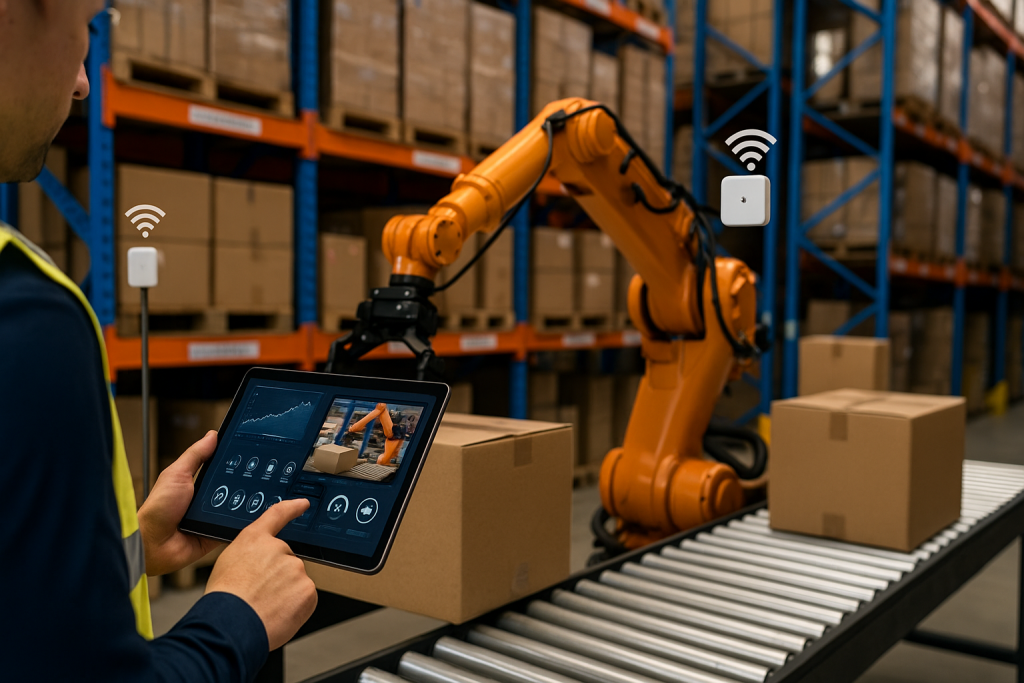
IoT ensures that every stakeholder — from manufacturers to retailers — has access to real-time visibility of product movement. This level of transparency builds customer trust, reduces disputes, and helps partners coordinate more effectively.
Automated IoT tracking eliminates the need for manual inventory checks, which often lead to discrepancies. As a result, warehouses achieve higher order accuracy, improving both efficiency and profitability.
Through energy optimization, predictive maintenance, and efficient labor allocation, IoT-driven warehouses can reduce costs by 25–40%. The savings are reinvested in scalability and technology upgrades.
Smart sensors monitor environmental hazards such as gas leaks, temperature surges, or unauthorized access. This not only protects staff and inventory but also ensures compliance with industry regulations like ISO 45001 and OSHA.
As businesses expand into new markets, IoT systems provide the flexibility to integrate with new sites, tools, and applications — making scaling faster and less expensive. Read how ByExpress supports adaptive logistics in The Future of Warehouse Automation.
With the exponential rise of e-commerce, speed and accuracy have become the backbone of customer satisfaction. IoT enables dynamic inventory updates, automated order picking, and intelligent packaging — all crucial for maintaining a competitive edge.
When integrated with Warehouse Management Systems (WMS), IoT allows real-time synchronization between online storefronts and physical warehouses. This ensures that product availability is always up to date, even during high-volume sales periods.
Discover how smart systems enhance fulfillment accuracy in How Smart Warehousing Solutions Improve Delivery Times.
While IoT brings immense advantages, it also introduces challenges such as data privacy, system interoperability, and cybersecurity risks. Warehouses must implement secure data encryption, access control protocols, and firewall protections to safeguard against potential breaches.
Governments and organizations like NIST provide frameworks to ensure IoT data protection. As more devices connect, standardization and compliance will become critical to prevent vulnerabilities in large-scale networks.
Amazon Smart Warehouses: Utilize over 100,000 IoT-enabled robots for sorting and delivery optimization.
DHL Smart Sensor Networks: Track shipment temperature and movement for pharmaceuticals, ensuring compliance.
ByExpress Logistics: Implements real-time tracking and analytics to enhance warehouse efficiency and delivery precision across North America.
For deeper insights, explore ByExpress’s case study on Successful Warehousing Strategies from Industry Leaders.
IoT lays the groundwork for AI-driven automation, enabling machines to make intelligent decisions without human input. Smart robots equipped with IoT sensors can autonomously pick, sort, and pack items while communicating with the central system to adjust workflow in real time.
This synergy drives next-generation efficiency, as highlighted in Integrating AI in Warehouse Management: Future Trends and Current Applications.
The next phase of IoT development in warehousing will focus on edge computing, 5G integration, and AI-powered logistics orchestration. These technologies will further reduce latency, expand automation, and enable fully autonomous warehouse ecosystems.
As seen in What Makes a Warehouse Truly Smart in 2026, the trend is clear: warehouses are evolving from static storage spaces into self-regulating ecosystems that optimize themselves.
Smart sensors and IoT have elevated warehousing from operational efficiency to strategic intelligence. Businesses embracing IoT solutions gain unmatched visibility, accuracy, and adaptability, setting themselves apart in a market driven by speed and precision.
To explore customized IoT-driven logistics solutions, contact ByExpress today and discover how your warehouse can transition into a fully connected, data-powered operation.
Smart sensors collect and transmit real-time data about temperature, movement, and equipment performance, helping warehouse operators make informed decisions instantly.
IoT enables automated tracking and live updates, reducing manual errors and improving order accuracy through connected systems.
Initial setup costs may be high, but long-term savings from reduced labor, downtime, and maintenance justify the investment.
IoT optimizes energy usage, reduces waste, and promotes green logistics practices through intelligent monitoring systems.
Yes. IoT solutions are designed to integrate with most modern WMS, ERP, and CRM systems, providing a seamless flow of data across operations.


“Thanks to Byexpress all my shipping and fulfillment costs are in line now”

“All my issues were solved by Byexpress team that I had with pervious 3pl provider.”

“Thank you Byexpress team could not done it without you guys.”

“Their integration and customer service were the key for me”

“Outstanding delivery service! The package was well-packaged, and
the delivery team was professional and courteous”

“Great and knowledgeable team to work with.”

Thanks, guys, for reducing my shipping rates
Ottawa Office
2411 Holly Lane
Ottawa, ON, K1V 7P2
Toronto Office
13-280 West Beaver Creek Road Unit #136
Richmond Hill, ON, L4B 3Z1
Alexandria Office
173 Kenyon Street West
Alexandria, ON, K0C 1A0
Montreal Office
4388 Saint-Denis Street Unit #200
Montreal, QC, H2J 2L1
California Office
155 North Riverview Drive
Anaheim Hills, CA, 92808
Call Us
Toll-Free: 1-866-744-7122
Local : 613-739-3000
Email Us
Multilingual Services