By Martin Vassilev / 16 Dec, 2025
Warehouse location is not a logistical afterthought—it is a strategic business decision that directly affects delivery speed, operating costs, customer satisfaction, and long-term scalability. In Canada’s geographically vast and economically diverse landscape, choosing the right distribution hub can be the difference between operational efficiency and constant friction.
Toronto, Vancouver, and Calgary dominate the national conversation around warehousing for good reason. Each city plays a distinct role in Canada’s supply chain ecosystem, offering unique advantages tied to population density, transportation infrastructure, real estate dynamics, and access to domestic and international markets.
This guide provides a professional, business-focused comparison of Toronto vs Vancouver vs Calgary as strategic warehouse locations. It is written for executives, logistics managers, eCommerce founders, and supply chain leaders who need clarity—not theory—when deciding where to place inventory and fulfillment operations in Canada.
Toronto anchors the Greater Toronto Area (GTA), home to over 6 million people and positioned within a one-day trucking radius of more than 60% of Canada’s population. For businesses prioritizing speed-to-customer, Toronto remains unmatched.
From a distribution standpoint, Toronto offers:
Direct highway access via the 401, 403, 407, and QEW
Rail connectivity across Canada and into the U.S.
Proximity to Pearson International Airport, Canada’s busiest cargo hub
Seamless cross-border access to the U.S. Northeast and Midwest
For companies operating omnichannel or high-volume eCommerce models, Toronto provides the most efficient last-mile coverage across Ontario and Quebec.
Businesses looking to understand how large-scale fulfillment operations work in this region benefit from insights found in what a fulfillment center actually does in 2025, especially when evaluating whether Toronto-based 3PLs align with growth targets.
Toronto’s biggest advantage—density—is also its greatest challenge.
Industrial real estate in the GTA commands premium pricing due to:
Intense demand from retailers and eCommerce brands
Limited available industrial land
High labor competition
Warehouse space costs are higher than national averages, but for businesses that prioritize delivery speed, inventory turnover, and customer proximity, the ROI often justifies the investment. Strategic cost control comes from optimizing layout, automation, and inventory velocity rather than seeking cheap square footage.
For cost-sensitive operations, understanding how to maximize warehouse efficiency and cut costs is essential when operating in Toronto’s competitive logistics environment.
Vancouver is Canada’s primary gateway to Asia-Pacific trade. The Port of Vancouver is the largest port in the country and one of the most significant on the west coast of North America. For import-heavy businesses, Vancouver is often non-negotiable.
Key strategic advantages include:
Direct ocean freight access from Asia
Strong rail connectivity into Western and Central Canada
Immediate proximity to U.S. Pacific Northwest markets
Faster inbound shipping cycles for overseas inventory
Businesses involved in international freight, wholesale imports, and coastal distribution benefit enormously from Vancouver-based warehousing, particularly when speed from port to shelf matters.
Companies evaluating west-coast logistics infrastructure often align Vancouver operations with broader regional strategies similar to those discussed in Vancouver logistics company solutions.
Despite its strategic trade position, Vancouver presents operational challenges:
Industrial land scarcity
High leasing costs driven by geography
Strict zoning regulations
Limited expansion flexibility
These factors make Vancouver ideal for port-adjacent, fast-turn inventory, but less suitable for long-term bulk storage. Businesses often adopt hybrid strategies—using Vancouver for inbound processing and transloading, while pushing inventory inland for long-term fulfillment.
This model aligns well with modern distributed logistics strategies outlined in why businesses are switching to distributed warehousing.
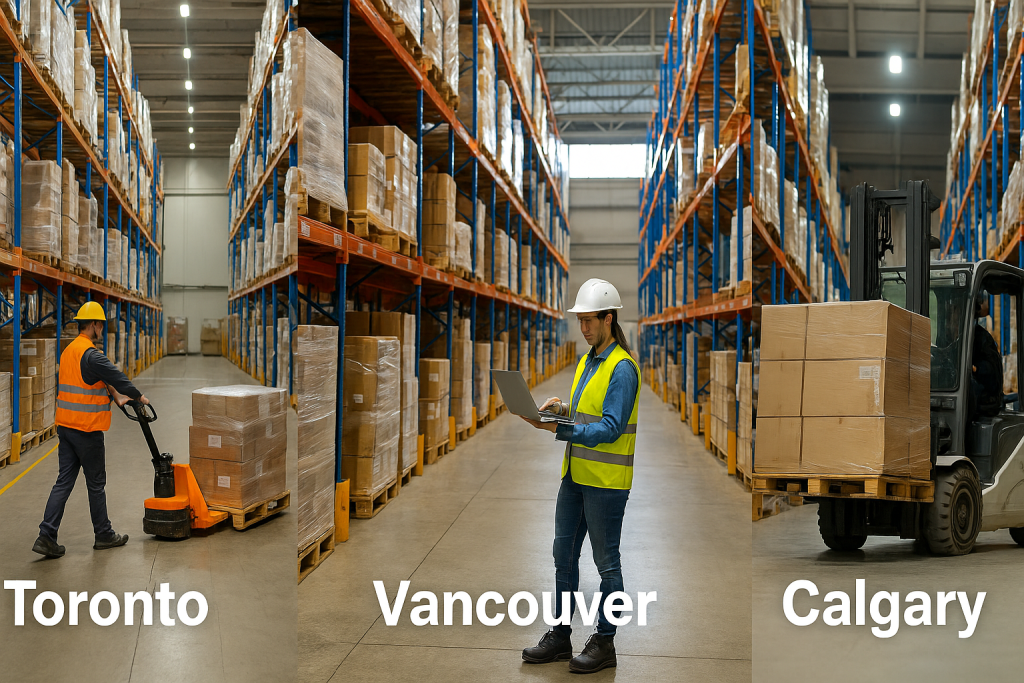
Calgary has emerged as one of Canada’s most attractive warehousing markets for businesses seeking scalability without Toronto or Vancouver price pressure.
Strategic advantages include:
Centralized western location
Lower industrial real estate costs
Less congestion and faster freight movement
Strong access to Western Canada and U.S. Midwest routes
Calgary excels as a regional fulfillment hub, particularly for businesses serving Alberta, Saskatchewan, British Columbia, and cross-border U.S. markets.
Its growing importance as a logistics nucleus is highlighted in Calgary logistics hubs and cross-border growth, where cost efficiency meets strategic reach.
Calgary is especially effective for:
Mid-market eCommerce brands
B2B distribution networks
Businesses expanding westward without coastal constraints
Companies requiring long-term storage and flexible space
Lower overhead enables greater investment in technology, automation, and workforce stability—factors increasingly critical in modern supply chains. Many brands leverage Calgary as a secondary or tertiary node in a multi-location warehousing strategy.
Toronto dominates Eastern Canada and cross-border U.S. markets
Vancouver excels in international imports and Pacific trade
Calgary provides balanced access across Western Canada
Toronto: Highest real estate and labor costs
Vancouver: High land scarcity and premium pricing
Calgary: Most affordable with room for expansion
Toronto: Scale constrained by cost
Vancouver: Scale constrained by geography
Calgary: Strong scalability potential
Toronto: High-volume, fast-delivery consumer fulfillment
Vancouver: Import-driven, port-centric distribution
Calgary: Cost-efficient regional and national fulfillment
The most competitive Canadian supply chains no longer rely on a single warehouse location. Businesses increasingly adopt multi-node distribution strategies, placing inventory closer to customers while balancing cost and speed.
A typical optimized model includes:
Vancouver for inbound international freight
Calgary for bulk storage and western distribution
Toronto for high-velocity eastern fulfillment
This approach reduces transit times, lowers risk, and improves resilience against disruptions—principles central to optimizing supply chains for global challenges.
Warehouse location decisions must align with national transportation frameworks. Resources from Transport Canada and Statistics Canada provide valuable insight into freight corridors, population distribution, and trade flows.
These datasets reinforce why Toronto, Vancouver, and Calgary consistently outperform secondary markets in logistics efficiency.
Warehouse location strategy is inseparable from technology adoption. Facilities in all three cities increasingly integrate AI-driven inventory systems, automation, and real-time analytics to offset labor costs and improve accuracy.
Businesses planning long-term growth should align location decisions with technology-readiness benchmarks discussed in the future of warehouse automation.
Toronto for same-day and next-day delivery density
Calgary for scalable fulfillment with controlled costs
Vancouver for port access
Calgary for inland redistribution
Calgary for storage efficiency
Toronto for customer proximity
Businesses evaluating outsourcing options often benefit from frameworks outlined in choosing the right fulfillment partner.
There is no universal “best” warehouse location in Canada—only the right location for your operational priorities. Toronto delivers unmatched market access, Vancouver controls international flow, and Calgary offers cost-efficient scalability.
The strongest supply chains leverage all three strategically.
To explore customized warehousing, fulfillment, or multi-node distribution strategies, connect directly through ByExpress logistics solutions for tailored planning and execution.
Toronto offers the fastest delivery coverage due to population density and infrastructure.
Yes. Calgary’s central-west position and low costs make it ideal for scalable national fulfillment.
Direct port access reduces inbound shipping time and handling costs from Asia.
Yes. Multi-node warehousing improves speed, reduces risk, and lowers long-term costs.
For most growing businesses, outsourcing provides flexibility, scalability, and cost control.


“Thanks to Byexpress all my shipping and fulfillment costs are in line now”

“All my issues were solved by Byexpress team that I had with pervious 3pl provider.”

“Thank you Byexpress team could not done it without you guys.”

“Their integration and customer service were the key for me”

“Outstanding delivery service! The package was well-packaged, and
the delivery team was professional and courteous”

“Great and knowledgeable team to work with.”

Thanks, guys, for reducing my shipping rates
Ottawa Office
2411 Holly Lane
Ottawa, ON, K1V 7P2
Toronto Office
13-280 West Beaver Creek Road Unit #136
Richmond Hill, ON, L4B 3Z1
Alexandria Office
173 Kenyon Street West
Alexandria, ON, K0C 1A0
Montreal Office
4388 Saint-Denis Street Unit #200
Montreal, QC, H2J 2L1
California Office
155 North Riverview Drive
Anaheim Hills, CA, 92808
Call Us
Toll-Free: 1-866-744-7122
Local : 613-739-3000
Email Us
Multilingual Services