By Martin Vassilev / 26 Mar, 2026
In today’s hyper-competitive global economy, businesses that dominate cross-border logistics between the United States and Canada gain a decisive advantage in speed, cost efficiency, and customer satisfaction. Border fulfillment services are no longer optional—they are the backbone of scalable eCommerce, B2B distribution, and omnichannel retail success across North America.
This comprehensive guide delivers a deep, strategic breakdown of USA–Canada cross-border fulfillment solutions, empowering businesses to streamline operations, eliminate delays, and maximize profitability.
Border fulfillment refers to the seamless movement, storage, processing, and delivery of goods across international borders—specifically between Canada and the United States. This includes:
Unlike domestic fulfillment, cross-border operations require precision, compliance, and infrastructure that aligns with international trade regulations.
To fully grasp how modern fulfillment systems operate, reviewing the complete fulfillment process provides essential insight into how inventory flows from warehouse to customer with maximum efficiency.
Positioning inventory near key border crossings drastically reduces transit times. Businesses leveraging dual-country fulfillment networks can offer:
This aligns directly with modern consumer expectations for rapid delivery, as highlighted in why fast shipping is crucial for e-commerce success.
Shipping internationally from a single warehouse often leads to excessive costs. Cross-border fulfillment solves this by:
Businesses can further optimize cost structures using insights from 5 ways to lower shipping costs without compromising speed.
Navigating customs is one of the biggest challenges in cross-border logistics. Professional fulfillment providers handle:
For official regulatory guidelines, consult the
Canada Border Services Agency (CBSA) and
U.S. Customs and Border Protection (CBP).
These authoritative resources ensure compliance and reduce the risk of shipment delays or penalties.
Modern fulfillment relies on strategically located warehouses across North America. By distributing inventory:
Businesses exploring scalable infrastructure should review the benefits of outsourcing warehousing for e-commerce brands.
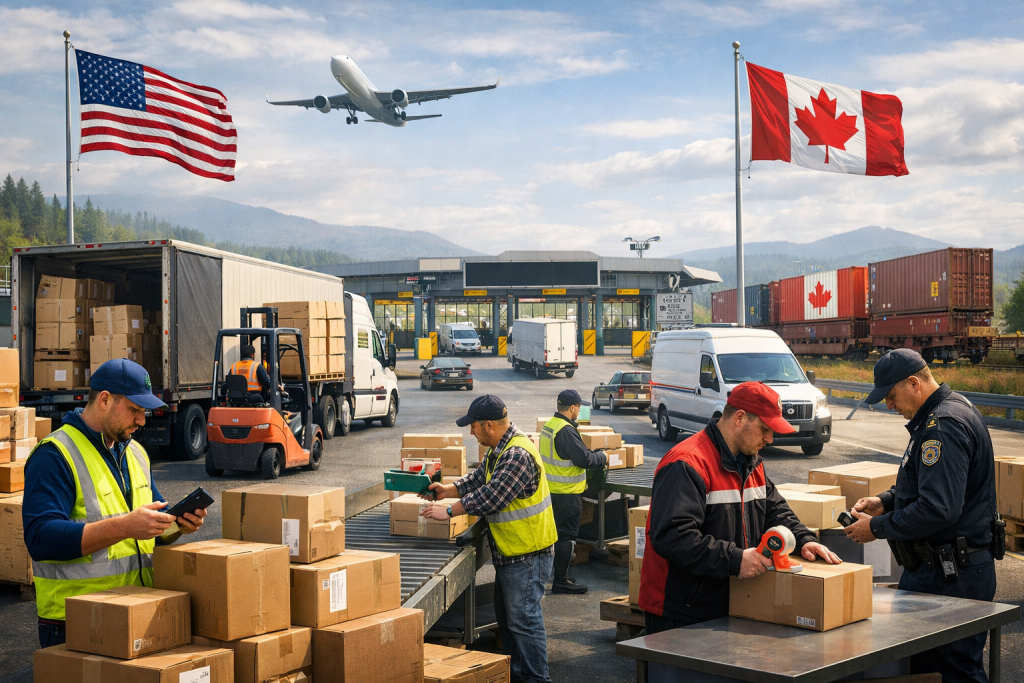
A critical component of cross-border fulfillment is integrated customs clearance. This ensures:
Advanced providers integrate these systems directly into their platforms, eliminating manual intervention.
Inventory visibility is essential when managing multiple warehouses. With real-time synchronization:
Learn how to improve accuracy through real-time inventory updates.
Cross-docking minimizes storage time by moving goods directly from inbound to outbound transportation.
This strategy:
For deeper insights, explore what is cross-docking and how it works.
Automation has transformed fulfillment operations, enabling:
Explore how innovation is reshaping logistics in how AI is transforming the logistics industry in 2025.
Modern fulfillment platforms provide end-to-end visibility:
These capabilities directly improve customer trust and retention.
Seamless integration with platforms like Shopify, WooCommerce, and Amazon ensures:
Businesses leveraging these systems gain a competitive advantage in speed and accuracy.
Solution: Partner with providers offering automated customs clearance and pre-approved documentation workflows.
Solution: Use dual-country warehousing and rate shopping systems to minimize costs.
Solution: Implement predictive analytics and demand forecasting to distribute stock efficiently.
Solution: Work with experienced logistics providers who understand cross-border regulations.
Third-party logistics (3PL) providers play a critical role in simplifying cross-border operations. They offer:
Businesses evaluating partners should review how to choose the right fulfillment partner to ensure scalability and reliability.
Predictive analytics will reduce inventory waste and improve fulfillment accuracy.
Sustainable shipping solutions are becoming a priority for businesses and consumers alike.
Smaller, strategically located facilities will enable ultra-fast delivery across borders.
Blockchain technology will enhance supply chain visibility and trust.
These strategies ensure operational efficiency and long-term scalability.
ByExpress delivers industry-leading cross-border fulfillment solutions designed for speed, efficiency, and scalability. With advanced infrastructure and technology-driven logistics, businesses gain:
For companies ready to scale their operations, explore the full range of transportation services and fulfillment solutions available.
Businesses looking to dominate the North American market must implement a robust cross-border fulfillment strategy. By leveraging advanced logistics networks, automation, and expert partners, companies can unlock:
To begin optimizing your cross-border logistics strategy, connect with a fulfillment expert through the contact page and take the next step toward operational excellence.
Cross-border fulfillment is the process of storing, managing, and delivering goods across international borders, typically involving customs clearance and multi-location warehousing.
By using dual-country warehousing, optimizing shipping routes, and leveraging bulk shipping rates.
Common causes include incorrect documentation, customs inspections, and lack of compliance with regulations.
While not mandatory, a 3PL significantly simplifies logistics, reduces risk, and improves efficiency.
With optimized fulfillment networks, delivery can take as little as 1–3 days.


“Thanks to Byexpress all my shipping and fulfillment costs are in line now”

“All my issues were solved by Byexpress team that I had with pervious 3pl provider.”

“Thank you Byexpress team could not done it without you guys.”

“Their integration and customer service were the key for me”

“Outstanding delivery service! The package was well-packaged, and
the delivery team was professional and courteous”

“Great and knowledgeable team to work with.”

Thanks, guys, for reducing my shipping rates
Ottawa Office
2411 Holly Lane
Ottawa, ON, K1V 7P2
Toronto Office
13-280 West Beaver Creek Road Unit #136
Richmond Hill, ON, L4B 3Z1
Alexandria Office
173 Kenyon Street West
Alexandria, ON, K0C 1A0
Montreal Office
4388 Saint-Denis Street Unit #200
Montreal, QC, H2J 2L1
California Office
155 North Riverview Drive
Anaheim Hills, CA, 92808
Call Us
Toll-Free: 1-866-744-7122
Local : 613-739-3000
Email Us
Multilingual Services