Guide · · 10 min read
Ontario and California Cross-Border Warehousing: A Strategic Distribution Corridor
Ontario, Canada and California, US together cover ~50% of North America's ecommerce demand. Here's how merchants are structuring two-node networks across the corridor — and the lane, customs, and cost decisions that matter.
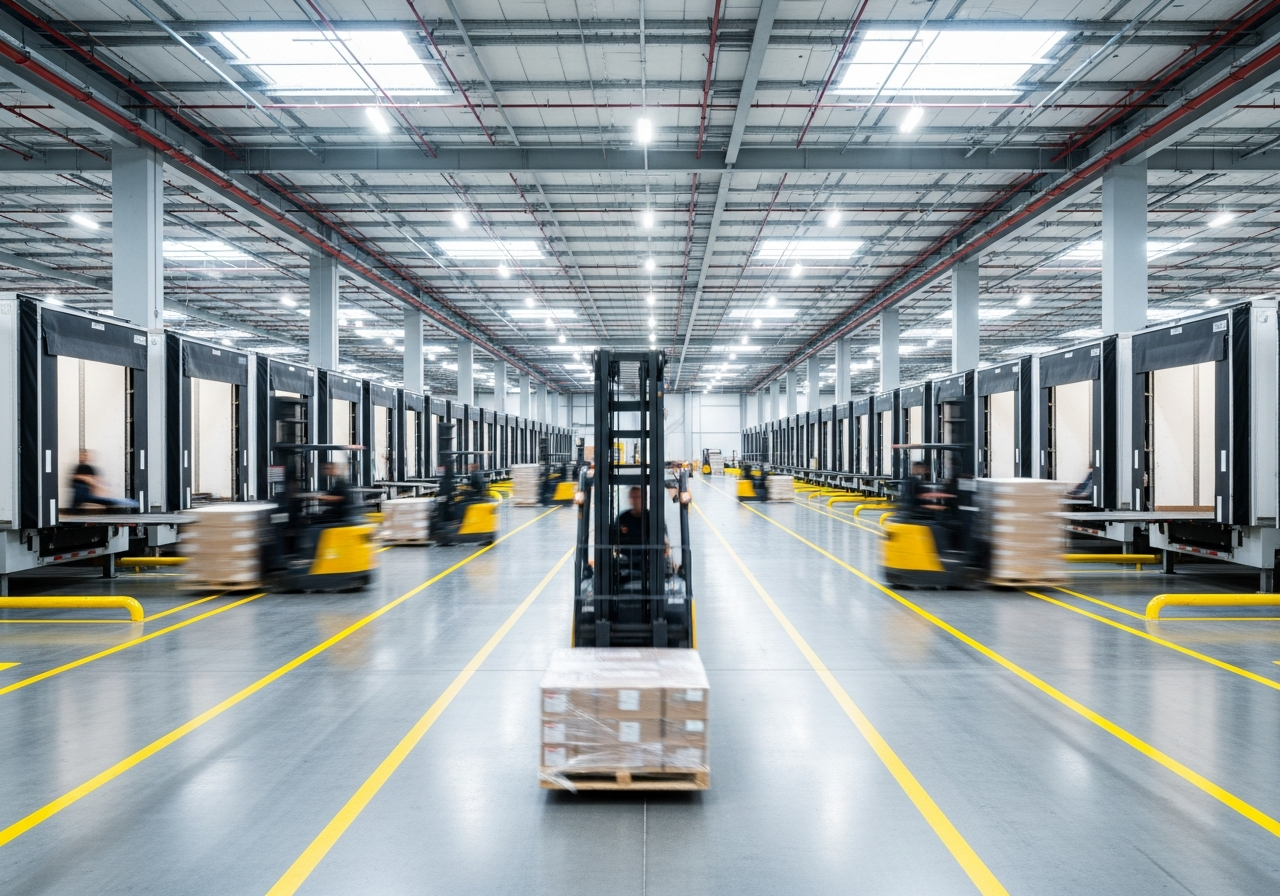
Ontario and California are the two largest ecommerce markets in their respective countries. Together they represent roughly half of all North American DTC shipment volume. For Canadian brands scaling into the US — and California-origin brands selling into Canadian retail — the Ontario-California corridor is the highest-volume, most carrier-served cross-border lane in North America. This guide breaks down what cross-border warehousing in this corridor actually looks like, the lane and customs trade-offs, and how to structure a two-node distribution network without overpaying for redundant inventory.
The Ontario–California corridor in numbers
Ontario contains 40% of the Canadian population and ~50% of Canadian ecommerce GMV. California contains 12% of the US population but ~14% of US ecommerce GMV. The two markets combined represent close to $200B USD in annual ecommerce spend. Cross-border freight between them flows through the Windsor-Detroit lane (highest volume) or the Niagara crossings (Lewiston-Queenston, Peace Bridge) for east coast destinations. From Toronto/Mississauga to Los Angeles is a 5-day truckload move; from Vancouver to Los Angeles is 2 days.
Two-node warehousing structure
The right structure depends on your customer mix. Brands selling primarily to Canadian customers with opportunistic US demand can run Ontario-origin with Section 321 cross-border parcel shipping (cost-effective up to $800 USD per parcel). Brands with sustained California demand (>20% of revenue) should hold forward-deploy inventory in California — typically Los Angeles (LA County) or the Inland Empire (Ontario, CA / San Bernardino) for cost-effective real estate. The Inland Empire alone houses over 1.2B sq ft of warehouse space and is the second-largest US logistics market after the NY/NJ area.
- Ontario primary node: covers all of Canada + opportunistic US Northeast/Midwest
- California secondary node: covers US West Coast + Pacific Northwest + Mountain West
- Replenishment: monthly truckload Ontario → California via I-75/I-40/I-15
- Order routing logic: customer zip determines origin (modern OMS handles this natively)
Customs and lane considerations
Section 321 (de minimis) allows duty-free entry for shipments valued under $800 USD per consumer per day — making single-parcel cross-border shipping economically viable for most DTC SKUs. For commercial freight replenishment between your Ontario and California nodes, you'll use standard formal entry with a US Customs Broker. The Windsor-Detroit lane (Ambassador Bridge, Detroit-Windsor Tunnel, Blue Water Bridge) handles ~25% of all US-Canada surface trade and offers daily LTL and FTL service to California via Detroit-Chicago-Denver-LA carrier networks.
The Inland Empire (Ontario, CA — yes, same name) is the fastest-growing warehousing market in North America and ironically is the most common California node for Ontario, Canada-origin brands.
Frequently Asked Questions
Why does the Inland Empire show up in so many 'Ontario California' searches?
Confusion between Ontario, Canada (the province) and Ontario, California (the city in the Inland Empire) is genuine — and amusingly the city of Ontario, CA is one of the most common warehousing destinations for Canadian brands. Both share rail/road hub characteristics, hence the name.
Is Section 321 still viable in 2026?
Yes, but with active CBP scrutiny. The $800 USD per-consumer-per-day cap remains in force, with stronger HTS code data requirements as of 2025. Compliant brands continue to use Section 321 for parcel-level cross-border, but consumer-level volume capping is required.
What's the transit time for parcel cross-border from Toronto to LA?
Typically 5-7 business days via UPS Worldwide Expedited or FedEx International Economy. Forward-deploy via California node cuts this to 1-2 day domestic ground at significantly lower per-parcel cost.