Guide · · 14 min read
Cross-Border Shipping Canada to US: The Complete 2026 Guide
Should you ship cross-border from Canada or open a US warehouse? Here's the real math, the customs reality after recent Section 321 changes, and how to decide.
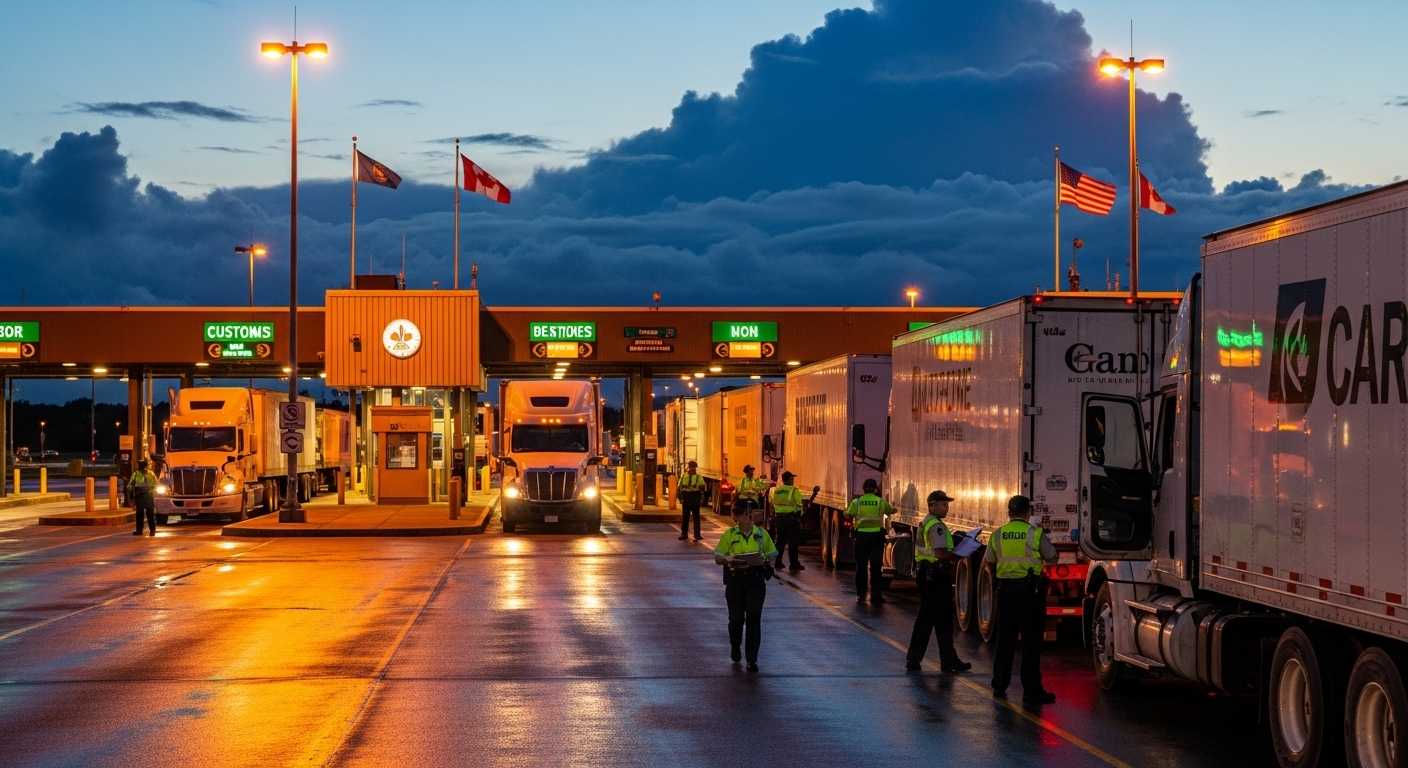
Cross-border shipping from Canada to the United States is the single most over-complicated topic in Canadian e-commerce logistics. The actual mechanics are well-defined and stable, but the conversation is muddied by outdated blog posts, by 3PLs who upsell unnecessary complexity, and by recent regulatory changes around Section 321 de minimis that genuinely have changed the math. This guide gives you a 2026-current view: how cross-border parcel actually works, what the recent Section 321 enforcement changes mean, when cross-border beats opening a US warehouse, what realistic landed cost looks like by carrier, and how to set up an IOR (Importer of Record) and customs broker without overpaying.
The two cross-border models: parcel and bulk-and-inject
Almost all Canadian DTC brands shipping to the US use one of two structural models. Model one is direct cross-border parcel: each US order is picked, packed, and labeled for the US destination in a Canadian warehouse, then handed to a carrier (FedEx, UPS, DHL eCommerce, USPS via UPS Mail Innovations, or Canada Post via the USPS partnership) that handles customs clearance and final-mile delivery. Model two is bulk-and-inject: orders are picked and packed in Canada, bulk-trucked across the border in a sealed line-haul, customs-cleared as one consolidated entry, then injected into a US carrier's network at a southern injection point (Buffalo, Detroit, or Champlain are common from Ontario; Blaine for the West Coast). Bulk-and-inject is more operationally complex but typically yields 25–40% lower per-parcel landed cost at volume, with one-to-three-day faster transit.
 The two cross-border models: parcel and bulk-and-inject
Section 321 de minimis: what changed and what didn't
Section 321 of the U.S. Tariff Act has historically allowed parcels valued under USD 800 to enter the US duty-free with simplified customs clearance — the foundation of low-cost cross-border DTC ecommerce for the past decade. In 2024–2025, U.S. CBP issued enforcement-tightening rules around Section 321, particularly affecting goods subject to Section 301 China tariffs, and Congress signaled further restrictions. The practical 2026 reality: Section 321 still applies to most direct-from-Canada shipments below USD 800, but the entry-data requirements have hardened (more SKU-level detail required, more accurate HTS codes, real consignee data), and certain product categories — particularly those subject to PGA (Partner Government Agency) review like FDA-regulated cosmetics, pharma, and dietary supplements — face additional scrutiny. Brands that historically shipped cross-border with sloppy entry data are now seeing held shipments. Cross-border still works, but the data hygiene bar is higher than it was three years ago.
If your cross-border carrier is not asking you for SKU-level HTS codes, country of origin, and detailed product descriptions, you are exposed. Section 321 enforcement has changed; sloppy data is now actually held at the border.
USMCA, country of origin, and what actually qualifies duty-free
USMCA (the successor to NAFTA) provides duty-free entry for goods that qualify as originating in Canada, the United States, or Mexico under the agreement's rules of origin. The trap most brands fall into: 'made in Canada' is not the same as 'qualifies under USMCA.' A finished good assembled in Canada from largely Chinese-sourced components may not qualify, depending on the specific HTS code and the regional value content rules for that product. For most low-AOV DTC parcels under USD 800, this is moot because Section 321 already provides duty-free entry. But for higher-value shipments, B2B orders, or wholesale moves, USMCA classification matters and can be the difference between a 0% duty and a 6.5–25% duty bill. A qualified customs broker should assess and document USMCA eligibility for each of your SKUs.
Carrier comparison for Canada-to-US ecommerce parcel
The realistic carrier set for Canadian DTC brands shipping to the US covers four main options, each with distinct trade-offs. Choosing well per-parcel — not per-brand — typically saves 15–25% on blended cross-border cost.
| Carrier | Strength | Weakness | Best for |
|---|
| FedEx Ground / Cross-Border | Speed, tracking, broad coverage | Higher per-parcel cost | Time-sensitive or high-AOV |
| UPS Cross-Border | B2B and time-definite, broker integration | Premium pricing | B2B and 2-day commits |
| DHL eCommerce / IMEX | Low cost-per-parcel for low-weight | Slower transit (4–7 days) | Low-AOV DTC, lightweight |
| Canada Post → USPS partnership | Cheapest for sub-1lb parcels | Limited tracking, slower | Sub-1lb DTC at low AOV |
| Bulk-and-inject (USPS via injection) | Lowest cost at volume | Requires consolidation, customs | 1,000+ US orders/month |
Importer of Record and customs broker setup
Every commercial shipment entering the US needs an Importer of Record (IOR) — the legal entity responsible for entry compliance, duty payment, and recordkeeping. For low-value DTC parcels, the carrier or shipper acts as IOR by default. For higher-value or bulk-and-inject moves, you (the brand) typically need to be the IOR, which requires a US Tax ID (EIN), a US address (which can be a registered agent), and a Customs Power of Attorney issued to a licensed US customs broker. A reputable customs broker handles HTS classification, entry filing, duty calculation, and PGA coordination — typically charging $35–$95 per consolidated entry plus a per-line fee for complex classifications. Avoid setting up IOR and broker arrangements yourself unless you have in-house customs expertise; the regulatory cost of getting it wrong (FDA holds, CBP penalties, retroactive duty assessments) dwarfs the broker fee.
Cross-border vs. US warehouse: the real cost math
The decision to open a US warehouse versus continue cross-border depends almost entirely on US monthly order volume and average order value. Below ~1,500 US orders per month, cross-border parcel from Canada is almost always cheaper than the all-in cost of a US warehouse (rent, labour, US 3PL fees, doubled inventory carry, US payroll or 3PL margin). Between 1,500 and 5,000 monthly US orders, bulk-and-inject from Canada usually wins on landed cost while a US warehouse wins on transit time — making it a service-level decision rather than a cost decision. Above 5,000 monthly US orders, a dedicated US warehouse (or split US/Canada inventory) typically becomes the lowest-cost option. The hidden cost most brands ignore: duplicating SKUs into a second warehouse doubles your inventory carry, often adding 8–15% to working capital that should be priced into the decision.
| US Volume / Month | Best Model | Why |
|---|
| < 500 orders | Direct cross-border parcel | No fixed cost burden; carrier handles customs |
| 500–1,500 | Direct cross-border parcel + brokerage | Volume justifies dedicated broker, not warehouse |
| 1,500–5,000 | Bulk-and-inject from Canada | Best landed cost; transit close to US warehouse |
| 5,000–15,000 | Hybrid: bulk-inject + small US node | Speed gains justify partial US footprint |
| 15,000+ | Full US warehouse + Canadian for Canadian demand | US-side speed and cost both win at scale |
Product categories that require special attention
Several product categories create disproportionate cross-border friction and need a 3PL with specific PGA experience. Cosmetics, skincare, and personal care fall under FDA jurisdiction even at low value. Dietary supplements require an FDA Prior Notice for any inbound, regardless of value. Food and beverage products require FDA Facility Registration, FSMA compliance, and Prior Notice. Lithium battery products (electronics, vapes, anything with embedded batteries) face dangerous-goods regulations. Cannabis-adjacent or CBD products are categorically blocked by US Customs and should not be shipped cross-border. Any of these categories require both a customs broker familiar with the specific PGA and a 3PL that can compile compliant entry data automatically — not a generic operator.
 Product categories that require special attention
How ByExpress handles cross-border
ByExpress operates direct cross-border parcel from our Ottawa, Toronto, and Vancouver facilities, plus a bulk-and-inject program from our Anaheim Hills satellite for high-volume West Coast US demand. Entry data is generated automatically from our WMS at pack time — including HTS codes, country of origin, and FDA Prior Notice where required — and our customs brokerage relationships handle clearance for bulk moves. Brands typically run direct cross-border up to roughly 2,000 US orders per month, then transition to bulk-and-inject without changing 3PLs.
Frequently Asked Questions
Can I still use Section 321 de minimis?
Yes, for most product categories on shipments under USD 800 — but the data quality requirements have tightened significantly since 2024. Entry now requires accurate SKU-level HTS codes, real country of origin, real consignee data, and detailed product descriptions. Sloppy data is increasingly held at the border. Section 301 China-tariff goods face additional scrutiny.
When does opening a US warehouse make sense?
Generally above 5,000 monthly US orders, where transit-time gains justify the fixed cost of a US footprint and the working capital cost of duplicated inventory. Below that, bulk-and-inject from Canada typically wins on landed cost. Below 1,500 orders, direct cross-border parcel is almost always cheapest.
Do I need a US EIN to ship cross-border?
For low-value DTC parcels with the carrier acting as Importer of Record, no — your Canadian business handles everything. For bulk-and-inject moves, higher-value shipments, or any time you want to be IOR (which gives you cleaner duty drawback options), yes — you'll need a US EIN, a registered US agent, and a Customs Power of Attorney with a licensed US customs broker.
What's the cheapest way to ship from Canada to the US?
It depends on parcel weight and US volume. Sub-1lb parcels: Canada Post → USPS partnership is usually cheapest. 1–5lb parcels under USD 800 at moderate volume: DHL eCommerce IMEX or FedEx Cross-Border Economy. Above ~1,500 monthly US orders: bulk-and-inject from Canada injecting into USPS at a US southern point.
Can I ship cosmetics or supplements from Canada to US ecommerce customers?
Yes, but they require FDA-aware processes. Supplements need FDA Prior Notice for every inbound. Cosmetics require accurate ingredient declarations and may need MoCRA registration for the manufacturer. CBD and cannabis products are categorically blocked. Use a 3PL with documented PGA experience and a customs broker who handles your specific category.
How fast does cross-border parcel actually arrive?
Direct cross-border parcel from Ontario or Quebec to US Northeast: 2–4 business days. To US Midwest: 3–5 days. To US West Coast from Eastern Canada: 5–7 days. Bulk-and-inject from Canada to US East Coast injection: 2–3 days last-mile. From a US warehouse: typically 1–3 days nationally. The cross-border-vs-warehouse transit gap has narrowed significantly with bulk-inject programs.
Related ByExpress resources