Guide · · 11 min read
Greater Toronto Area Fulfillment Overview (2026)
The GTA is not one market — it's five regions with different highways, rates, and strengths. Here's how the region's geography shapes your fulfillment strategy.
People say 'Toronto' but mean the Greater Toronto Area — a region of roughly 6.5 million people spanning the City of Toronto plus the four surrounding regional municipalities: Peel (Mississauga, Brampton, Caledon), York (Vaughan, Markham, Richmond Hill, Newmarket), Durham (Pickering, Ajax, Whitby, Oshawa), and Halton (Oakville, Burlington, Milton, Halton Hills). Each has distinct highway access, industrial character, labour pools, and rate levels. Where you fulfill within the GTA — and whether you use one DC or a hub-and-spoke network — materially affects cost and transit. This 2026 overview explains how the region's geography shapes fulfillment decisions.
How the GTA's geography shapes fulfillment
The GTA is laid out around Lake Ontario in a roughly east-west band, with Highway 401 as the spine, the 407 ETR as the northern express bypass, the QEW running southwest toward Hamilton/Niagara, and the 400/404/410/427 feeding north and south. Because the population and the industrial corridor are spread along this band, where your DC sits determines which customers and carriers you reach fastest. A central Peel or York location balances east-west reach; an eastern Durham location favours eastern Ontario; a Halton location favours the Hamilton/Niagara/QEW corridor and US-border lanes.
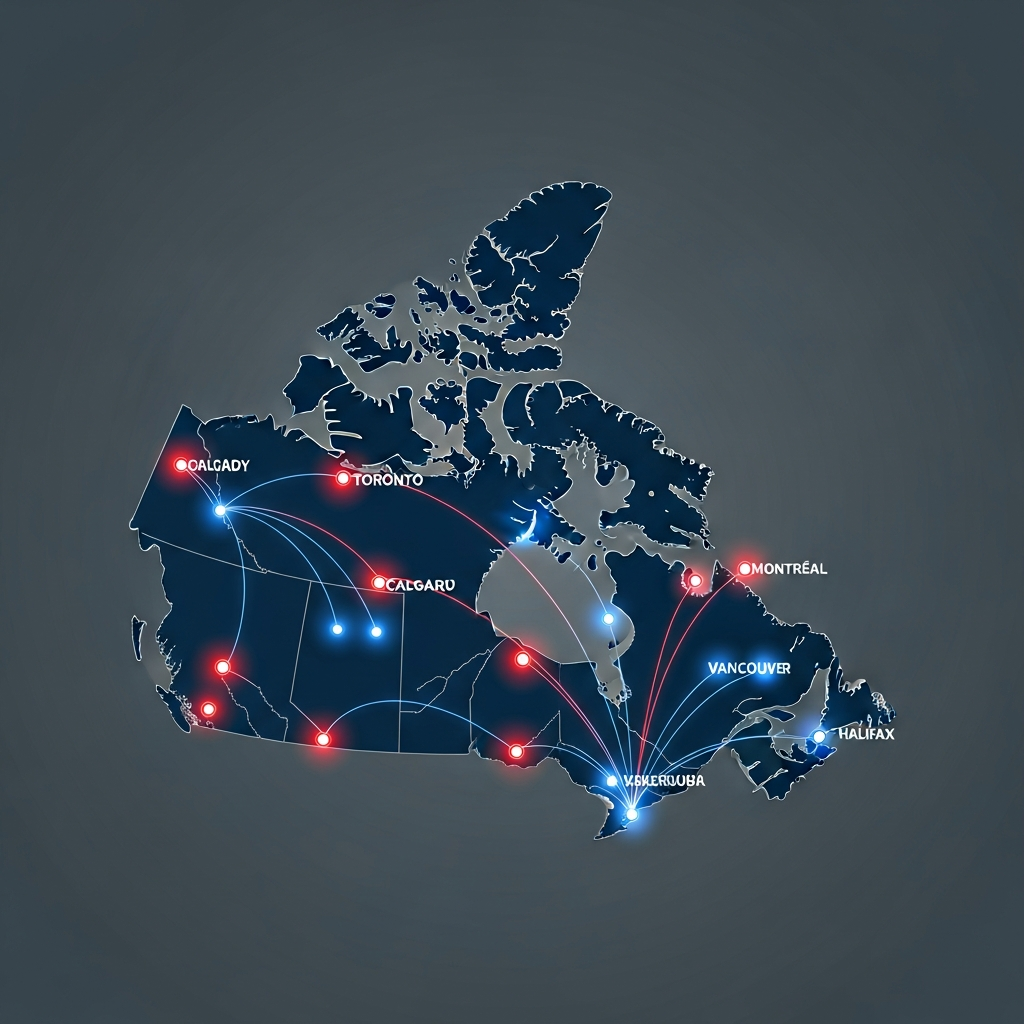 How the GTA's geography shapes fulfillment
The five GTA regions at a glance
Each GTA region has a different fulfillment profile:
| Region | Key highways | Fulfillment character |
|---|
| Peel (Mississauga, Brampton) | 401, 410, 407, 427 | Largest industrial cluster; intermodal & Pearson access |
| York (Vaughan, Markham) | 400, 404, 407 | Fast-growing; CPKC Vaughan intermodal; tech corridor |
| Toronto proper (Scarborough, North York, Etobicoke) | 401, 400, DVP, 427 | Dense urban; last-mile & infill warehousing |
| Durham (Pickering–Oshawa) | 401, 407, 412/418 | Eastern gateway; lower rates; automotive heritage |
| Halton (Oakville, Burlington, Milton) | QEW, 403, 407, 401 | West/QEW corridor; Hamilton & US-border lanes |
Hub-and-spoke vs single-DC within the GTA
Most brands fulfill the entire GTA from a single well-located DC, because one-day ground transit covers the whole region from almost any central node. A hub-and-spoke model — a main DC plus satellite cross-dock or forward-stocking points — only becomes worthwhile for same-day delivery brands, very high local volume, or bulky goods where last-mile distance dominates cost. For the vast majority of DTC and B2B brands, a single central GTA DC plus strong carrier rate-shopping beats running multiple GTA buildings.
Don't over-engineer GTA coverage. One central distribution centre with a rate-shopped multi-carrier mix reaches the entire region next-day. Add satellite nodes only when same-day delivery or bulky-goods last-mile economics demand it.
Carrier mix across the region
The GTA is the most competitive carrier market in Canada. Canada Post offers the broadest residential reach; Purolator runs a strong B2B and express network; FedEx and UPS compete on guaranteed delivery and US cross-border; and a deep bench of regional couriers handles same-day and dedicated GTA delivery. A good GTA fulfillment operation rate-shops every order across several of these networks rather than committing all volume to one — the density of options is one of the region's biggest advantages.
Choosing where in the GTA to fulfill
The right submarket depends on your customers and inbound. If most orders go to GTA and southern Ontario consumers, a central Peel or York node is hard to beat. If you import containers, proximity to the Brampton/Vaughan intermodal terminals or Pearson matters. If you ship heavily into the US Northeast or Hamilton/Niagara, a Halton or western node shortens border lanes. If your customer base skews east, Durham trims transit and rent. Map your actual order destinations and inbound flows before picking a submarket — the 'best' location is specific to your network.
How ByExpress supports GTA fulfillment
ByExpress provides full-service fulfillment for brands serving the Greater Toronto Area, with cloud-WMS order management, multi-carrier rate-shopping, kitting, and returns. Because the GTA is best paired with strong Eastern Canadian reach, ByExpress can combine GTA-area fulfillment with its Ottawa operations to balance the region's import density and population with lower-cost Eastern storage and bilingual reach into Quebec.
Frequently Asked Questions
What does the 'GTA' include for fulfillment?
The City of Toronto plus the four regional municipalities around it: Peel (Mississauga, Brampton), York (Vaughan, Markham), Durham (Pickering–Oshawa), and Halton (Oakville, Burlington, Milton) — roughly 6.5 million people in total.
Do I need multiple warehouses to cover the GTA?
Usually no. A single central DC reaches the entire region next-day by ground. Multiple GTA nodes only make sense for same-day delivery brands, very high local volume, or bulky goods where last-mile distance dominates cost.
Which GTA region is cheapest for warehousing?
Peripheral submarkets like Durham, Hamilton, and the outer Halton/Milton edge generally run below the central Peel and York clusters, which command a premium for their intermodal and Pearson access.
How should I choose which GTA submarket to fulfill from?
Map your actual order destinations and inbound flows. Central Peel/York balances regional reach; Durham favours the east; Halton/west favours the QEW, Hamilton, and US-border lanes; airport-adjacent sites suit air-freight-heavy brands.
What's the advantage of the GTA's carrier market?
It's the most competitive in Canada — Canada Post, Purolator, FedEx, UPS, and many regional couriers all operate here, so rate-shopping every order across several networks meaningfully lowers blended shipping cost.
Related ByExpress resources