Guide · · 13 min read
Inventory Management for Canadian E-commerce: A Practical 2026 Playbook
Inventory is the largest balance-sheet line item for most growing e-commerce brands and the most operationally consequential. Here's a practical playbook for managing it at scale — accuracy, forecasting, safety stock, and the integration discipline that separates 95% accuracy from 99.5%.

Inventory is the largest balance-sheet line item for most Canadian e-commerce brands above $1M in annual revenue, and managing it well or poorly has a larger impact on cash position, working capital, and growth runway than virtually any other operational discipline. Yet most brand operators inherit inventory practices from whatever their first 3PL provided — which is usually 'we count what's there and update the system' rather than the multi-discipline practice that inventory management actually is. This playbook walks through what inventory management for Canadian e-commerce actually entails: accuracy practices, demand forecasting, safety stock calculation, ABC analysis, reorder discipline, multi-location pooling, and the integration architecture that holds it all together.
Inventory accuracy is the foundation everything else sits on
Without high inventory accuracy, none of the more sophisticated inventory practices (forecasting, safety stock, reorder triggers) work. If your system says you have 200 units and you actually have 180, your forecast is off by 10%, your safety stock calculation is wrong, your reorder point is wrong, and you'll either oversell (worst customer experience), overspend on emergency replenishment, or carry excess safety stock to compensate for not knowing what you actually have. Best-in-class inventory accuracy is 99.5%+ at the SKU level, measured by independent cycle counts. Industry average is closer to 96–98%. The gap between 96% and 99.5% sounds tiny but represents the difference between confident operations and constant firefighting. Accuracy comes from three disciplines: scan-based receive and pick (no untracked physical movements), daily cycle counting (1–2% of SKUs per day rather than annual full counts), and reconciliation between WMS, e-commerce platform, and accounting systems on a defined cadence.
If your 3PL only does annual or quarterly full physical counts and never does daily cycle counts, your inventory accuracy is almost certainly below 97% — and you have no way to know which SKUs are wrong until you next count. Daily cycle counting is the single highest-leverage inventory discipline.
ABC analysis: where to focus your attention
Not all SKUs deserve the same operational attention. ABC analysis classifies SKUs by their contribution to revenue or units shipped, with A-SKUs being the top contributors (typically the top 15–20% of SKUs that drive 70–80% of revenue), B-SKUs being the middle tier, and C-SKUs being the long tail. Operationally, A-SKUs deserve: tighter accuracy targets (99.7%+), more frequent cycle counts (weekly), prime warehouse slotting, multi-location stocking, and active demand forecasting. B-SKUs get standard treatment. C-SKUs can run leaner — single-location stocking, less frequent counts, simpler reorder triggers, and acceptance of slightly higher stockout risk in exchange for lower carrying cost. Brands that treat all SKUs the same either over-invest in long-tail SKUs or under-invest in their top revenue drivers.
| Tier | % of SKUs | % of Revenue | Operational Treatment |
|---|
| A (top contributors) | 15–20% | 70–80% | Weekly counts, multi-location, active forecasting |
| B (mid-tier) | 30–40% | 15–20% | Bi-weekly counts, primary location, standard forecasting |
| C (long tail) | 40–55% | 5–10% | Monthly counts, single location, simple reorder triggers |
Demand forecasting that actually works for DTC
Most Canadian DTC brands use one of three forecasting approaches. Naive forecasting projects future demand from a simple historical average — easy and works adequately for stable, mature SKUs but fails for new SKUs, seasonal SKUs, and growing SKUs. Statistical forecasting layers in seasonality, trend, and basic statistical methods (Holt-Winters, ARIMA, exponential smoothing) — better but requires reasonable data history (12+ months ideal). Demand-sensing forecasting incorporates leading indicators like marketing spend, promotional calendar, conversion rate trends, web traffic, and inventory positioning at competitors — most accurate but requires either internal data science capability or specialized forecasting software (Streamline, Inventory Planner, Cogsy). For most growing Canadian brands, statistical forecasting at the SKU-week level is the right starting point, with manual adjustment for known events (new product launches, marketing campaigns, seasonal peaks).
 Demand forecasting that actually works for DTC
Safety stock: the math nobody enjoys but everyone needs
Safety stock is the buffer inventory you hold above forecasted demand to absorb forecast error and supply variability. The simplest safety stock formula is: safety stock = service level factor × standard deviation of demand × square root of lead time. In English: how confident do you need to be in not stocking out (service level factor — 1.65 for 95% service level, 2.05 for 98%, 2.33 for 99%); how variable is your daily demand (standard deviation); and how long does it take to replenish (lead time, including manufacturing and inbound freight). The mistake most brands make is setting a single safety stock target across all SKUs without varying by service level priority. A-SKUs deserve high service level (98%+); C-SKUs can run at 90–95% and free up working capital. Safety stock that's too high quietly destroys cash position; too low quietly destroys customer experience. Recalculate quarterly minimum, monthly for fast-moving SKUs.
Reorder points and replenishment cadence
A reorder point is the inventory level at which you trigger replenishment — typically calculated as (average daily demand × lead time) + safety stock. The discipline of setting accurate reorder points and actually firing replenishment orders when they trigger is the difference between consistent inventory availability and constant firefighting. Most Canadian DTC brands chronically miss reorder points for one of three reasons: reorder points were set once and never updated as demand or lead times changed; the system flags reorder points but no human owns acting on them; or replenishment is approved on a slow internal cadence (weekly approval cycles for SKUs that need to reorder twice a week). A serious operation has clear ownership of reorder decisions, automated alerts when reorder points trigger, and rapid approval workflow for replenishment under defined thresholds.
- Daily reorder point review for A-SKUs
- Automated alerts when reorder point triggers
- Pre-approved purchase orders under defined dollar thresholds
- Lead time tracking by supplier (with quarterly recalibration)
- Multi-location replenishment logic for brands with multiple warehouses
- Inbound freight tracking integrated with reorder point triggers
Multi-location inventory: pooling vs forward-positioning
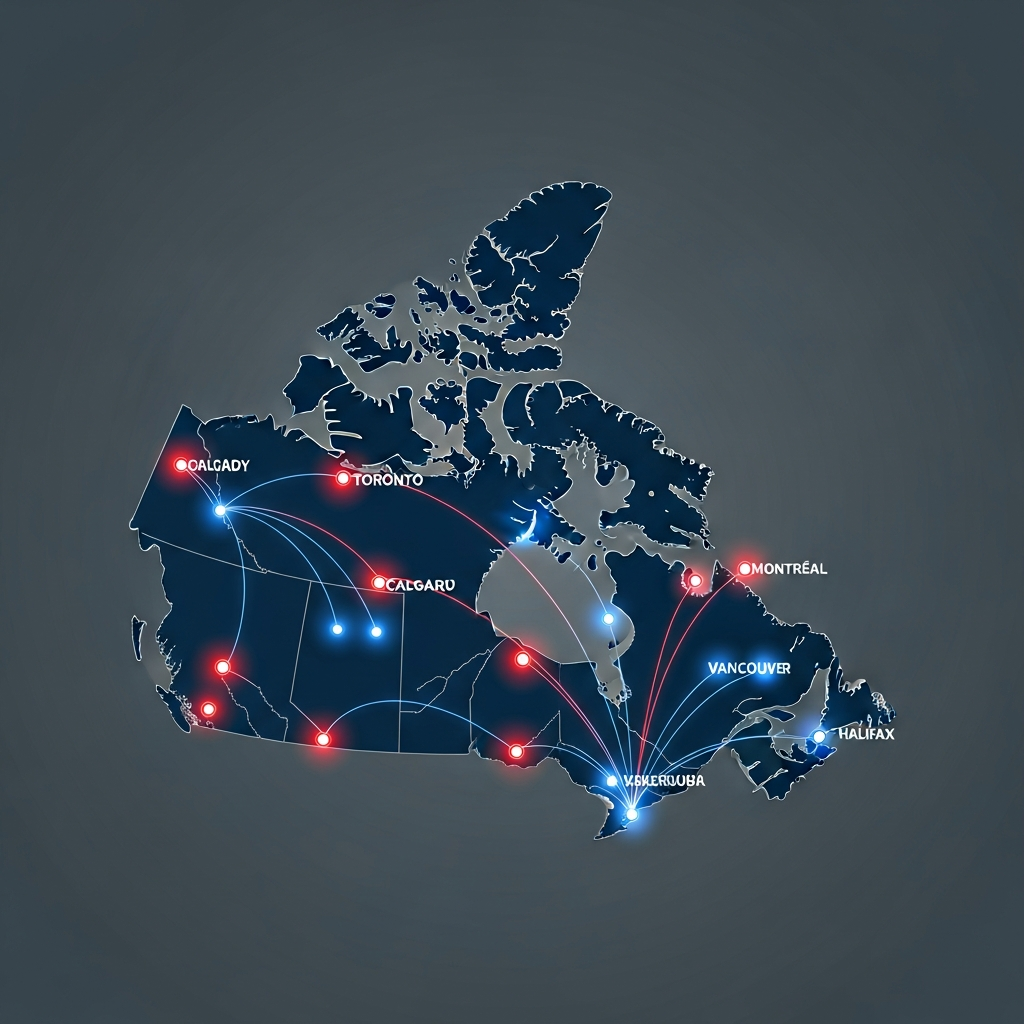
Brands operating from multiple Canadian fulfillment locations face a structural decision about how to allocate inventory across nodes. Pooled inventory keeps all units in one primary location and ships nationally from there — simpler operationally, lower total inventory required, but slower transit to far regions and higher per-parcel shipping cost for cross-zone deliveries. Forward-positioned inventory holds inventory in regional locations close to demand — faster transit, lower per-parcel shipping cost, but higher total inventory required and more complex operations. The right answer is usually category- and SKU-specific: A-SKUs in fast-moving categories deserve forward positioning to support faster delivery promises; B and C SKUs can run pooled to minimize working capital. The operational discipline required is multi-location demand forecasting, transfer order logic between nodes, and inventory visibility that aggregates across locations into a single brand-side view.
 Multi-location inventory: pooling vs forward-positioning
Integration architecture: the technical foundation
Inventory management discipline depends on a clean integration architecture between four systems: the WMS (source of truth for what's physically in the warehouse); the e-commerce platform (Shopify, BigCommerce, WooCommerce, Amazon, Walmart Marketplace — source of truth for what's available to sell); the ERP or accounting system (NetSuite, Brightpearl, QuickBooks — source of truth for inventory cost and balance sheet value); and the demand planning or forecasting tool (Streamline, Cogsy, Inventory Planner). Most brands run with broken integrations between two or more of these — leading to stockouts on Shopify when WMS shows inventory, available-to-sell numbers that don't match accounting balance, or forecasting that runs on stale data. A serious 3PL provides real-time WMS-to-platform sync (sub-5-minute latency), webhook-based inventory events, and API access to inventory state for both forecasting and accounting integration.
Inventory management at ByExpress
ByExpress operates inventory management as a first-class discipline across all five Canadian fulfillment locations. Standard service includes: 99.5%+ inventory accuracy with daily cycle counting; real-time WMS-to-platform sync with sub-5-minute latency to Shopify, Amazon, BigCommerce, WooCommerce, Walmart Marketplace, and EDI retail accounts; brand-side inventory visibility through our customer portal with SKU-level reporting; multi-location inventory pooling and forward-positioning for brands operating across multiple ByExpress nodes; integration with major demand planning tools (Inventory Planner, Cogsy, Streamline) and ERPs (NetSuite, Brightpearl, QuickBooks); reorder point alerting and customizable replenishment workflows; and ABC analysis reporting at the brand-account level. For brands that need it, we also support consigned inventory models and vendor-managed inventory arrangements with retail customers.
Frequently Asked Questions
What is the right inventory accuracy target for Canadian e-commerce?
Best-in-class is 99.5%+ at the SKU level, measured by independent cycle counts. Industry average is closer to 96–98%. Anything below 96% creates constant operational firefighting — your forecasts, safety stock, and reorder points are all running on bad data. Demand 99%+ accuracy from any 3PL serving your inventory.
What is ABC analysis and how do I use it?
ABC analysis classifies SKUs by revenue contribution: A-SKUs are the top 15–20% driving 70–80% of revenue; B-SKUs are mid-tier; C-SKUs are the long tail. Use it to focus operational attention — A-SKUs get tighter accuracy targets, more frequent cycle counts, prime warehouse slotting, multi-location stocking, and active demand forecasting. C-SKUs can run leaner.
How much safety stock should I carry?
Depends on service level priority by SKU and the variability of your demand and lead time. The simplest formula: service level factor × standard deviation of demand × square root of lead time. A-SKUs typically warrant 98%+ service level; C-SKUs can run at 90–95%. Recalculate quarterly minimum, monthly for fast-moving SKUs.
Should I forward-position inventory across multiple Canadian warehouses?
It depends on category and demand geography. Forward positioning makes sense for A-SKUs in fast-moving DTC categories where delivery speed is part of the value proposition (apparel, beauty, urgent supplements). It rarely makes sense for B and C SKUs where the working capital cost of duplicate inventory exceeds the shipping savings. Most growing Canadian brands run a hybrid: A-SKUs forward-positioned in 2–3 locations, B and C SKUs pooled in one primary location.
What is daily cycle counting?
Cycle counting is the practice of counting a small percentage of SKUs every day (typically 1–2% of total SKUs daily) on a rolling schedule, rather than counting everything once a year in a full physical inventory. Daily cycle counting catches accuracy errors quickly, requires no operational shutdown, and produces dramatically higher accuracy than annual full counts. It is the single highest-leverage inventory accuracy discipline.
What integrations should I demand from my 3PL for inventory management?
At minimum: real-time WMS-to-e-commerce-platform sync (sub-5-minute latency); webhook-based inventory events for downstream systems; API access to inventory state; native integrations with your specific platforms (Shopify, Amazon, etc.); and either native or middleware integration with major demand planning tools and ERPs. A 3PL whose inventory updates run nightly batches is operating below the standard you should accept.
Related ByExpress resources