Guide · · 11 min read
How Much Does 3PL Cost in Canada? The Real 2026 Pricing Breakdown
Every Canadian 3PL has line-item pricing — but most quotes hide the real cost in receiving, storage, and surcharges. Here's a clean breakdown of what fulfillment actually costs, by service and by city.

Every 3PL in Canada quotes the same headline numbers: a pick rate, a storage rate, a receiving fee. Then your invoice arrives at the end of month one and it doesn't match the proposal — because the proposal omitted half of the line items that actually drive cost. This guide gives you the real 2026 cost structure for fulfillment in Canada, broken down by service line, by major city, and by the surcharges that turn a $2.95 pick into a $4.40 effective per-order cost. Use it to pressure-test any 3PL quote you receive, and to model your real fully-loaded fulfillment cost before signing.
The five cost categories every 3PL invoice contains
Whatever a 3PL calls their pricing model, every Canadian fulfillment invoice resolves to five categories: receiving, storage, pick-and-pack, postage/shipping, and value-added services (returns, kitting, special handling). A clean way to model your real fulfillment cost is to sum these per order, then divide by orders to get a fully-loaded per-order fulfillment cost. Most brands focus exclusively on the pick-and-pack line because it's quoted prominently — but receiving and storage often equal or exceed pack costs for slow-moving SKUs, and surcharges (oversize, fragile, hazmat, peak) can add 15–35% to a quoted base rate. The hidden tax is always in the lines you didn't ask about.
 The five cost categories every 3PL invoice contains
Pick & pack: the headline number, and what it really costs
Pick-and-pack is what most 3PL quotes lead with because it's the rate clients fixate on. In Canada, expect $2.40–$3.65 for the first item picked and packed, depending on city (Ottawa low end, Mississauga and Vancouver high end), and $0.30–$0.65 for each additional item on the same order. These rates assume standard SKUs, normal-size cartons, no special handling. The moment you add a surcharge — oversize, fragile, lithium battery, gift wrap, custom inserts, photo proof — the effective rate jumps. A reasonable Canadian 3PL will list every applicable surcharge upfront in the SOW. A bad one quotes $2.75 first-pick and surprises you with eight surcharge categories on the first invoice.
| City | First-pick range | Add'l-pick range | Notes |
|---|
| Ottawa | $2.40 – $3.20 | $0.30 – $0.55 | 8–12% below GTA |
| Toronto / GTA | $2.75 – $3.65 | $0.40 – $0.65 | Premium for Mississauga |
| Montreal | $2.50 – $3.30 | $0.30 – $0.55 | Bilingual support standard |
| Vancouver | $2.85 – $3.75 | $0.40 – $0.65 | Highest land cost |
| Calgary | $2.55 – $3.35 | $0.35 – $0.60 | Best Western Canada base |
Receiving: the line item that surprises every brand
Receiving — the cost of unloading, counting, and putting away your inbound inventory — is often the most under-modeled line on a 3PL invoice. Standard 2026 pricing in Canada runs $28–$50 per pallet received, plus $0.15–$0.30 per individual unit if your inventory arrives loose-cartoned rather than palletized. For brands with fast inventory turnover or frequent small inbounds (typical for newly-launched DTC brands), receiving costs can equal or exceed storage. The fix is operational: send pre-palletized, properly-labeled, ASN-noticed inbounds whenever possible. A clean ASN with accurate SKU/quantity per pallet can take a $42-per-pallet receiving fee down to $32 because the 3PL doesn't have to recount and reconcile mismatches.
Storage: pallets, bins, and the dimensional trap
Canadian storage pricing is universally quoted in two structures: per pallet per month (for bulk SKUs that fit standard 48×40 pallet positions) and per bin per month (for small SKUs that live in shelf bins). Pallet storage in Canada runs $22–$38 per pallet per month for ambient (climate-controlled adds 15–25%), and bin storage runs $0.85–$1.65 per bin per month. The dimensional trap: a 'pallet' for billing purposes typically means a standard pallet position, including height. If you ship double-stacked pallets that occupy 1.5 vertical positions, you pay for 1.5 pallets. If you ship oversized or oddly-shaped goods that can't double-stack, you may pay for the full vertical position even if you only use the bottom half. Always clarify how a 3PL calculates pallet positions before signing.
If a 3PL quotes 'storage' without specifying pallet vs. bin and ambient vs. climate, the quote is meaningless. These are 2× cost differences.
Shipping: pass-through vs. marked-up postage
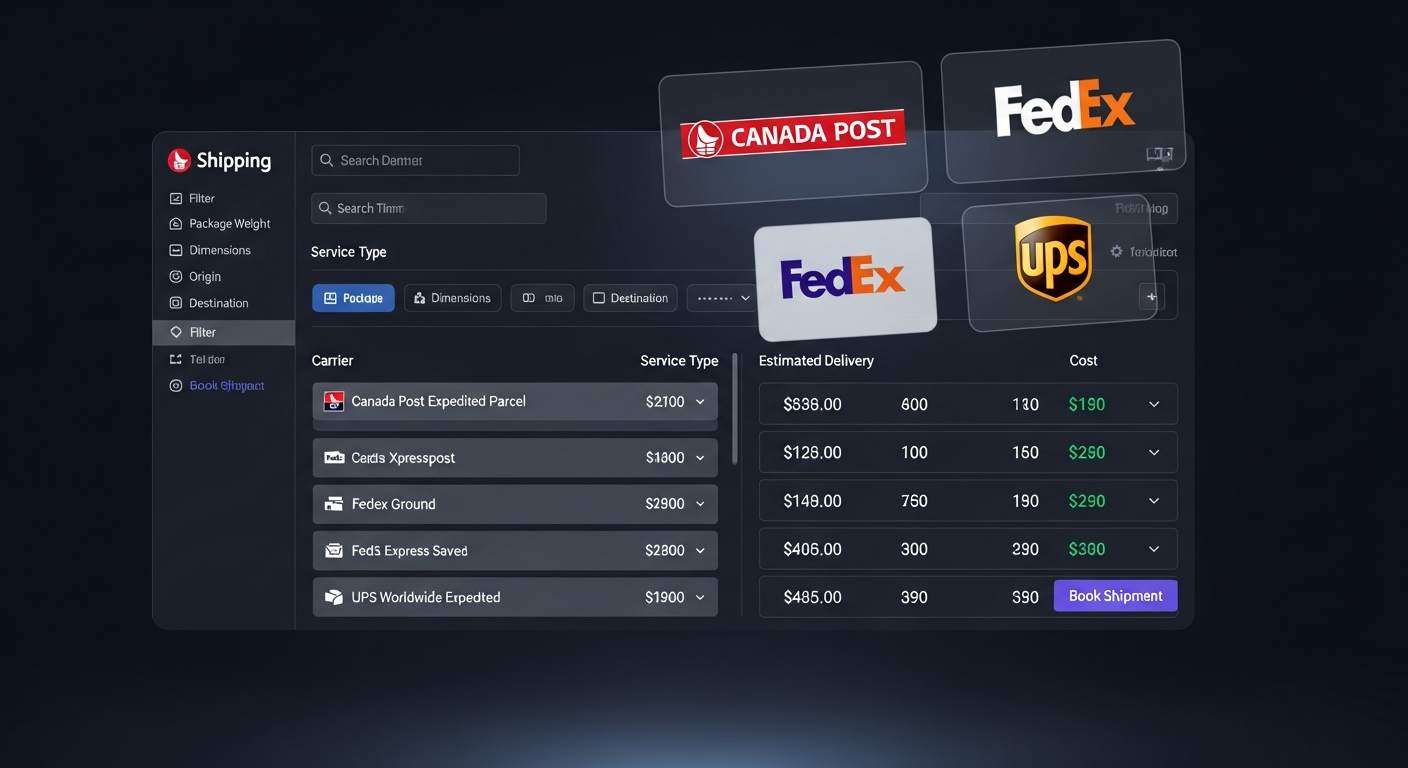
Postage is where Canadian 3PL economics genuinely differ. Two models exist. Pass-through: the 3PL gives you their negotiated carrier rate at cost, charges a per-label processing fee (typically $0.15–$0.40) or a small percentage markup, and you see the carrier rate transparently on your invoice. Marked-up: the 3PL bills you a 'shipping rate' that's 12–25% above their actual carrier cost, takes the spread as margin, and never shows you the underlying rate. Pass-through is dramatically more brand-friendly because it lets you see and control your own shipping cost, and it incentivizes the 3PL to rate-shop aggressively because they don't capture the savings. Marked-up creates misaligned incentives — the 3PL benefits from picking the more expensive carrier. Always insist on pass-through with disclosed processing fee.
 Shipping: pass-through vs. marked-up postage
Value-added services: kitting, returns, and special handling
Kitting (assembling subscription boxes, bundles, custom sets) typically costs $0.85–$2.50 per kit in Canada depending on complexity, plus component costs. Returns processing runs $3.50–$7.00 per return for standard inspect/restock, with photo documentation and grading often $1.00–$2.00 extra. Special handling (oversize, fragile, hazmat, lithium battery, FDA-prior-notice goods) adds $0.50–$3.00 per unit on top of base pick rates. Most VAS line items are reasonable individually but compound quickly — a subscription box brand with custom kitting, photo-proof inspections, and FDA-regulated supplements can easily add $4–$6 in VAS per outbound order on top of base pick-and-pack. Model these into your real cost-per-order before signing.
Calculating your real fully-loaded cost-per-order
The number that matters isn't the headline pick rate — it's your fully-loaded fulfillment cost per outbound order. Calculate it as: (monthly receiving + monthly storage + monthly pick-and-pack + monthly VAS + monthly surcharges + monthly account/minimum fees) divided by monthly outbound orders. Most Canadian DTC brands shipping 500–5,000 orders per month land between $4.50 and $8.50 per outbound order fully-loaded, depending on SKU complexity, AOV, and service mix. Above $9 per order without obvious reason, you're either paying for excess capacity, being squeezed on surcharges, or the 3PL is over-priced. Below $4 per order, you're either flagship volume, very simple SKUs, or being lured by a teaser rate that won't survive scaling.
Account minimums, monthly fees, and the small print
Most established Canadian 3PLs charge some combination of: a monthly account fee ($150–$500 to cover account management overhead), a minimum monthly billing ($800–$3,500 depending on service tier), a WMS/integration fee (often bundled or quoted separately at $50–$300/month per integration), and onboarding/implementation fees ($2,500–$15,000 one-time depending on complexity). None of these are unreasonable, but they should all be itemized in the SOW. Beware of any 3PL that omits these — they exist; the question is whether they're disclosed up-front or buried in the fine print.
Frequently Asked Questions
What is the average cost of 3PL fulfillment in Canada?
For most DTC brands shipping 500–5,000 orders per month, fully-loaded fulfillment cost runs $4.50–$8.50 per outbound order, including all receiving, storage, pick-and-pack, VAS, and account fees. Headline pick-and-pack is typically $2.40–$3.65 first-item plus $0.30–$0.65 per additional item, but real per-order cost is always materially higher once everything is included.
Why is 3PL pricing in Toronto higher than in Ottawa?
Industrial real-estate and labour costs are 25–40% higher in the GTA than in Ottawa, and 3PLs pass these through. Expect Toronto pick rates 8–15% above Ottawa, and Toronto storage rates 15–25% higher. The trade-off: the GTA offers proximity to Pearson air cargo, the densest Amazon FBA infrastructure in Canada, and same-day delivery into Toronto urban.
What hidden fees should I look for in a 3PL contract?
Most common: receiving surcharges for non-palletized inbounds, storage minimums during slow months, oversize/fragile/lithium-battery surcharges, peak-season pick rate increases (often a 15–25% Q4 bump), monthly account fees, integration fees per platform, and label-processing markups on shipping. All legitimate; all should be disclosed in the SOW.
Should I pay per pick or a flat monthly fee?
Per-pick (transactional) pricing is industry standard and the right model for almost every brand because it scales linearly with your business. Flat monthly fees (sometimes offered as 'all-inclusive') only make sense at very high, very predictable volume — they almost always favour the 3PL on the math because you pay for capacity you don't use during slow months.
How does pass-through shipping pricing work?
Pass-through means the 3PL bills you their actual negotiated carrier rate (FedEx, UPS, Purolator, Canada Post) at cost, plus a small per-label processing fee or percentage markup. You see the carrier rate transparently on your invoice. The alternative — marked-up shipping — bundles a margin into the shipping rate without disclosure. Always insist on pass-through.
Are 3PL implementation fees worth it?
Generally yes. A $2,500–$15,000 implementation fee buys you proper SKU intake, integration testing, an SOP document, a named launch lead, and a structured go-live plan. The risk of skipping implementation work to save $5K is a botched launch that costs you $50K in stockouts, customer-service blowback, and emergency 3PL switching. Pay for proper onboarding.
Related ByExpress resources