Guide · · 13 min read
How to Choose a 3PL in Canada: The 2026 Buyer's Guide
The framework for choosing a Canadian fulfillment partner — network coverage, technology, transparent pricing, and the operational red flags that separate a real 3PL from a sub-scale one.

Choosing a 3PL is the single most consequential operational decision an e-commerce brand will make in its first five years — and the most frequently mishandled. Most brand founders evaluate 3PLs on the easiest-to-compare variables (pick rate, storage rate) and ignore the variables that actually drive long-term outcomes (network density, technology integration, operational maturity, transparency). This guide is the framework we'd use ourselves: a structured evaluation across the eight dimensions that matter, the questions that separate competent operators from sub-scale ones, the red flags worth walking away from, and the pricing models you should accept versus reject.
Network coverage: single-node vs multi-node trade-offs
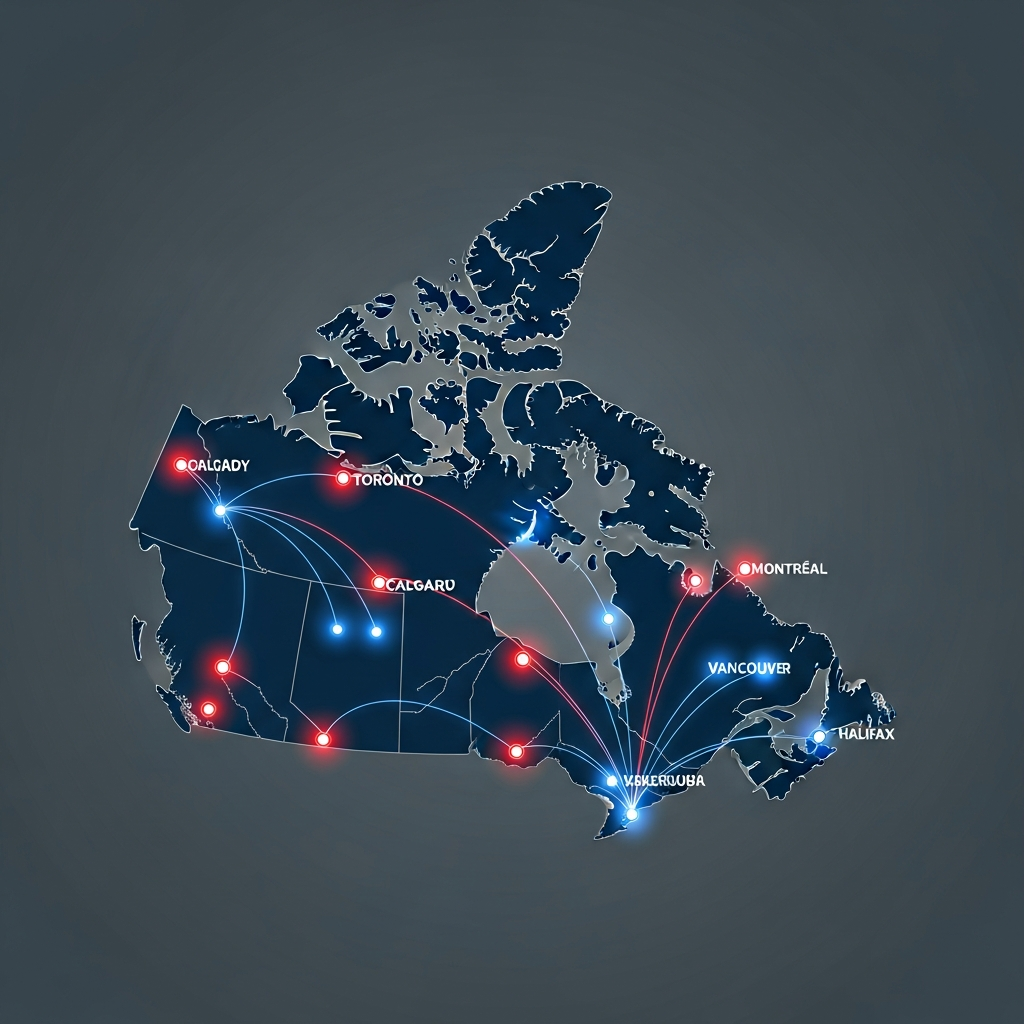
The first decision is structural: do you anchor with a single-node 3PL or a multi-node Canadian network? A single Toronto warehouse might be the right answer if your demand is concentrated in southern Ontario and you ship under 1,500 orders per month. Above that, the math almost always favours a multi-node setup because cross-country parcel from Toronto to Vancouver costs 2.5–3× a single-zone parcel within Ontario. The cleanest multi-node networks for Canadian brands cover Ottawa or Toronto in the East, Vancouver or Calgary in the West, with optional Montreal for Quebec depth and a U.S. cross-border injection point. Don't pay for nodes you don't need — but don't anchor a national brand to a single regional 3PL.
 Network coverage: single-node vs multi-node trade-offs
Technology depth: WMS, integrations, and API
A modern 3PL is as much a software company as a warehouse operator. The hard checks: which Warehouse Management System do they run, is it built in-house or a named platform, and what integrations does it natively support? Native integrations (built and maintained by the 3PL) with Shopify, Amazon Seller Central, NetSuite, BigCommerce, Walmart Marketplace, WooCommerce, and EDI partners (X12 850, 856, 810) are table-stakes. A documented REST API with webhooks for order events, inventory changes, and shipment updates is required for any brand running custom front-end logic. Ask to see API documentation, sample webhook payloads, and a sandbox tenant for testing — a serious 3PL has all three.
Pricing transparency and the SOW pressure test
Every 3PL has line-item pricing. The differentiation is whether they disclose all line items upfront or surprise you on invoice month one. The SOW (Statement of Work) pressure test: ask for a fully line-itemized SOW that includes pick rates, additional-pick rates, all surcharges (oversize, fragile, lithium battery, hazmat, peak season), receiving rates, storage rates (pallet and bin), kitting rates, returns rates, account fees, integration fees, monthly minimums, and shipping pricing model (pass-through versus marked-up). If any of these are 'TBD' or missing, push for them in writing before signing. A 3PL that resists is one that benefits operationally from opacity.
Insist on pass-through shipping with disclosed processing fees. Marked-up shipping (where the 3PL bundles a margin into your shipping rate without disclosure) misaligns incentives — they benefit from picking the more expensive carrier.
Operational KPIs and the metrics gate
Five operational KPIs separate functional 3PLs from troubled ones: order accuracy (target ≥99.5%), on-time pick (target ≥97%), on-time ship (target ≥98%), inventory accuracy (target ≥99.5%), and damage rate (target ≤0.3%). Ask any prospective 3PL for these five metrics, monthly, for the last six months, in writing. Three things happen: a top-tier operator sends them within 24 hours, a competent operator sends them within 3 business days after pulling them, and a sub-scale operator either refuses, delays, or sends suspiciously perfect numbers without methodology. The last category should be eliminated immediately — 3PLs that don't measure these can't be holding themselves accountable to them.
| KPI | Healthy Target | Warning Signal |
|---|
| Order accuracy | ≥ 99.5% | < 99.0% indicates pick/SOP issues |
| On-time pick | ≥ 97% | < 95% indicates capacity strain |
| On-time ship | ≥ 98% | < 96% indicates carrier hand-off problems |
| Inventory accuracy | ≥ 99.5% | < 99% indicates cycle-count discipline gaps |
| Damage rate | ≤ 0.3% | > 0.5% indicates pack quality issues |
| First-response support time | < 4 hours | > 1 day indicates support understaffing |
The site visit: what to look at, what to ignore
Always visit the warehouse physically before signing — and look at the operation, not the office. Things that signal operational health: dock organization (are inbound trailers being unloaded systematically, or is freight piled in chaos?), racking density and labeling (are bin and pallet positions clearly labeled and consistent?), pick path organization (do picker paths make geometric sense, or are pickers backtracking?), packing station cleanliness (is the pack area orderly, well-lit, with materials staged?), and floor cleanliness (a dirty floor is a leading indicator of operational neglect). Ignore the front-office aesthetics, the marketing collateral, and the C-suite tour. The operation is on the floor.
 The site visit: what to look at, what to ignore
Reference checks: how to call them, what to ask
Every credible 3PL provides reference customers. The reference call is where you find out what the 3PL is actually like to work with. Ask for three references in your size band (within 2× of your current monthly order volume) and your industry vertical. Call all three. Ask: How long have you been with [3PL]? What surprised you positively after launch? What surprised you negatively? Have you ever had a major operational issue, and how did they handle it? Would you recommend them to me, knowing what you know now? The third question matters most — every 3PL has issues; the differentiation is how they handle them. A reference who praises problem-handling is signaling operational maturity. A reference who has never had an issue is either lying or has too small a relationship to test the 3PL's response capability.
Will they scale with you, or break at 3×?
Most 3PL switches happen because the 3PL was the right fit at signing and the wrong fit at 3× the volume. Two questions test scaling capability. First: what's your largest current customer's monthly order volume, and what does their operation look like? You want a 3PL where your projected 18-month volume is well within their existing operational range, not at the edge. Second: how do you handle the kind of growth I'm projecting — what does staffing look like, what does WMS configuration look like, what does Account Manager attention look like? A serious 3PL has a growth playbook; a sub-scale one has hopes.
Red flags worth walking away from
Six patterns indicate you should walk away even if the headline pricing is attractive. First: refusal or reluctance to host a physical site visit. Second: refusal to provide reference customers in your size band. Third: inability to produce KPIs from the last six months. Fourth: pricing structure that hides shipping mark-ups, omits surcharges, or relies heavily on monthly minimums. Fifth: WMS that's a homegrown spreadsheet-and-CSV system rather than a real platform. Sixth: any 3PL where the founder or named senior person promises to personally handle issues — this is a sub-scale operator who will be unreachable when you have a real problem at 2 AM. Walk away from all six. The 3PL market is large enough that you don't need to compromise on any of them.
Frequently Asked Questions
What's the most important thing to evaluate when choosing a 3PL in Canada?
Operational maturity, measured by KPI transparency. A 3PL that can produce six months of order accuracy, on-time pick, on-time ship, inventory accuracy, and damage-rate data within 24 hours is measurably more reliable than one that can't. Everything else — pricing, technology, geography — matters, but operational discipline is the foundation that lets all of them work.
Should I pick a single-node or multi-node 3PL?
Below ~1,500 monthly orders or with concentrated regional demand, a single-node 3PL is usually sufficient. Above that, with national distribution, a multi-node Canadian network (typically Ottawa-or-Toronto in the East plus Calgary-or-Vancouver in the West) usually wins on blended parcel cost and transit time. Don't pay for nodes you don't need; don't anchor a scaling national brand to a single regional 3PL.
How do I know if a 3PL's quoted pricing is real?
Demand a fully line-itemized SOW with: pick rates, additional-pick rates, all surcharges (oversize, fragile, lithium battery, peak), receiving and storage rates, kitting and returns rates, account fees, integration fees, monthly minimums, and shipping pricing model. If any line is 'TBD' or omitted, push for it in writing before signing. The hidden cost in 3PL invoices almost always lives in the lines that weren't disclosed up-front.
What KPIs should I expect a 3PL to report on?
Order accuracy (target ≥99.5%), on-time pick (≥97%), on-time ship (≥98%), inventory accuracy (≥99.5%), damage rate (≤0.3%), and first-response support time (<4 hours). A serious 3PL produces all six monthly without you asking. Ask for the last six months of all six in writing as part of due diligence.
How long does a 3PL migration take?
Standard migrations run 6–10 weeks: contract finalization, integration build (1–2 weeks for typical Shopify/Amazon stacks), inventory transfer planning, physical relocation across one to two weekends, and a 2-week parallel-operations period where both 3PLs are live to catch sync issues. Complex migrations (heavy SKU counts, B2B EDI, kitting workflows) can run 12–16 weeks.
Should I sign a long-term 3PL contract?
Multi-year contracts with reasonable termination clauses are fine and often come with better pricing. Avoid: contracts with high termination fees relative to monthly billing, contracts that auto-renew silently, contracts with annual price-increase clauses tied to CPI without caps, and contracts that lock you into a specific WMS or integration that's hard to migrate from. Always read termination, pricing-adjustment, and data-portability clauses carefully.
Related ByExpress resources