Guide · · 13 min read
Last-Mile Delivery in Canada: Costs, Carriers, and Rural Reach
Last mile is where 40–60% of your shipping cost and almost all of your customer-experience risk live. Here's how it really works across Canada's geography.
The last mile — the final leg from a local depot to your customer's door — is the most expensive, most variable, and most emotionally charged part of Canadian fulfillment. It routinely accounts for 40–60% of total shipping cost, and it is the only part of the journey the customer actually sees. Canada makes last mile uniquely hard: the second-largest country on earth by area, with roughly 90% of the population clustered within 160 km of the US border and the remaining 10% spread across enormous distances. This guide breaks down how last-mile delivery really works here, the carrier trade-offs, why delivery density is the single biggest lever on cost, and how a national 3PL footprint changes the math.
Why the last mile is harder in Canada than almost anywhere
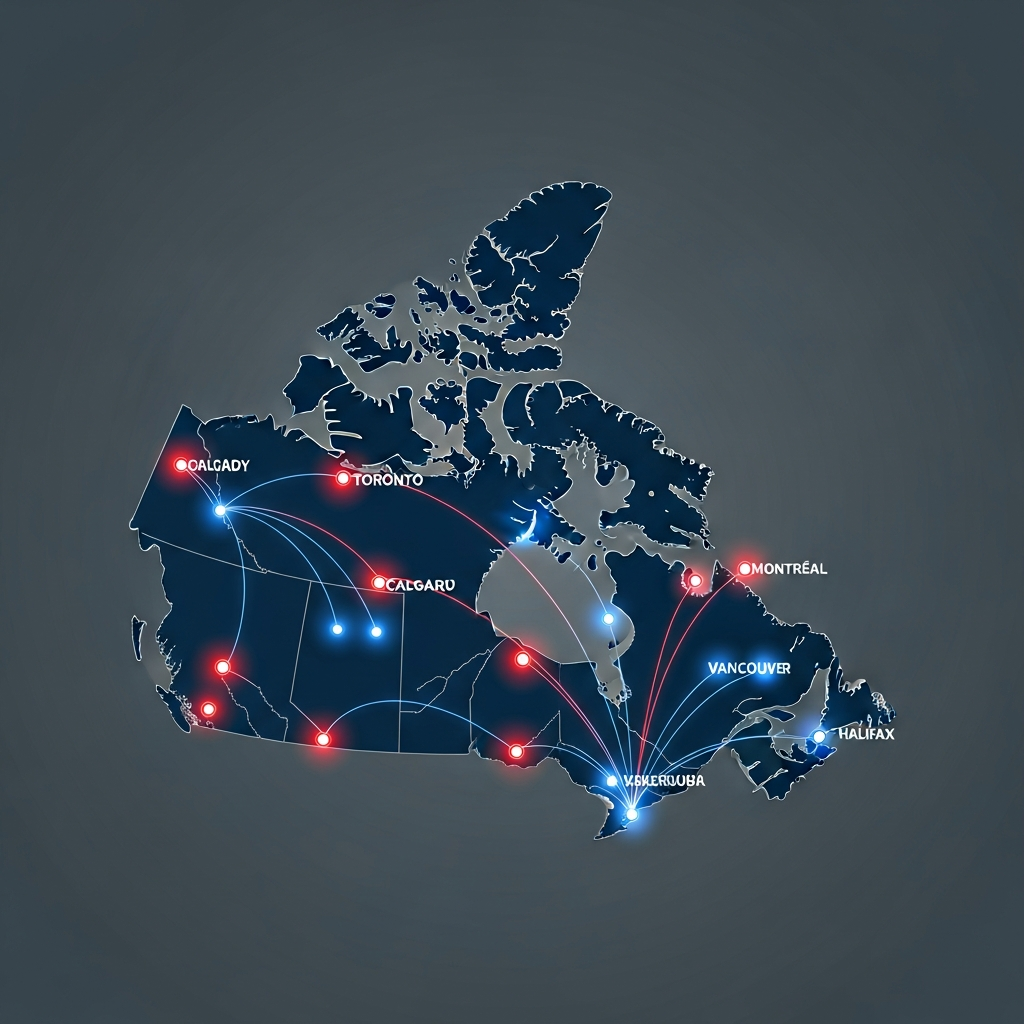
Three structural facts shape every last-mile decision in Canada. First, population geography: the Quebec City–Windsor corridor holds more than half the country, so dense, cheap delivery is possible there — but the Prairies, Atlantic Canada, and the North are sparse and expensive. Second, weather: winter routinely degrades transit reliability for four to five months a year, and northern routes can depend on seasonal ice roads or air freight. Third, carrier concentration: a small number of national carriers (Canada Post, Purolator, FedEx, UPS, and regional players like Intelcom and Day & Ross) dominate, so leverage on rates comes from volume and zone mix, not from a long tail of competitors. The practical result is that a single national rate card almost never reflects your real cost — your blended last-mile cost is a weighted average of cheap urban zones and expensive remote ones.
 Why the last mile is harder in Canada than almost anywhere
The Canadian last-mile carrier landscape
No single carrier wins everywhere. The realistic playbook is to route each parcel to the carrier that is cheapest and fastest for that specific destination and weight — not to standardize on one. Below is how the main options actually compare for e-commerce parcel.
| Carrier | Strength | Weakness | Best for |
|---|
| Canada Post | Widest residential + rural coverage, PO boxes, cheapest sub-1kg | Slower, weaker live tracking, labour-disruption risk | Rural, remote, lightweight DTC |
| Purolator | Strong national ground, good urban speed | Premium pricing on residential | Time-sensitive ground, B2B |
| FedEx / UPS | Express, tracking, integrated cross-border | Higher residential surcharges | Express, high-value, US lanes |
| Intelcom / regional | Low-cost urban metro density | Coverage gaps outside metros | High-volume urban DTC |
| Courier / local | Same-day metro, white-glove | Not scalable nationally | Same-day, oversized, local |
Delivery density: the lever that actually moves cost
The economics of last mile are dominated by stops per route. A van that drops 120 parcels in a dense urban neighbourhood has a far lower cost-per-parcel than one driving 250 km to deliver 12 packages across rural roads. This is why the same parcel can cost $7 to deliver in downtown Toronto and $19 to a rural postal code three provinces away. You cannot change geography, but you can change where inventory sits. Distributing inventory across multiple fulfillment nodes shortens the average last-mile leg, pushes more parcels into cheaper local zones, and raises effective density — which is the entire reason multi-node fulfillment exists.
If your last-mile cost feels high, the problem is usually zone mix, not your carrier rate. Moving inventory closer to demand fixes zone mix; renegotiating a rate card rarely does.
How to hit 2-day ground across most of Canada
Two-day ground to roughly 90% of Canadians is achievable, but only with the right node placement. A single warehouse in Ontario can reach the Quebec City–Windsor corridor in one to two days, but Western Canada and Atlantic Canada fall into three-to-five-day ground from there. Adding a Western node (Vancouver or Calgary) collapses Western transit to one to two days, and an Eastern/Atlantic strategy handles the Maritimes. The standard national pattern is a Central node (Ontario) plus a Western node, which together cover the large majority of the population in two days. Ottawa is a strong Central-East anchor because it sits inside the corridor and is well positioned for both Eastern Canada and the US Northeast.
 How to hit 2-day ground across most of Canada
The hidden cost of failed deliveries and returns
A failed first delivery attempt is one of the most expensive events in last mile: it doubles (or triples) the delivery cost, delays the customer, and is a leading trigger for refund requests and chargebacks. The biggest drivers are bad address data, no safe-drop instructions, and signature requirements applied indiscriminately. Reducing failed deliveries is mostly an upstream data problem — address validation at checkout, smart safe-drop defaults, proactive delivery notifications, and right-sizing signature requirements to order value. For higher-value items, a parcel locker or pickup-point option often beats repeated home-delivery attempts.
- Validate and standardize addresses at checkout, not at the warehouse
- Default to safe-drop for low-value parcels; reserve signature for high-value
- Send proactive tracking + delivery-window notifications to cut WISMO tickets
- Offer pickup points / lockers for dense urban and apartment-heavy zones
- Feed delivery-exception data back into carrier selection by zone
How ByExpress approaches last mile
ByExpress runs rate-shopping across Canada Post, Purolator, FedEx, UPS, and regional carriers at pack time, choosing the cheapest compliant service per destination and weight rather than forcing every parcel onto one carrier. With fulfillment nodes positioned across the country — including an Ottawa anchor for Eastern Canada and the US Northeast — we shorten the average last-mile leg and push more volume into cheaper local zones. The result for most brands is a lower blended last-mile cost and a higher share of orders landing in the two-day ground window, without the brand having to manage multiple carrier contracts directly.
Frequently Asked Questions
What percentage of shipping cost is the last mile?
For most Canadian e-commerce parcels, last mile is 40–60% of total delivery cost. It is the single largest and most variable component, which is why optimizing it (through node placement and per-parcel carrier selection) has the biggest impact on your blended shipping cost.
Which carrier has the best rural coverage in Canada?
Canada Post has the widest residential and rural reach, including remote postal codes, PO boxes, and northern communities that private carriers either don't serve or surcharge heavily. For lightweight parcels to rural and remote destinations, it is usually both the cheapest and the most complete option.
How many warehouses do I need for 2-day ground across Canada?
Most brands reach roughly 90% of Canadians in two-day ground with two well-placed nodes: one Central (Ontario, e.g. the Ottawa–Toronto corridor) and one Western (Vancouver or Calgary). A single Ontario node covers the dense Central corridor but leaves the West and Atlantic Canada at three-to-five days.
Why does the same parcel cost so much more to some postal codes?
Because of delivery density and zone distance. Dense urban routes spread fixed driving cost across many stops; remote routes spread it across few. Carriers price this through zones and extended-area / rural surcharges, so the same item can cost two to three times more to a sparse postal code.
How do I reduce failed first-delivery attempts?
Fix the upstream data and defaults: validate addresses at checkout, enable safe-drop for low-value parcels, send proactive delivery notifications, and offer pickup-point or locker options in apartment-dense areas. Failed attempts are mostly an address-quality and instruction problem, not a carrier problem.
Related ByExpress resources