Guide · · 14 min read
Marketing Fulfillment: The Complete Guide to Amplifying Your Brand's Impact
Marketing fulfillment — the storage, kitting, and distribution of your branded materials, swag, sales kits, and campaign assets — is the unglamorous machinery behind every campaign that lands on time. Here's how it works, where it breaks, and how to run it well in Canada.
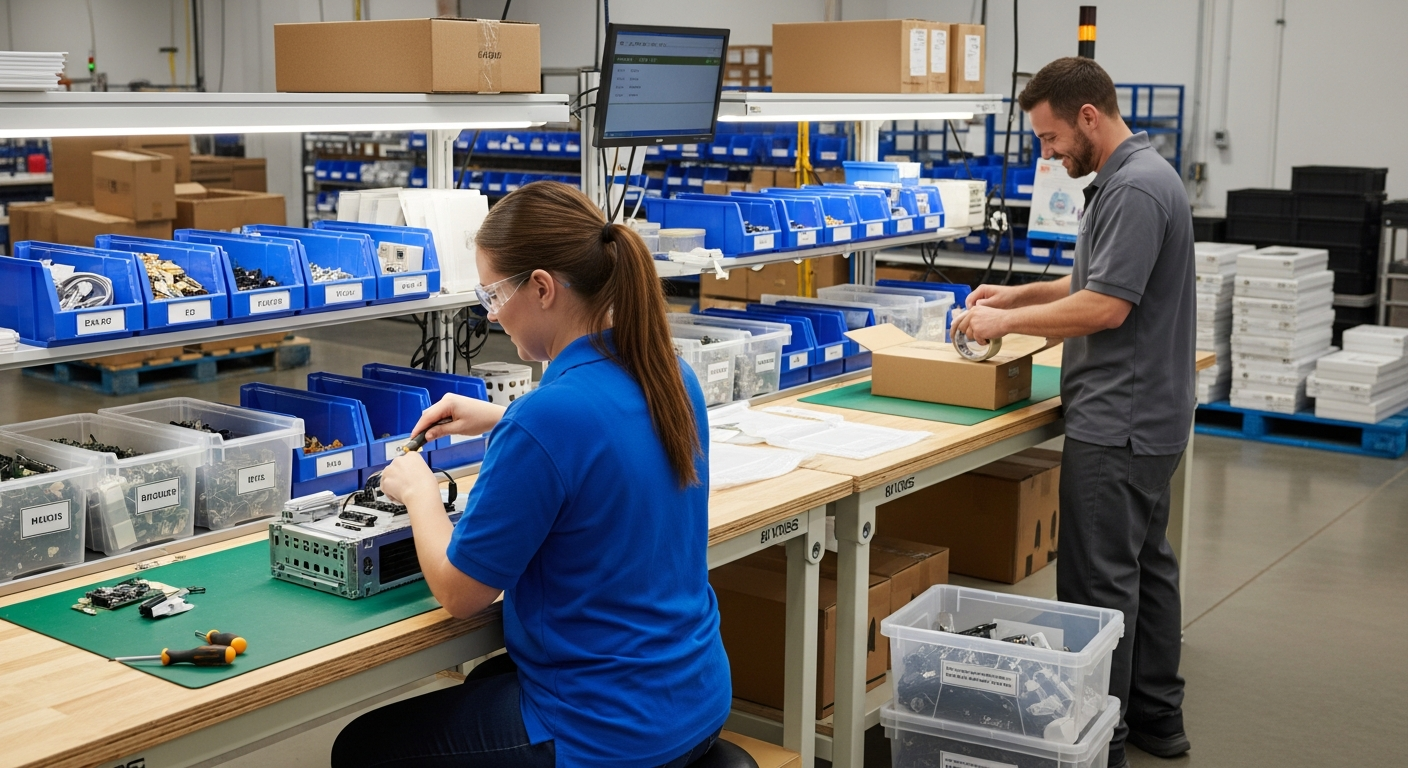
Marketing teams obsess over creative, media spend, and messaging — and then a campaign underdelivers because 4,000 branded kits arrived at the sales conference two days late, or the dealer network received last quarter's price sheets, or the influencer seeding boxes went out with crushed packaging. Marketing fulfillment is the operational discipline that prevents these failures: the managing, storing, assembling, and distributing of the physical (and print-on-demand) materials that carry your brand into the world. It rarely gets budget-meeting airtime, but it determines whether the money you spent on strategy and creative actually shows up — intact, on-brand, and on time. This guide covers what marketing fulfillment includes, why it fails, the ingredients of an operation that works, what it costs in Canada, and twelve marketing material ideas that consistently outperform generic swag.
What is marketing fulfillment?
Marketing fulfillment is the end-to-end process of managing the physical assets behind your marketing: receiving materials from printers and merch suppliers, storing them in organized inventory, assembling them into kits or campaign packages, and distributing them to wherever the campaign needs them — sales reps, retail locations, trade-show floors, dealer networks, event venues, media contacts, or directly to customers and prospects. It sits at the intersection of marketing and logistics, and it covers a wider range of items than most people expect: printed brochures, catalogues, and price sheets; branded merchandise and corporate swag; point-of-sale displays and retail signage; product samples and demo units; direct-mail pieces; event and trade-show materials; onboarding and welcome kits; and influencer or PR seeding packages. The common thread: none of it generates revenue directly, all of it represents your brand physically, and every piece has a time-sensitive destination.
A useful mental model: e-commerce fulfillment delivers what a customer bought. Marketing fulfillment delivers what makes them want to buy. The service levels are different — a late e-commerce order annoys one customer; a late campaign drop wastes the entire media spend built around it.
Why marketing fulfillment makes or breaks campaigns
Marketing fulfillment is the bridge between strategy and execution. A campaign is a synchronized event: the ads go live, the emails send, the sales team starts conversations — and the physical materials must land in the same window or the whole choreography falls apart. Three things make it genuinely high-stakes. First, deadlines are absolute: a product launch, conference, or seasonal promotion doesn't move because a pallet is stuck in transit. Second, brand consistency is on the line: a faded reprint, an outdated logo, or a kit assembled with mismatched components quietly erodes the professionalism your brand spends years building. Third, waste compounds silently: companies routinely scrap 20–30% of printed marketing materials because they were over-ordered, went stale before use, or simply couldn't be located when needed. Good marketing fulfillment converts that waste into reach — the right materials, at the right place, at the right time, in the right quantity.
 Why marketing fulfillment makes or breaks campaigns
Where marketing fulfillment breaks down
Most marketing fulfillment failures trace back to a handful of structural problems. Brand consistency drift: when materials are produced by multiple vendors and stored in multiple places (the office storage room, a rep's garage, a printer's warehouse), version control disappears — reps hand out old spec sheets, events display superseded pricing, and regional teams improvise their own materials. Obsolete inventory: products change, prices change, executives change — and every change strands printed material. Without visibility into what exists and where, teams reorder what they already have and store what they'll never use, paying storage on dead stock. Demand spikes: marketing demand isn't smooth; it's a flat line punctuated by launches, trade-show season, and Q4. An operation sized for the average will fail at exactly the moments that matter most. Kitting complexity: a 'simple' welcome kit with six components has six ways to be assembled wrong, and errors are discovered by the recipient — your prospect — not by you. Last-mile variety: the same campaign might need one pallet to a convention centre with a strict dock appointment, 200 individual boxes to sales reps' homes, and 40 mixed cartons to retail stores. Each channel has different packaging, labelling, and carrier requirements.
- Version control: old materials circulating alongside new ones, with no way to purge stale stock
- Invisible inventory: nobody knows what exists, so teams over-order and over-store
- Spiky demand: launches and event season overwhelm operations sized for average volume
- Kitting errors: multi-component kits assembled inconsistently, discovered by recipients
- Channel complexity: trade-show freight, home delivery, and retail distribution in one campaign
- Rush-fee dependency: chronic late planning turns every campaign into premium-priced expedited shipping
The five ingredients of marketing fulfillment that works
Operations that consistently deliver campaigns share five characteristics. Speed to market: the window between 'campaign approved' and 'materials in-market' keeps shrinking; the operation must compress receiving, kitting, and dispatch into days, not weeks — which requires standing capacity, documented kit specs, and carrier relationships already in place. Accuracy: marketing shipments are unusually unforgiving — a wrong-language brochure in Quebec, a competitor's co-branded item in the wrong kit, or a misdirected pallet is a brand incident, not just a logistics miss; barcode-verified pick and pack with photographed kit builds is the standard to demand. Real-time inventory visibility: marketing teams should see stock levels, locations, and consumption rates in a portal — visibility is what kills over-ordering and stale-stock circulation. Scalability: the operation must absorb a 10x volume spike for launch week without degrading, then scale back down without charging you for idle capacity. Integration: order portals for field reps, approval workflows so regional teams order pre-approved materials only, and connections to your CRM or campaign calendar so fulfillment sees demand coming instead of reacting to it.
| Ingredient | What it looks like in practice | What its absence costs |
|---|
| Speed to market | 48–72h from kit approval to dispatch | Missed launch windows, chronic rush fees |
| Accuracy | Barcode-verified kitting, photo-documented builds | Brand-damaging errors found by prospects |
| Inventory visibility | Live portal with stock, location, burn rate | Over-ordering, stale materials circulating |
| Scalability | 10x surge capacity for launches and event season | Failures at exactly the highest-stakes moments |
| Integration | Rep ordering portals, approval workflows, CRM sync | Email-and-spreadsheet chaos, rogue materials |
Strategies that separate great marketing fulfillment from adequate
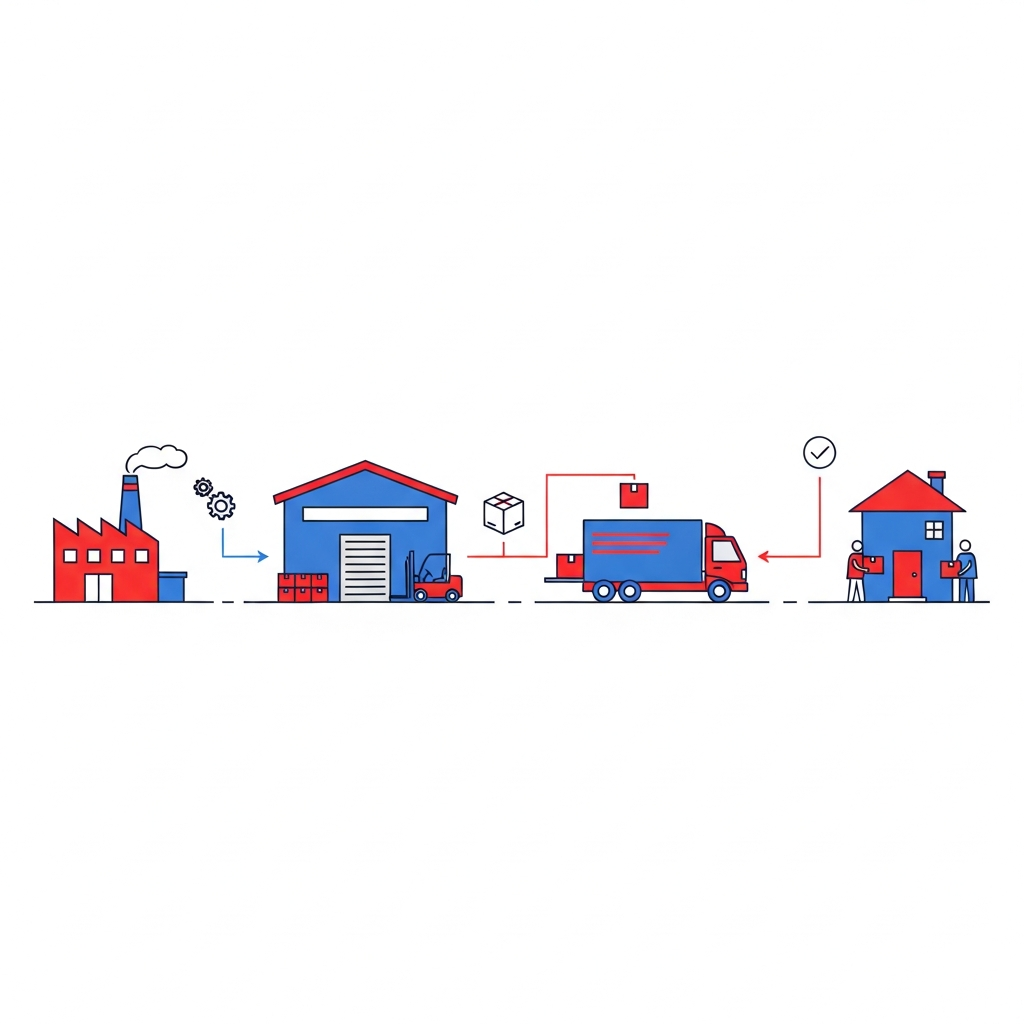
Beyond the fundamentals, a few strategic choices consistently pay for themselves. Go digital-first, print-on-demand second: hold evergreen brand materials in modest quantities and shift date-sensitive or version-sensitive collateral to print-on-demand, so updates cost a file change instead of a dumpster of obsolete brochures. Centralize into a single source of truth: one warehouse (or one coordinated network) holding all marketing assets, with one inventory system, ends the garage-and-storage-room sprawl that destroys version control. Pre-build your kits: assemble welcome kits, sales kits, and event packages during quiet weeks so launch week is pure dispatch — pre-built kits ship same-day; built-to-order kits ship when the line has capacity. Set reorder automation: minimum-stock triggers on evergreen items prevent the 'we're out of catalogues during our biggest show' emergency. Audit quarterly: a scheduled purge of superseded materials keeps stale stock from circulating and cuts storage spend. Measure it like marketing: track cost-per-kit-delivered, on-time in-market rate, and material waste percentage — when fulfillment reports into campaign metrics, it gets managed like the campaign asset it is.
 Strategies that separate great marketing fulfillment from adequate
Marketing fulfillment in Canada: what's different
Running marketing fulfillment for Canadian audiences adds a layer most U.S.-centric guides skip. Bilingual compliance: consumer-facing materials destined for Quebec must respect French-language requirements, which means dual-language inventory, language-split kitting rules, and version control across two parallel material sets. Cross-border friction: shipping branded merchandise from a U.S. warehouse into Canada attracts duties, brokerage fees, and delays that can double landed cost on low-value swag — holding campaign inventory in-country eliminates the single biggest source of blown event deadlines for brands expanding north. Geographic spread: a national dealer or event campaign spans six time zones and 5,500 km; distribution from a central Ontario location reaches the bulk of the population within two days by ground, but Western and Atlantic events need earlier dispatch cut-offs built into the campaign calendar. Seasonal reality: winter storms are a scheduled certainty, not an excuse — experienced Canadian fulfillment operations pad event freight timelines from November through March by default.
In-house vs. outsourced: when to hand it off
Early-stage teams usually run marketing fulfillment from a supply closet, and at low volume that's rational. The economics flip when any of these become true: someone in marketing spends more than a few hours a week packing and shipping materials; campaigns regularly need more than ~50 shipments in a burst; you're storing pallets, not boxes; kits have four or more components; or you're distributing across provinces (or the border) with mixed freight and parcel. Outsourcing to a 3PL with kitting capability converts a fixed internal burden into a variable cost that scales with campaign activity — you pay for storage you use and kits you ship, not for idle space and interrupted marketers. The right provider also brings things an internal closet never will: barcode-verified accuracy, live inventory visibility, discounted multi-carrier rates, surge capacity for launches, and a physical operation that treats a Tuesday dealer replenishment and a 3,000-kit product launch with the same process discipline.
Rule of thumb: when the fully-loaded hours your marketing team spends on packing, shipping, and inventory-hunting exceed the monthly cost of outsourced fulfillment — typically at a few hundred shipments a month or one major campaign a quarter — you're paying a premium to do it worse.
12 marketing material ideas that actually get kept
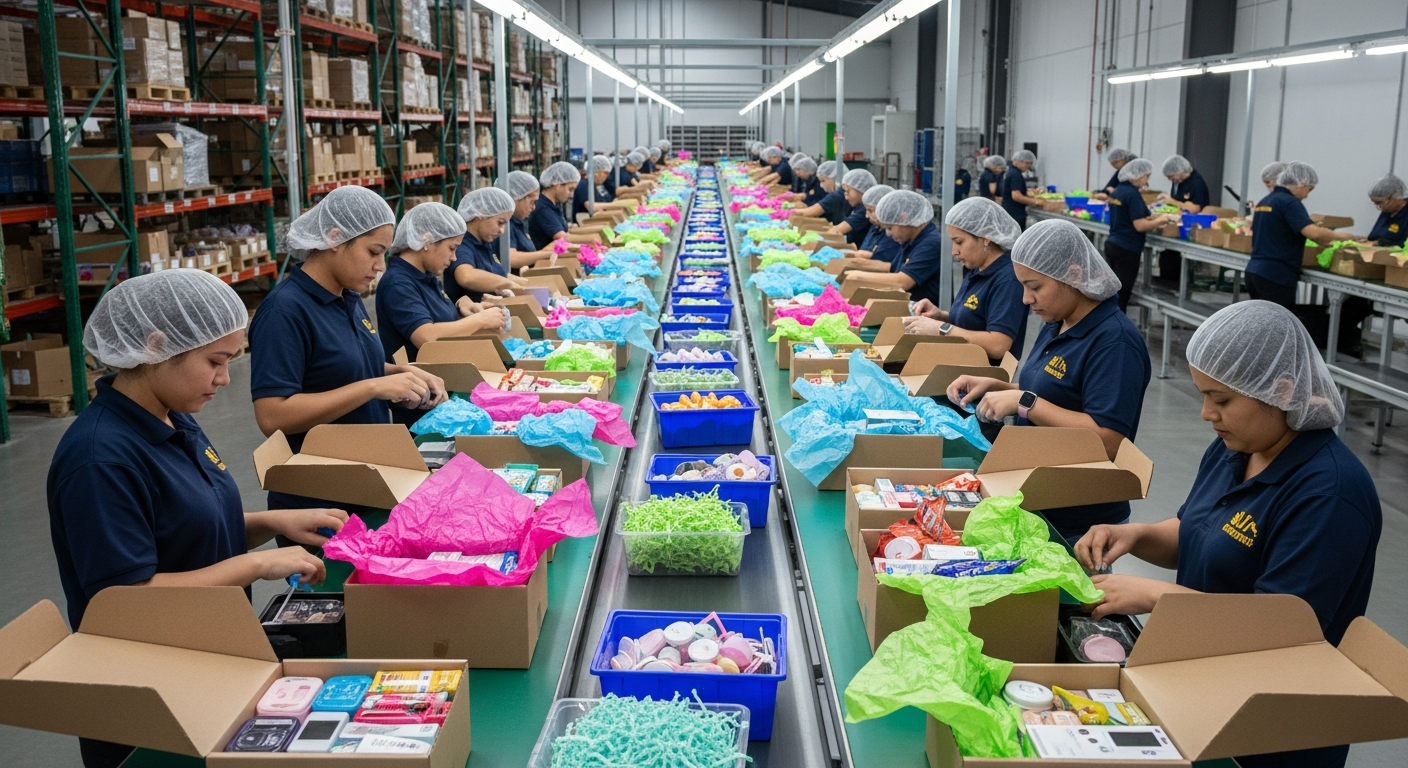
The best marketing fulfillment operation can't save materials nobody wants. These twelve ideas consistently outperform generic giveaways because they're kept, used, or shared rather than binned: (1) Quality-first drinkware — one good insulated bottle beats fifty disposable pens and lives on a desk for years. (2) Branded notebooks with genuinely good paper — cheap ones get left behind; good ones get carried into meetings. (3) Tech accessories people actually need — multi-cable chargers, laptop sleeves, webcam covers. (4) Welcome kits with sequencing — a branded box where opening order tells a story outperforms a bag of loose items. (5) Locally-sourced consumables — coffee, maple products, or regional snacks give kits a sense of place national swag can't. (6) Wearables people would buy — one well-cut hoodie at retail quality outperforms ten boxy t-shirts. (7) Desk plants or seed kits — high keep-rate, photographs well, reads as thoughtful. (8) Practical event survival items — portable chargers and quality tote bags get used all conference long, with your logo visible. (9) Sample-size product with a reorder QR code — the material is the product; the QR closes the loop. (10) Dimensional mailers — a box with presence gets opened; a flat envelope gets triaged. (11) Co-created influencer kits — seeding boxes designed to be unboxed on camera, with photogenic interior presentation. (12) Useful print — a genuinely helpful reference card, sizing guide, or industry cheat sheet survives on a wall or desk long after a brochure is recycled.
 12 marketing material ideas that actually get kept
How ByExpress runs marketing fulfillment
ByExpress provides marketing fulfillment as a first-class service alongside e-commerce fulfillment: climate-controlled storage for print and merchandise, barcode-tracked inventory with a live client portal, documented kitting with photo-verified builds, and multi-channel dispatch — parcel to reps and prospects, LTL to venues and dealer networks, and scheduled retail distribution — from our Canadian facilities in Ottawa, Toronto, Montreal, Vancouver, and Calgary. Campaign work is planned against your marketing calendar, not reacted to: we pre-build kits ahead of launches, hold surge capacity for event season, manage bilingual material sets for national campaigns, and run quarterly obsolescence reviews so you stop paying to store materials you'll never use. For U.S. brands running Canadian campaigns, in-country inventory eliminates cross-border duties and delays on every kit.
Frequently Asked Questions
What is marketing fulfillment?
Marketing fulfillment is the process of managing, storing, assembling (kitting), and distributing marketing materials — printed collateral, branded merchandise, sales and welcome kits, point-of-sale displays, samples, and event materials — so campaigns have the right materials at the right place, time, and quantity. It's the logistics discipline behind marketing execution.
How is marketing fulfillment different from e-commerce fulfillment?
E-commerce fulfillment ships products customers purchased; marketing fulfillment distributes materials that support selling. The operational differences: marketing fulfillment is deadline-driven around campaigns and events rather than order-driven, involves heavy kitting and assembly, ships to a wider mix of destinations (reps, venues, retailers, prospects), and has near-zero tolerance for version errors since materials represent the brand directly.
What does marketing fulfillment cost in Canada?
Typical components: storage ($15–$35 per pallet per month), kitting ($0.75–$3.50 per kit depending on component count and complexity), pick-and-pack fees ($1.50–$4 per shipment), and carrier costs at the provider's discounted rates. A brand running quarterly campaigns of 500–2,000 kits typically spends $1,500–$8,000 per campaign all-in — usually less than the internal labour and rush-shipping costs it replaces.
When should a company outsource marketing fulfillment?
Common triggers: marketing staff spending multiple hours weekly packing and shipping, campaign bursts above ~50 shipments, pallet-scale storage needs, kits with 4+ components, multi-province or cross-border distribution, or a pattern of rush fees from late logistics planning. If internal time spent on fulfillment costs more than an outsourced program, the switch pays for itself.
Can ByExpress handle both trade-show freight and individual kit mailings?
Yes — that mix is the norm for campaign work. A single campaign can include palletized LTL freight to a convention centre with dock appointments, individual parcel shipments to sales reps and prospects, and mixed-carton replenishment to retail or dealer locations, all dispatched from the same inventory with channel-appropriate packaging and labelling.
How do you keep bilingual (English/French) materials straight?
Dual-language material sets are held as separate SKUs with language-split kitting rules, so Quebec-bound kits automatically receive French or bilingual components. Version control applies per language — when a material updates, both language versions are purged and replaced together, preventing mixed-version campaigns.
Related ByExpress resources