Guide · · 12 min read
3PL vs 4PL: What Canadian Brands Actually Need to Know
The 3PL vs 4PL conversation is one of the most over-marketed and under-understood in Canadian logistics. Here's how to actually decide — and why most growing brands are better served by a strong 3PL than by a thin 4PL veneer.
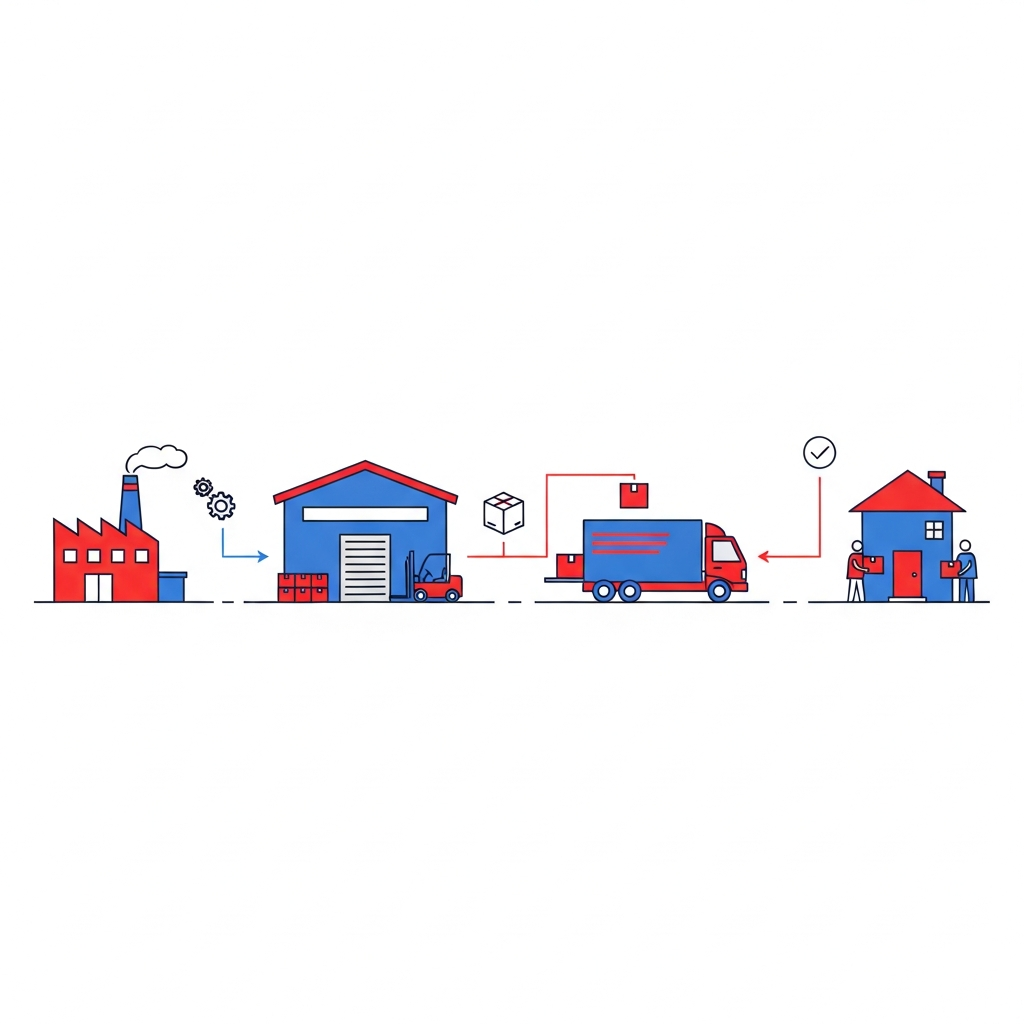
The terms '3PL' and '4PL' have been so thoroughly marketed-into-mush that most brand operators cannot give a clean answer to what either actually means — and many vendors selling 4PL services cannot either. The distinction matters, though, because the wrong choice locks brands into either too much operational overhead or too little operational control. This guide cuts through the marketing language to explain what each model actually does, what each actually costs in Canada, and which one is the right answer for brands at different stages of growth. Spoiler: most growing Canadian brands do not need a 4PL, and many of the ones who think they do are actually buying a re-badged 3PL with a thin coordination layer on top.
What 3PL and 4PL actually mean
A third-party logistics (3PL) provider physically operates fulfillment infrastructure on behalf of a brand. They lease and operate warehouses, employ pickers and packers, run a WMS, contract with carriers, and physically take possession of your inventory. You hand them inventory, they hand you fulfilled orders, and the asset base is theirs. A fourth-party logistics (4PL) provider, in the original Accenture-coined definition, does not operate physical assets — they manage other 3PLs and carriers on your behalf as a single point of accountability. In practice, the line has blurred: many self-described 4PLs operate some warehouses and subcontract others, and many 3PLs offer 'managed' services that look like 4PL coordination from the brand's perspective. The functional question is not 'which label do they use' — it is 'who owns the operational risk when something goes wrong.'
If your provider says they're a 4PL but cannot tell you which 3PLs they use, what their KPIs look like, and how those operators are contracted — they're either marketing a 3PL with extra steps or they don't actually have the visibility a 4PL is supposed to provide.
3PL vs 4PL: the practical comparison
The clean comparison gets murky in real-world Canadian deployments because the same vendor often plays both roles depending on the engagement. The table below isolates the structural differences as they would appear under a textbook deployment of each model.
| Dimension | 3PL | 4PL |
|---|
| Owns physical assets | Yes (warehouses, equipment) | No (typically) |
| Holds inventory directly | Yes | No (their subcontracted 3PLs do) |
| Single contract | One per 3PL relationship | One contract covers all logistics |
| Carrier relationships | Direct with carriers | Coordinates 3PL carrier rates |
| Multi-region brand | Often requires multiple 3PLs | Single point of contact |
| Typical brand stage | Startup to mid-market | Enterprise / multi-region |
| Cost overhead | Lower (no extra coordination layer) | Higher (margin on top of 3PL) |
| Operational control | Direct visibility into one operator | Indirect, abstracted |
When a 3PL is the right answer
For roughly 90% of Canadian DTC and B2B brands, a strong 3PL is the right answer — full stop. A 3PL wins when: your fulfillment can be operated from one to two warehouses (most Canadian brands fit easily within a two-node domestic network); you need direct operational visibility (the 3PL's KPIs are your KPIs, not filtered through a coordination layer); you are sensitive to per-order cost (no 4PL margin on top of fulfillment costs); your brand's value proposition includes operational details like packing presentation, inserts, custom unboxing, or branded packaging (these are easier to manage with a single direct 3PL relationship than through a 4PL abstraction); and you are growing fast enough that operational agility matters (changes to a 3PL relationship happen in days; changes to a 4PL-coordinated multi-3PL network happen in weeks or months).
 When a 3PL is the right answer
When a 4PL is the right answer
A genuine 4PL relationship makes sense when: your brand operates across many regions or countries with no single 3PL footprint that covers them efficiently (think: a brand with North America, EU, and APAC distribution where each region has different best-in-class 3PLs); your annual logistics spend is large enough to justify a dedicated coordination layer (typically $5M+ of annual logistics spend); you have meaningful regulatory or compliance complexity that benefits from a single accountable owner across multiple 3PLs (pharmaceutical, regulated health products, hazardous materials); your brand has internal logistics expertise sufficient to govern the 4PL relationship (a 4PL with no informed counterparty on your side becomes an opaque cost centre very quickly); or you have specific internal mandates (procurement requirements, audit requirements) that genuinely require a single contract for all logistics.
What each model actually costs in Canada
Pricing models differ. A 3PL typically charges activity-based rates (per pick, per pallet stored, per receipt, per return) plus carrier passthroughs. A 4PL typically charges either a management fee on top of underlying 3PL/carrier costs (often 8–18% of total managed spend) or a fixed monthly retainer plus passthroughs. For mid-market Canadian brands ($1M–$10M annual revenue, 3,000–30,000 orders/month), the all-in cost difference between a strong direct 3PL relationship and a 4PL-coordinated equivalent typically runs 12–22% in favour of the direct 3PL. The 4PL premium is sometimes worth it for genuine multi-region or compliance-heavy operations; for pure domestic Canadian DTC, it rarely is.
| Cost Component | 3PL Direct | 4PL Coordinated |
|---|
| Per-order pick & pack | $2.50 – $3.50 (Canadian average) | $2.50 – $3.50 (passthrough) |
| Storage | $22 – $34 per pallet/month | $22 – $34 per pallet/month (passthrough) |
| Coordination / management fee | Included | 8–18% of total spend OR $5K–$25K/month retainer |
| Setup / onboarding | $2K – $15K one-time | $15K – $75K one-time (multi-3PL setup) |
| Typical effective premium for 4PL | — | +12% to +22% all-in |
The managed-3PL middle ground
A growing model in Canadian logistics is what is often called 'managed 3PL' or 'integrated 3PL' — essentially a strong 3PL that adds 4PL-style coordination and reporting on top of their own operations, without the additional contractual and margin overhead of a true 4PL. For brands operating from a single Canadian fulfillment network, this hybrid model frequently delivers most of the 4PL benefits (single point of accountability, consolidated reporting, integrated carrier strategy) without the 4PL premium. The hard test: ask the prospective provider whether their 'managed services' are actually built on top of operations they own, or whether they are subcontracting major pieces. If the latter, you are paying 4PL prices for a less integrated experience.
 The managed-3PL middle ground
A practical decision framework
Six questions, in order. (1) Do you operate, or plan to operate within 18 months, in more than one of the following major regions: Canada, US, EU, APAC? If no, you almost certainly want a 3PL. (2) Is your annual logistics spend above $5M? If no, the 4PL coordination layer rarely pays for itself. (3) Do you have a Director-of-Logistics-or-equivalent who can govern a 4PL? If no, a 4PL becomes opaque fast. (4) Do you have regulatory or compliance requirements that materially benefit from single-vendor accountability across multiple operators? If no, a 4PL adds complexity, not control. (5) Are you operationally sensitive to fulfillment details (unboxing, inserts, brand packaging) that benefit from direct 3PL relationship? If yes, lean strongly toward 3PL. (6) Is your brand growth volatile or fast? If yes, 3PL agility usually beats 4PL coordination overhead.
How ByExpress fits the spectrum
ByExpress is structured as an integrated 3PL with managed-services capability. We own and operate our five Canadian fulfillment locations directly, employ our own warehouse and customer service staff, and contract directly with all major carriers. Brands operating from a single primary node get a pure 3PL relationship; brands operating across multiple locations within our Canadian network get consolidated WMS, reporting, and account management — the practical benefits of a 4PL coordination layer without the 4PL margin overhead, because everything you are coordinating across is operated by the same company.
Frequently Asked Questions
What is the actual difference between a 3PL and a 4PL?
A 3PL physically operates warehouses and equipment and holds your inventory directly. A 4PL coordinates other logistics providers (3PLs and carriers) on your behalf without typically owning physical assets. In practice the line has blurred and most self-described 4PLs operate some assets and subcontract others. The functional question is who owns the operational risk and who has direct visibility into operations.
Do I need a 4PL for my Canadian DTC brand?
Almost certainly not. For brands operating within a single national network (Canada-only or Canada plus modest US distribution), a strong 3PL is the right answer. 4PLs make economic sense primarily for brands with multi-region operations across continents and annual logistics spend above ~$5M. Below that, the 4PL coordination overhead typically costs more than it saves.
Is a 4PL more expensive than a 3PL?
Yes — typically 12–22% more expensive all-in for equivalent operational scope, because the 4PL adds a coordination margin (8–18% of total spend) or a fixed retainer ($5K–$25K/month) on top of the underlying 3PL and carrier costs. The 4PL premium is sometimes justified by the operational benefits, but for pure domestic Canadian fulfillment it rarely is.
What is a 'managed 3PL' and how is it different from a 4PL?
A managed 3PL is a 3PL that offers 4PL-style coordination and reporting on top of their own operations — essentially the consolidated reporting, single point of accountability, and integrated carrier strategy of a 4PL, but without the additional contractual layer and margin. For brands operating across multiple locations within a single 3PL's network, this is often the best of both models.
Can a 3PL grow with me as I expand internationally?
Most Canadian 3PLs can grow with you within Canada and into the US. International expansion (EU, APAC, LATAM) typically requires either a 4PL with that regional reach or partnerships between your Canadian 3PL and regional 3PLs in target markets. The right time to evaluate that handoff is usually when international revenue exceeds 20% of total or when international order volume exceeds ~3,000/month per region.
How do I avoid 4PL marketing fluff?
Three hard questions for any prospective 4PL. (1) Which specific 3PLs and carriers do you use, and how are they contracted? (2) Show me the consolidated KPI report you'd produce for my account on a monthly basis. (3) When something goes wrong with a subcontracted operator, what is your escalation path and SLA for resolution? Vague answers to any of these means you're being sold a marketing layer, not a real 4PL relationship.
Related ByExpress resources