Guide · · 15 min read
Moving Your Business to Vancouver: The 2026 Operations & Logistics Playbook
Relocating a company to Vancouver is a logistics project before it is a real-estate project. This is the operator's playbook — sequencing, vendor selection, inventory handling, IT cutover, and the surprises that catch most CFOs off-guard.

Relocating a business to Vancouver is, on paper, a real-estate transaction. In practice, it is a logistics project with a lease attached. Companies that treat the move as a real-estate decision plus 'hire some movers' routinely overrun their relocation budget by 40–80 percent, lose days of revenue to a botched IT cutover, and discover three months later that their first lease was the wrong submarket entirely. Companies that treat it as a logistics project — sequenced, vendor-managed, with inventory and equipment moves planned alongside the office move — generally land on budget, open their doors on the planned date, and avoid the painful 'we have stock in transit on opening day' scenario. This 2026 playbook is written for operators, COOs, and founders who are about to move a business of 5 to 250 employees to the Lower Mainland — and want the honest sequencing, vendor selection, and cost reality before they commit.
Why companies relocate to Vancouver in 2026
Vancouver is the most expensive Canadian city to operate in by almost every input cost — industrial rent, office rent, warehouse labour, residential cost of living, and parking. Despite this, net business migration to Greater Vancouver has been positive every year since 2018. The reasons cluster: proximity to Asian trade lanes (the Port of Vancouver moves more containerized cargo than any other Canadian port), the densest Pacific-facing talent pool in the country, a film and tech ecosystem that pulls senior creative and engineering talent, time-zone alignment with U.S. West Coast customers and investors, and the simple lifestyle pull that keeps key hires from accepting Toronto offers. For logistics-sensitive businesses — importers, fulfillment-dependent e-commerce brands, ocean-freight-heavy manufacturers — the import-transit advantage alone often pays for the premium within twelve months. For talent-sensitive businesses — software, design, biotech, film — the calculation is more about retention than cost.
- Closest major Canadian container port to most Asian origins — 11–14 ocean days vs 28–35 routing through Panama to Eastern ports
- Pacific-Northwest U.S. coverage within 1–3 ground-transit days
- Bilingual Cantonese/Mandarin operator pool for Asia-facing brands
- Tax-equivalent footing to most Canadian cities — BC corporate rates align with Ontario
- Direct flights to Asian capitals — meaningful for founders and import buyers
The most common mistake CFOs make: budgeting Vancouver costs at a 10–15% premium to Toronto. The real premium is closer to 20–30% across every line item once labour, parking, and short-term housing for relocating staff are included.
The 90-day relocation sequence that actually works
Most failed relocations fail because the sequence is wrong, not because any individual vendor failed. A clean 90-day sequence works backwards from the opening date: week minus-12, lease signed and IT/network cutover scheduled with the new building's ISP. Week minus-10, commercial movers booked (good Vancouver crews are booked 6–10 weeks out, especially for month-end dates). Week minus-8, inventory and warehouse contents inventoried, with anything obsolete liquidated rather than moved — moving obsolete inventory is the single most overlooked waste in a corporate move. Week minus-6, furniture decisions finalized (sell-and-rebuy is almost always cheaper than long-distance move for anything under $1,200/desk replacement cost). Week minus-4, staff relocation packages issued and movers retained for residential moves. Week minus-2, IT staged at new site; week minus-1, soft cutover with parallel operation; opening day, full cutover with the old space still leased for one buffer week.
| Week | Critical Path Item | Why It Matters |
|---|
| −12 | Lease executed; ISP cutover booked | Telus/Shaw business install lead times run 6–10 weeks in Vancouver |
| −10 | Commercial movers contracted | Good Vancouver crews fill month-end slots first; book early |
| −8 | Inventory audit + obsolete liquidation | Don't pay to move what should be written off |
| −6 | Furniture sell-vs-move decision | Threshold ~$1,200/desk replacement; under that, sell-and-rebuy wins |
| −4 | Residential moves booked for staff | Family moves should not collide with office cutover week |
| −2 | IT staged at new site | Run dual-site for one week to catch routing/DNS surprises |
| −1 | Soft cutover | Parallel operation, customer-facing changes paused |
| 0 | Opening day with old space still under lease | One week of buffer rent is cheap insurance |
Office move vs warehouse move: completely different projects
Treating the office move and the warehouse move as one project is the second-most-common cause of relocation overruns. They have different vendors, different insurance requirements, different scheduling windows, and entirely different risk profiles. An office move is largely a furniture-and-IT project — boxed contents, desks, monitors, server racks, a network closet, and the inevitable Pelican cases of cables. A warehouse move is an inventory project — pallets, racking, MHE (forklifts, pallet jacks), WMS data, and serialized inventory that has to reconcile to the cent on the other side. The same crew that beautifully moves a 40-person office is almost never the same crew that should be moving 2,400 SKUs of pallet inventory. Hire the right vendor for each, and never let a generalist mover quote both unless you have validated they actually have warehouse-grade equipment and an in-house WMS migration team.
 Office moves and warehouse moves are different projects with different vendors, equipment, and insurance.
How to choose commercial movers in Vancouver
The Vancouver moving market is crowded — over 200 registered moving companies operate in Metro Vancouver, ranging from one-truck operators to national franchises. For a business move, the selection criteria are different from a household move. You need WCB coverage and commercial liability insurance at materially higher limits ($2M minimum, $5M for any warehouse work). You need a fixed-quote-with-cap pricing model, not hourly — hourly billing creates a perverse incentive on a multi-day commercial job. You need a written inventory protocol with barcode or tag tracking for high-value items like servers, monitors, and any signed/numbered artwork. You need a designated single point of contact on move day, not a rotating crew lead. And critically, you need to verify the company actually handles commercial jobs as a routine line of business — not as a once-a-quarter exception they accept between residential bookings. Always ask for three commercial references from the last six months and call them.
- Commercial liability insurance: $2M minimum, $5M for warehouse work
- WCB account in good standing (verifiable on the WorkSafeBC site)
- Fixed-quote-with-cap pricing — never hourly for multi-day commercial jobs
- Written inventory protocol with barcode or tag tracking
- Three commercial references from the last six months — and call them
- Move-day single point of contact, identified by name in the contract
- Storage option for staged inventory during the gap week
Inventory transfer: the part that breaks reconciliation
If your business holds physical inventory — whether DTC SKUs, retail stock, parts for service operations, or finished-goods awaiting B2B distribution — the inventory transfer is the highest-risk leg of the entire move. Inventory that leaves an old warehouse must arrive, scan-by-scan, at the new one, and the WMS must reconcile both sides to the unit. Brands that handle this casually routinely discover three weeks after the move that 1–3% of inventory has 'vanished' — actually a mix of miscounts at origin, mislabelled cartons in transit, and putaway errors at destination. The fix is straightforward but requires discipline: cycle count to a clean baseline before the move, freeze receiving and shipping for a 48–72 hour window across the cutover, transfer pallets with carton-level scan-out at origin and scan-in at destination, and reconcile within 24 hours of putaway. A 3PL with an in-house WMS team — like the multi-node operation we run at ByExpress — typically does this kind of inventory migration four to eight times a year and has the muscle memory most one-off moves lack.
The IT cutover that ruins or saves opening day
An opening-day IT failure is the single most-remembered detail of any office move. Email working, VoIP working, internet working, printers working, badge readers working — none of these are individually hard, but they all have to be working by 9 AM on opening day, and any one of them missing creates a story your staff tells for years. The reliable pattern is dual-site operation for one week: the new office is live and operational while the old office is still online, with email and VoIP routing tested under real load before the old site goes dark. ISP install lead times in Vancouver are the biggest single trap — both Telus and Shaw business install windows have stretched to 6–10 weeks in 2026, and 'expedited' rarely means what it sounds like. Order the connection the day the lease is signed. Cellular backup (a router with a 4G/5G failover SIM) is cheap insurance against any opening-day ISP failure and should be on the equipment list even for small offices.
Opening-day rule: if the receptionist's phone, the printer, the Wi-Fi, and Slack/email are all working at 8:45 AM, your move is a success. If any one of those four fails, every staff member's first impression of the new office is negative. Test all four with real load the day before.
Vancouver-specific permits, bylaws, and surprises
Vancouver's municipal regulations are stricter than most Canadian cities, and several catch out-of-town operators every year. Downtown Vancouver and the West End require a moving permit and reserved parking for any truck over a certain size — apply 7–10 business days in advance through the City of Vancouver, not the day-of. Several office towers (especially in Yaletown, Coal Harbour, and the financial district) require move-in to happen outside business hours and have move-in elevators that must be reserved and protected. Burnaby, Richmond, Surrey, and the North Shore each have slightly different rules — and the Tri-Cities (Coquitlam, Port Coquitlam, Port Moody) often have stricter weekend noise bylaws that affect overnight moves. The single best protection: ask your commercial mover for a written permit and elevator-booking checklist for your specific destination address, and verify each item is actually booked before move day. Generalist movers from out of region routinely miss the building-specific requirements.
Setting up ongoing logistics after the move
Once the move is complete, the ongoing logistics setup is where the real cost-of-operation gets locked in for the next three to five years. Three decisions matter most. First: do you fulfill from your own Vancouver space, or do you partner with a Vancouver 3PL? For most businesses doing less than 4,000 monthly outbound parcels, a 3PL is unambiguously cheaper than running your own dock, hiring pickers, and licensing a WMS. Second: do you anchor all Canadian inventory in Vancouver, or do you split with an eastern node (Toronto, Montreal, Ottawa)? Brands with more than 35% Western Canada and U.S. West Coast demand justify Vancouver as primary; brands with predominantly Eastern Canada demand should use Vancouver as a secondary node only. Third: what is your carrier mix? Vancouver's regional carrier ecosystem (Intelcom, FlashBox, Day & Ross) competes hard with the national carriers on residential urban density and B2B LTL — a 3PL that rate-shops across all of them will save you 12–18% versus a single-carrier setup.
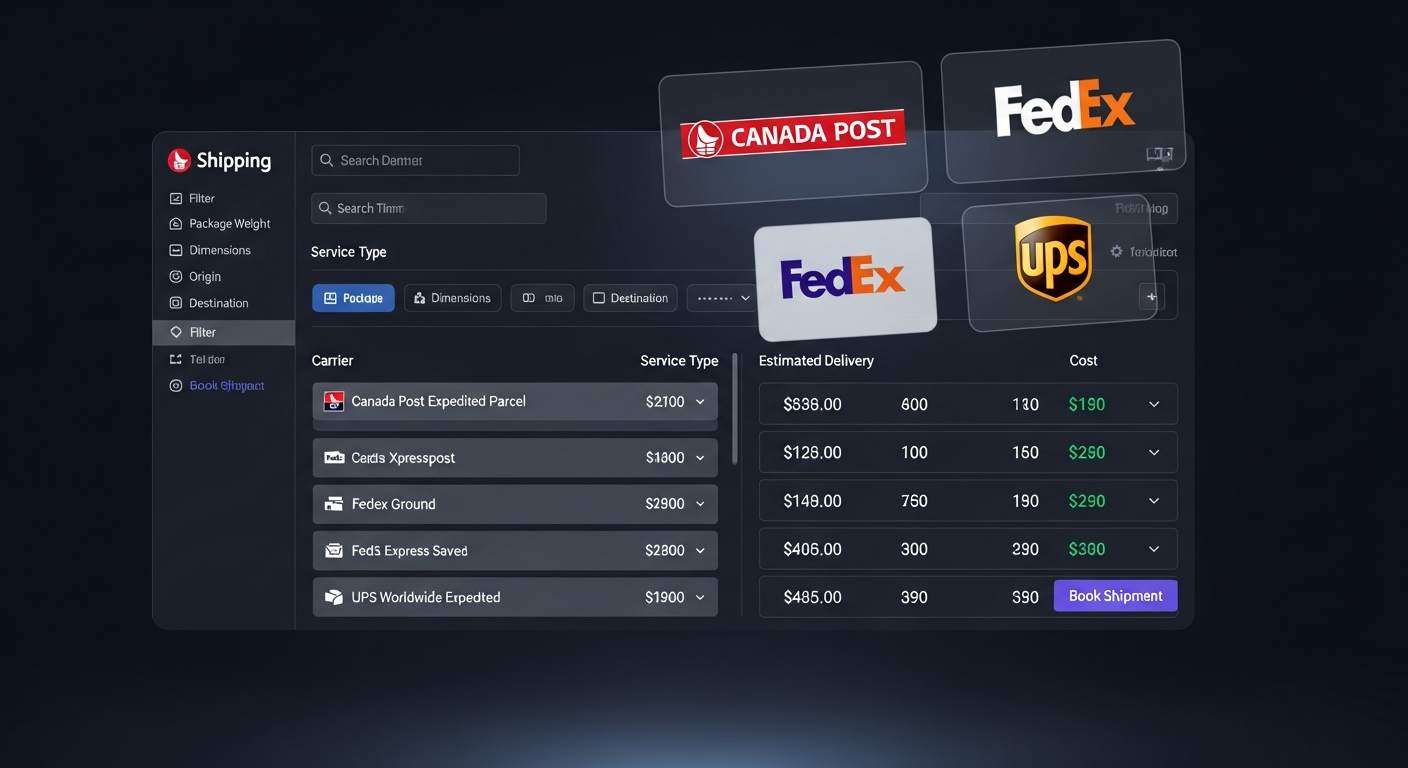 A multi-carrier rate-shopping setup typically saves Vancouver shippers 12–18% versus single-carrier rate cards.
The honest budget: what a Vancouver business move actually costs
Public benchmarks for commercial relocations are unreliable because every move is bespoke, but the ranges below reflect what 2026 quotes actually look like for businesses moving to or within Greater Vancouver. The single biggest budget surprise is not the moving cost itself — it is the staff productivity loss during the 2–4 weeks bracketing the move (typically 15–25% productivity reduction, which on a 40-person team is a real number) and the gap-week double-rent which most CFOs forget to model. A relocation budget that does not include those two line items is wrong by 25–50%.
| Move Type | Typical Cost (2026) | Notes |
|---|
| 10-person office, within Metro Vancouver | $8,500 – $14,000 | 1 truck-day, IT cutover, basic furniture |
| 40-person office, within Metro Vancouver | $32,000 – $58,000 | 2–3 truck-days, full IT cutover, partial furniture replacement |
| 100-person office, within Metro Vancouver | $110,000 – $185,000 | Full project-managed move, parallel-week operation |
| Warehouse move, 10,000 sq ft inventory | $45,000 – $90,000 | Excludes new racking; includes inventory transfer + WMS migration |
| Cross-province inbound (Toronto → Vancouver office of 25) | $95,000 – $160,000 | Includes line-haul, storage gap, staff residential allowance |
| IT-only cutover (any size, dedicated project) | $12,000 – $35,000 | Network, VoIP, server migration, parallel ops week |
| Staff relocation allowance per family | $8,000 – $25,000 | Vancouver-specific premium for housing search + temporary accommodation |
Where ByExpress fits in a Vancouver business relocation
ByExpress is a Canadian logistics and 3PL operator, not a moving company. Where we typically come into a relocation project is on the inventory and ongoing-fulfillment side — receiving inventory transferred from an old warehouse, holding it during the cutover, and then operating ongoing pick-and-pack from our Vancouver node once the new operation is live. For brands moving to Vancouver, this often means: liquidate or transfer existing inventory to our Vancouver warehouse two to four weeks before the office move, run all customer-facing shipping from our facility during the cutover (so customers see no disruption), and continue running ongoing fulfillment from our node post-move rather than spinning up an in-house warehouse on day one. This pattern lets the company focus on the office, staffing, and customer-facing transition rather than simultaneously trying to stand up a brand-new warehouse operation in an unfamiliar market.
Frequently Asked Questions
How far in advance should I book commercial movers in Vancouver?
Six to ten weeks for any move of 20 or more people, longer for month-end dates (which are the most-booked windows). Good commercial crews in Vancouver are typically booked solid 6–8 weeks out, and the last-minute discount you might find in a smaller market does not exist in the Lower Mainland — month-end Vancouver slots get more expensive as the date approaches, not less.
What does an office relocation to Vancouver typically cost?
A 10-person office move within Metro Vancouver runs $8,500–$14,000; a 40-person move runs $32,000–$58,000; a 100-person fully project-managed move runs $110,000–$185,000. Cross-province inbound moves add line-haul costs (typically $20,000–$40,000 from Toronto) and staff residential allowances ($8,000–$25,000 per relocated family).
Should I move my furniture to Vancouver or sell and rebuy?
The break-even is around $1,200 per desk in replacement cost. Below that threshold, selling at origin and rebuying at destination is almost always cheaper than long-distance freight, packing, and damage risk. Above that threshold — especially for higher-end ergonomic chairs, sit-stand desks, or custom millwork — moving usually wins.
How long does an ISP install take in Vancouver in 2026?
Both Telus Business Internet and Shaw Business are quoting 6–10 weeks for new business installs as of mid-2026, occasionally longer for buildings without existing fiber. Order the day the lease is signed, and budget for a 4G/5G failover SIM as backup — it is cheap insurance against any opening-day ISP failure.
Do I need a moving permit for downtown Vancouver?
Yes, for any moving truck over a certain size operating in downtown Vancouver, the West End, and several other neighbourhoods. Permits are issued by the City of Vancouver with 7–10 business days of lead time. Most office towers in Yaletown, Coal Harbour, and the financial district additionally require move-in to happen outside business hours and have move-in elevators that must be reserved and protected with pads.
Should I run my own warehouse in Vancouver or use a 3PL?
Below roughly 4,000 outbound parcels per month, a Vancouver 3PL is almost always cheaper than running your own operation once you include rent (Vancouver industrial is ~$22/sq ft), labour (BC warehouse wages have risen sharply), WMS licensing, and the staff time to manage the operation. Above 4,000 parcels per month, the math becomes situational and depends on SKU count, returns rate, and how integrated your fulfillment is with your product team.
Can I keep operating during the move?
Yes — and you should plan to. The reliable pattern is one week of parallel operation: the new site live and tested while the old site stays online, with email, VoIP, and customer-facing systems cut over only after the new site has handled real load. If you ship physical product, partnering with a 3PL during the cutover lets customer orders ship uninterrupted while your team focuses on the office transition.
Related ByExpress resources