Guide · · 13 min read
Vancouver Fulfillment: The Complete 3PL Guide for Western Canada
Why Vancouver is the only sensible Canadian fulfillment node for brands importing from Asia — and how to choose between Surrey, Delta, Burnaby, and Richmond without overpaying for the wrong industrial submarket.
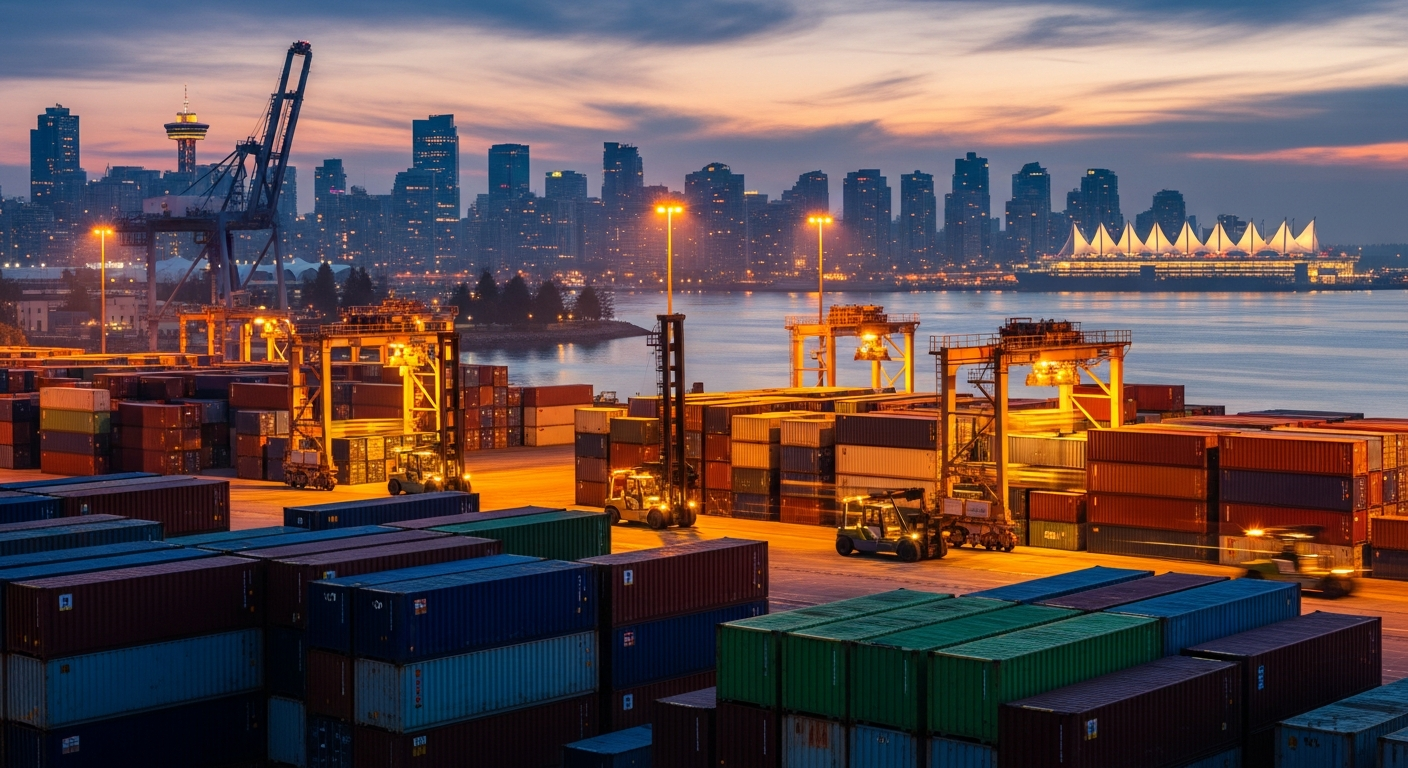
Vancouver is the most expensive industrial real-estate market in Canada and one of the most expensive in North America. Despite that, it remains the only sensible primary fulfillment node for any brand importing meaningful volume from Asia. The reason is simple geography: Vancouver is roughly two weeks of ocean transit closer to Shanghai, Shenzhen, Ningbo, and Busan than any East Coast port, and that two-week advantage compounds across every container, every drayage decision, and every working-capital calculation. This guide explains why Vancouver is worth the premium when it is, what real BC 3PL pricing looks like, how to think about the Surrey vs Delta vs Burnaby vs Richmond submarkets, and how to use Vancouver as a launchpad for U.S. West Coast distribution without opening a second warehouse.
Why Vancouver despite the cost
Industrial vacancy in the Lower Mainland has been below 2% for nearly five years and average net lease rates exceeded $20/sq ft — the highest in Canada and roughly double Ottawa. So why anchor inventory there? Three reasons. First, ocean transit. Vancouver is the closest North American port to most of Asia, with Trans-Pacific transit times running 11–14 days from Shanghai versus 28–35 days routing through the Panama Canal to a U.S. East Coast or Montreal port. For brands turning inventory faster than their import lead time, the difference matters dramatically. Second, BC is the natural home for any brand with significant Western Canadian or U.S. Pacific Northwest demand — shipping from a single Toronto node to Vancouver costs more in carrier surcharges per parcel than the Vancouver storage premium amortized across the same volume. Third, Vancouver is the only Canadian node from which you can serve Seattle, Portland, and the U.S. West Coast within one to three days via cross-border ground.
 Vancouver is 11–14 days from Asian ports and 1–3 ground days from Seattle, Portland, and the U.S. Pacific Northwest.
Surrey, Delta, Burnaby, Richmond: the submarket decision
Lower Mainland industrial real estate is not one market — it is at least four with materially different cost structures, transit profiles, and labour pools. Surrey is the largest and fastest-growing industrial submarket, generally cheaper than Burnaby or Richmond, with newer high-clear buildings and more available land. It is the natural home for any operation requiring 50,000+ sq ft. Delta sits adjacent to the Deltaport container terminal and Roberts Bank, making it the most cost-efficient option for high-throughput import operations where drayage cost dominates. Burnaby is closer to downtown Vancouver and the densest urban delivery zones, justifying its premium for last-mile-sensitive operations. Richmond is closest to YVR airport, ideal for time-sensitive air-cargo flows or reverse logistics involving import returns.
| Submarket | Typical Lease ($/sq ft) | Best For |
|---|
| Surrey | $17 – $22 | General fulfillment, larger footprints, growing brands |
| Delta / Tilbury | $19 – $24 | Container-heavy import operations near Deltaport |
| Burnaby | $22 – $27 | Urban same-day delivery, brands with downtown DTC density |
| Richmond | $23 – $28 | Air cargo, YVR-adjacent, reverse logistics on imports |
| Coquitlam / Port Coquitlam | $18 – $22 | Mid-Fraser overflow, secondary distribution |
Drayage from the Port of Vancouver: the real cost of import
Drayage — the move from container terminal to your warehouse — is one of the most under-budgeted line items in any new Vancouver fulfillment operation. Vancouver drayage rates are among the highest in North America because the port has chronic congestion, dispatch dwell times, and a unionized owner-operator driver pool. Expect to pay $475–$725 per container move from the Centerm or Vanterm terminals to a Surrey, Delta, or Burnaby warehouse, before fuel surcharges, chassis splits, and waiting-time charges. Brands importing more than 20 containers per year should prioritize 3PLs that hold their own bonded warehouse status and have direct relationships with drayage carriers — those operators can typically negotiate $75–$125 per container off published rates and avoid demurrage by pre-staging inland moves.
Hidden cost: container demurrage at the Port of Vancouver runs $150–$300 per day after the free-time window expires (typically 4 calendar days). A 3PL with weak port operations can quietly add 10–15% to your landed cost in demurrage you never see broken out as a line item.
Vancouver 3PL pricing benchmarks for 2026
Vancouver fulfillment is the most expensive in Canada — generally 12–20% above Ottawa and 8–14% above the GTA, driven primarily by labour cost (BC minimum wage and the construction trades premium have pulled warehouse wages up substantially) and lease cost. The bands below reflect mid-2026 quotes from credible multi-tenant 3PLs operating in the Lower Mainland. Bonded warehouse capability typically adds a 5–8% premium but pays back quickly for any brand importing more than $500K in landed inventory annually because it defers duty until product actually ships.
| Service | Typical Range (Vancouver) | Notes |
|---|
| Pick & pack (first item) | $2.85 – $3.75 | Includes basic pack, label, dunnage |
| Pick & pack (each add'l item) | $0.40 – $0.65 | Per additional SKU on the same order |
| Receiving (full container) | $650 – $1,100 | Devanning, count, putaway from a 40' container |
| Storage (pallet/month) | $28 – $40 | Ambient, rack-stored |
| Storage (bonded pallet/month) | $32 – $46 | Premium for duty deferral |
| Drayage (port to DC) | $475 – $725 | Per container move, before surcharges |
| Returns processing | $4.00 – $7.00 | Inspect, photograph, restock or grade |
 Vancouver 3PL pricing benchmarks for 2026
Using Vancouver to serve the U.S. West Coast
Many brands assume that serving Seattle, Portland, San Francisco, and Los Angeles requires a U.S. warehouse. For lower-volume DTC brands, that is rarely true — and Vancouver is uniquely positioned to be the alternative. The Pacific Highway crossing at Surrey/Blaine and the Sumas crossing route directly to Seattle in under 90 minutes of drayage, where U.S. injection partners hand parcels to USPS or UPS Ground Saver for one-day Seattle and Portland delivery and two-to-three-day Bay Area delivery. Combined with Section 321 (de minimis) clearance for shipments under USD 800, brands can serve the U.S. Pacific Northwest from Vancouver inventory without paying duty or filing formal entries. For brands shipping more than roughly 800 U.S. orders per month, a dedicated U.S. injection program from Vancouver typically beats the cost of standing up a separate California 3PL.
Carrier coverage in BC and the Lower Mainland
The standard national mix (Canada Post, Purolator, FedEx, UPS, DHL eCommerce) all operate aggressive Vancouver hubs. Less obvious but equally important: BC has a meaningful regional carrier ecosystem worth rate-shopping into. ATS Healthcare, Day & Ross, Manitoulin, and several owner-operator LTL networks compete on B2B and oversize freight at meaningful discounts to the national carriers. For DTC, Intelcom and FlashBox are the urban-density specialists in Vancouver and operate at a price point national carriers cannot match for residential delivery within Metro Vancouver. A Vancouver 3PL should rate-shop across all of these — never just the carrier with whom they have a single rate card.
 Carrier coverage in BC and the Lower Mainland
Industries that justify Vancouver fulfillment
Vancouver makes sense for: brands importing from Asia (apparel, electronics, beauty, accessories, home goods, anything containerized from China, Vietnam, Korea, or Japan); brands with disproportionate Western Canada or U.S. West Coast demand; outdoor and athletic gear brands (the BC outdoor industry creates a deep talent pool of category-literate operators); cannabis-adjacent and natural health products (BC's regulatory climate is comparatively mature); and any brand routing meaningful inbound air cargo through YVR. Vancouver is rarely the right primary node for: Quebec or Eastern Canada-skewed demand; brands importing primarily from Europe (Montreal beats Vancouver dramatically on Trans-Atlantic transit); or brands whose U.S. demand is concentrated in the Northeast or Southeast.
ByExpress in Vancouver
ByExpress operates a Vancouver fulfillment node as the western anchor of our five-city Canadian network. The facility is positioned for both BC-market fulfillment and Asia-imported inventory flowing into national distribution. Bonded warehouse capability is available for brands managing duty-deferral on imported inventory. The Vancouver node integrates with the same in-house WMS and rate-shopping platform as our Ottawa, Toronto, Montreal, and Calgary locations — so brands operating multi-node inventory pools see real-time stock visibility, automatic order routing to the best-positioned warehouse, and consolidated invoicing across all five cities.
Frequently Asked Questions
How much does Vancouver 3PL cost?
Expect $2.85–$3.75 for the first pick-and-pack item, $0.40–$0.65 per additional item, $28–$40 per pallet per month for ambient storage, and $475–$725 per container drayage move from the Port of Vancouver. Vancouver runs 12–20% above Ottawa and 8–14% above Toronto, driven by the highest industrial labour and lease costs in Canada.
Should I use Surrey, Delta, Burnaby, or Richmond?
Surrey for general-purpose fulfillment and large footprints. Delta for container-heavy import operations adjacent to Deltaport. Burnaby for urban same-day delivery into Metro Vancouver. Richmond for air-cargo and YVR-adjacent operations. Most multi-tenant 3PLs operate from Surrey, Delta, or Burnaby because Richmond's land cost is hard to justify for general fulfillment.
What is bonded warehousing and do I need it?
Bonded warehouse status allows imported inventory to be stored without immediately paying duty — duty is deferred until the goods leave the warehouse for sale or distribution. For brands importing more than roughly $500K in landed inventory per year, bonded storage typically pays for itself in working capital savings within the first quarter.
Can I serve the U.S. West Coast from a Vancouver 3PL?
Yes, and well — for DTC volumes up to roughly 800 orders/month into the U.S. Pacific Northwest. Cross-border ground via Pacific Highway or Sumas, U.S. injection in Seattle, and last-mile via USPS or UPS Ground Saver typically delivers Seattle and Portland in one day and Bay Area in two to three. Above ~800 orders/month, a dedicated California 3PL begins to win on cost.
How long is drayage from the Port of Vancouver?
Drayage from Centerm, Vanterm, or Deltaport to a Surrey, Delta, or Burnaby warehouse runs 60–120 minutes of drive time, but actual port turn time (gate-in to gate-out with the loaded container) regularly exceeds 4 hours due to congestion. A 3PL with strong port operations should be able to predict and pre-stage drayage to keep demurrage risk low.
Is Vancouver worth the cost for a Canada-only DTC brand?
It depends on demand geography. If your demand is more than 35% Western Canadian (BC, Alberta, Saskatchewan, Manitoba), Vancouver typically pays for itself in carrier savings versus shipping the entire west from Toronto. If demand is heavily Ontario- and Quebec-skewed, Toronto, Ottawa, or Montreal will be more cost-efficient and Vancouver should be considered as a secondary node only.
Related ByExpress resources