Guide · · 11 min read
Finished-Goods Warehousing & Distribution for Ottawa Manufacturers (2026)
Where finished product goes after the line — bulk storage, B2B order picking, retail compliance, and outbound distribution across Eastern Ontario, the GTA, Quebec and the US.
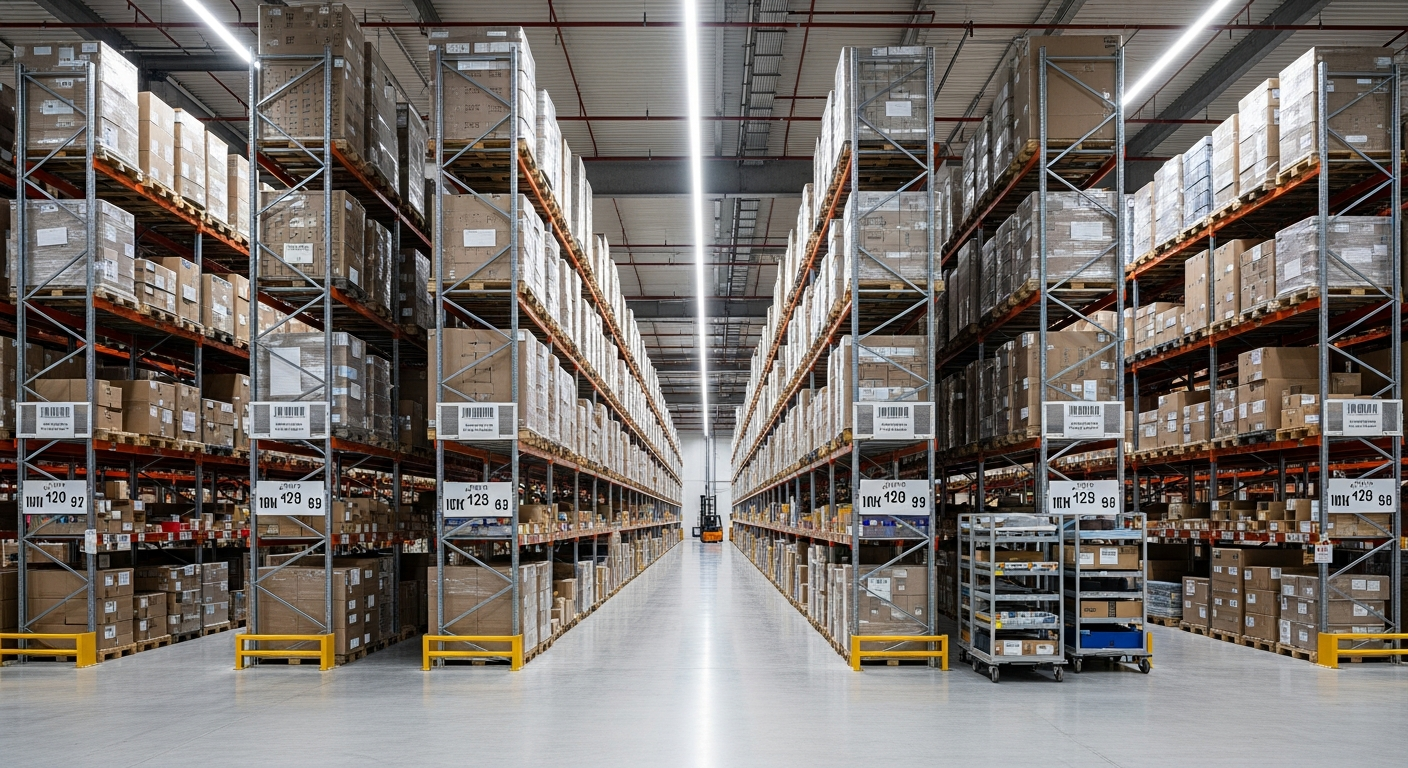
Once product comes off the line, a manufacturer needs somewhere to put it and a reliable way to get it to customers. For Ottawa-region manufacturers, finished-goods warehousing and distribution is often the part of the supply chain that's least worth owning — it's labour, racking, dock doors, and a transport network that scales poorly for a single plant. A contract 3PL turns that fixed cost into a variable service: bulk pallet storage, B2B order picking at pallet, case, and each level, retail EDI and compliance, and outbound transport across Eastern Ontario, the GTA, Quebec, and into the US. This guide covers how finished-goods operations actually run in the National Capital Region and what to look for when outsourcing them.
Storage profiles: bulk, rack, and flow
Finished goods rarely store the same way raw materials do. The right storage profile depends on SKU velocity, pallet count per SKU, stackability, and shelf life. A 3PL serving manufacturers typically blends several modes so slow bulk SKUs don't consume prime pick faces and fast movers stay accessible.
- Floor-stacked bulk for high-volume, stackable, single-SKU pallets
- Selective pallet racking for the bulk of palletized finished goods
- Drive-in or double-deep racking for low-SKU-count, high-pallet-count items
- Carton flow and shelving for case and each picking of faster movers
- Segregated zones for quality holds, returns, and lot/FEFO-controlled stock
B2B order picking: pallet, case, and each
Manufacturer distribution spans three picking granularities, and most operations need all three. Pallet picking serves full-pallet orders to retail DCs and large wholesalers. Case picking builds mixed-case pallets for smaller retail and distributor orders. Each (or 'piece') picking handles small B2B orders, samples, replacement parts, and any direct-to-customer flow. The mix matters because it drives labour, slotting, and system design — a plant shipping mostly full pallets has a very different operation from one breaking cases for hundreds of small accounts. Our companion guides on pallet/case/each picking and break-bulk repacking go deeper on the picking side.
 B2B order picking: pallet, case, and each
Retail EDI, ASN and routing compliance
Manufacturers selling into Canadian retail live and die by compliance. Large retailers mandate EDI documents (850 purchase order, 856 advance ship notice, 810 invoice), SSCC pallet and carton labels (GS1-128), case-pack and palletization standards, and tight routing/appointment windows at the DC. Miss any of these and the result is a chargeback that erodes margin. A finished-goods 3PL that already runs EDI for Canadian retailers — including Walmart Canada, Loblaws, Metro, Sobeys, Costco, and Canadian Tire — absorbs that complexity so the manufacturer doesn't have to build it in-house.
Retail chargebacks are often a bigger drain than freight cost. A 3PL fluent in ASN accuracy, SSCC labelling, and routing-guide compliance protects margin as much as it moves boxes.
Outbound transport from Ottawa
Ottawa's location shapes the outbound network. Eastern Ontario and the immediate National Capital Region are served by local and regional delivery; the GTA is a 4–5 hour truckload lane down the 401; Montreal is roughly two hours east; and US-bound freight runs the 401 corridor to the Prescott–Ogdensburg, Lansdowne–Thousand Islands, and Cornwall crossings. A finished-goods 3PL manages mode selection (parcel, LTL, truckload), carrier rate shopping, and consolidation so partial loads don't ship at full-truckload cost. For time-sensitive or high-value tech freight, Ottawa Macdonald–Cartier International Airport provides air options.
| Destination | Typical mode | Indicative transit |
|---|
| National Capital Region | Local / regional delivery | Same day – next day |
| GTA / southern Ontario | LTL or truckload | 1–2 days |
| Montreal / western Quebec | LTL or truckload | Next day |
| US Northeast / Midwest | Truckload / LTL, 401 crossings | 2–4 days |
Inventory accuracy and visibility
Manufacturers handing finished goods to a 3PL still need to see and trust their inventory. A capable operation provides real-time stock visibility through a WMS portal or ERP integration, cycle counting to keep accuracy high without full physical-count shutdowns, lot/serial and FEFO control where it's needed, and clear reporting on receipts, shipments, and on-hand by SKU and location. Accurate, visible inventory is what lets the manufacturer's planning, sales, and finance teams operate without a daily phone call to the warehouse.
Scaling and seasonality
Demand for finished goods is rarely flat. Building products spike with the construction season, consumer goods spike into the Q4 holiday window, and food and beverage swings with promotions and seasonality. A contract 3PL absorbs these swings with flexible space and labour — the manufacturer pays for the capacity it uses instead of building and staffing for its annual peak. That elasticity is one of the strongest reasons Ottawa-region manufacturers outsource finished-goods warehousing rather than carry the fixed cost of owning it year-round.
Frequently Asked Questions
What is finished-goods warehousing?
It's the storage and distribution of completed product after it leaves the production line — bulk and racked storage, B2B order picking at pallet, case, and each level, retail compliance, and outbound transport to customers, distributors, and retail DCs.
Can a 3PL handle retail EDI compliance for my products?
Yes. An experienced finished-goods 3PL manages EDI documents (850/856/810), SSCC/GS1-128 labelling, case-pack and palletization standards, and routing/appointment windows for retailers like Walmart Canada, Loblaws, Metro, Sobeys, Costco, and Canadian Tire — which prevents costly chargebacks.
What's the difference between pallet, case, and each picking?
Pallet picking ships full pallets to large DCs; case picking builds mixed-case pallets for smaller orders; each picking handles individual units for small B2B orders, samples, and direct shipments. Most manufacturer distribution needs all three.
How does outbound shipping work from Ottawa?
Local and regional delivery covers the National Capital Region; LTL and truckload serve the GTA, Montreal, and Quebec; and US-bound freight runs the 401 corridor crossings. A 3PL manages mode selection, carrier rate shopping, and consolidation, plus air freight via the Ottawa airport for urgent shipments.
Will I still have visibility into my inventory at a 3PL?
Yes. A capable 3PL provides real-time stock visibility through a WMS portal or ERP integration, cycle counting for accuracy, lot/serial and FEFO control where needed, and reporting on receipts, shipments, and on-hand by SKU and location.
Related ByExpress resources