Guide · · 10 min read
Kitting, Subassembly & VMI for Ottawa Manufacturers (2026)
How value-added services — kitting, subassembly, light assembly, and vendor-managed inventory — move work off the plant floor and into a flexible Ottawa 3PL.
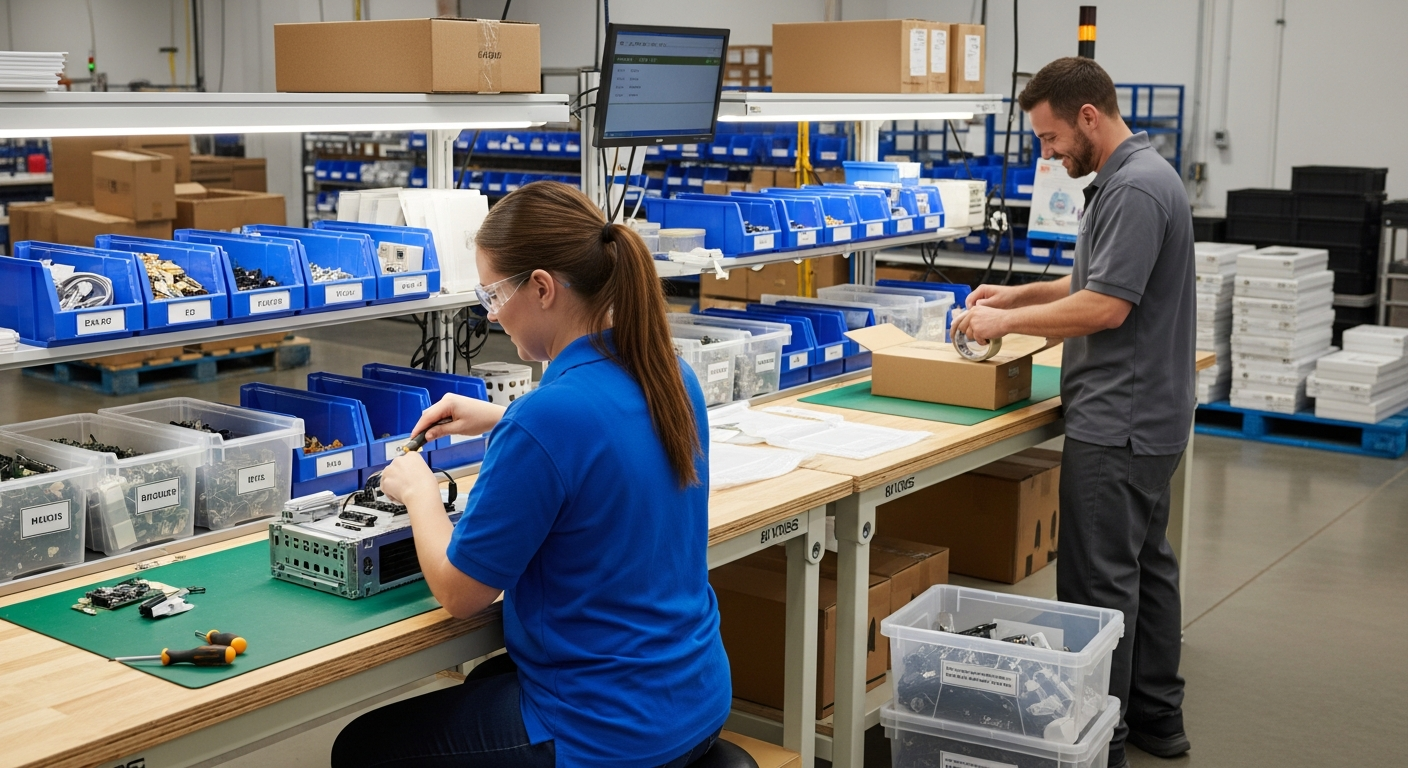
Not every step that touches a product has to happen on the plant floor. Kitting, subassembly, light assembly, labelling, and vendor-managed inventory (VMI) are value-added warehouse services that let Ottawa manufacturers move variable, labour-intensive work into a flexible 3PL — freeing the production line, converting fixed labour into scalable capacity, and shortening the path from order to shipment. For the region's tech hardware, defence-adjacent, building-products, and food and beverage producers, these services are often where a 3PL earns its keep. This guide explains what each service is, when it makes sense, and how programs are scoped and run in the National Capital Region.
Kitting: building ready-to-use sets
Kitting combines multiple components into a single, ready-to-ship or ready-to-use unit with its own SKU. Examples range from a tech product bundled with cables, mounting hardware, and a bilingual quick-start guide, to a retail promotional pack, to a maintenance kit of parts that always ship together. Done in the warehouse, kitting means the line doesn't stop to assemble bundles and the customer or downstream process receives one clean unit. The 3PL manages the bill of materials for each kit, picks the components, assembles, repacks, and relabels the finished kit as a new sellable SKU.
- Product bundles (device plus accessories, cables, and documentation)
- Retail promotional and display-ready packs
- Maintenance, repair, and spare-parts kits
- Sample and trade-show kits
- Subscription or recurring-shipment kits
Subassembly and light assembly
Subassembly and light assembly take it a step further — performing actual assembly steps in the warehouse rather than just combining packaged parts. This can include simple mechanical assembly, fastening, installing components, basic testing or inspection, and final packaging. For Ottawa manufacturers, moving non-core assembly steps to a 3PL relieves a constrained plant, smooths labour requirements, and lets the line concentrate on the operations that genuinely require its tooling and expertise. The work is governed by a documented work instruction and quality-check process so output is consistent and auditable.
Subassembly and light assembly
Labelling, repacking and Canadian-market compliance
Product entering the Canadian market often needs work before it can be sold: bilingual (English/French) labelling to meet federal requirements, country-of-origin marking, retailer-specific ticketing and price labelling, barcode application, and repacking into retail-ready or DC-ready cases. A 3PL handles this as a value-added step — receiving generic or import-spec product, relabelling and repacking it to Canadian and retailer standards, and shipping it compliant. This is especially relevant for importers and manufacturers selling internationally-sourced components or finished goods into Canadian retail.
Bilingual labelling and accurate retailer ticketing aren't optional in Canada — getting them done correctly in the warehouse avoids both customs issues and retail chargebacks at the DC.
Postponement: configure to order
Postponement is a strategy that delays final configuration until the last responsible moment — typically when an actual order is in hand. Instead of forecasting and pre-building every variant, the manufacturer holds generic base product and the 3PL configures, kits, labels, or packs it to the specific order at the warehouse. This cuts the risk of building the wrong mix, reduces finished-goods inventory, and improves responsiveness. For Ottawa producers serving multiple markets or retailers from a common base product, postponement can meaningfully lower obsolescence and carrying cost.
Vendor-managed inventory (VMI)
Vendor-managed inventory flips who owns the replenishment decision. Rather than the customer placing orders, the supplier (or a 3PL acting on the supplier's behalf) monitors consumption and proactively replenishes stock — often held in the 3PL's warehouse near the customer or plant and released as it's consumed. For manufacturers, VMI smooths the gap between long supplier lead times and a plant or customer that wants high availability, and it improves supplier-customer visibility. The 3PL provides the storage, the consumption tracking, and the replenishment execution that make VMI work in practice.
| Service | What moves to the 3PL | Primary benefit |
|---|
| Kitting | Component bundling into sellable SKUs | Line freed from bundling work |
| Subassembly | Light assembly and inspection steps | Relieves constrained plant capacity |
| Labelling / repack | Bilingual and retailer-compliant prep | Avoids customs and chargeback issues |
| Postponement | Final configure-to-order | Lower obsolescence and inventory risk |
| VMI | Consumption tracking and replenishment | High availability, less stockout risk |
How value-added programs are scoped and costed
Value-added work is typically priced on a combination of per-unit or per-kit labour, storage for the components and finished kits, and any setup for work instructions and quality checks. Scoping a program starts with the bill of materials, the volume and seasonality, the quality and documentation requirements, and how the finished output ships. A good 3PL pilots the work, tunes the work instructions and station layout, then scales — so the manufacturer gets predictable per-unit economics and consistent, auditable output rather than a fixed internal labour cost that sits idle between runs.
Frequently Asked Questions
What is kitting in a warehouse context?
Kitting combines multiple components into a single ready-to-ship or ready-to-use unit with its own SKU — for example a device bundled with cables, hardware, and a bilingual guide. The 3PL manages the bill of materials, picks the components, assembles, and relabels the kit.
What's the difference between kitting and subassembly?
Kitting combines packaged parts into a set; subassembly and light assembly perform actual assembly steps — fastening, installing components, basic testing, and final packaging — governed by documented work instructions and quality checks.
Can a 3PL handle bilingual labelling for the Canadian market?
Yes. Value-added warehousing includes bilingual English/French labelling, country-of-origin marking, retailer ticketing, barcode application, and repacking to Canadian and retailer standards — important for importers and manufacturers selling into Canadian retail.
What is vendor-managed inventory (VMI)?
VMI is a model where the supplier or a 3PL acting on its behalf monitors consumption and proactively replenishes stock, often held near the customer or plant and released as consumed. It smooths long supplier lead times against high availability needs.
How is value-added work priced?
Usually a mix of per-unit or per-kit labour, storage for components and finished kits, and setup for work instructions and quality checks. Programs are typically piloted, tuned, then scaled to give predictable per-unit economics.
Related ByExpress resources